Water Mill

Built in 1840, the Greek Revival farmhouse would become a haven for some of the 20th century’s most celebrated artists. Designer Glenn Gissler removed the shutters from the home’s windows to achieve an “ecclesiastical purity [for] the Greek temple front” that offers a more contemporary appearance.

An unassuming, streamlined boardwalk leads from the Atlantic Ocean across restored dunes to the shingle-style house, where expansive windows capture sweeping panoramas. The other side of the house borders Mecox Bay.

Water Mill, New York

Water Mill

Built thirty years ago on five acres in Water Mill, New York, this expansive beachfront, shingle-style residence represents a considered collaboration between the late architect Francis Fleetwood and Glenn Gissler Design. Uniquely positioned between the Atlantic Ocean and Mecox Bay, the property offers water views in all directions.

The homeowner is Caroline Hirsch, the comedy industry impresaria who ran Caroline’s Comedy Club in New York City for 40 years, and her partner, Andrew Fox. Hirsch and Fox now head the New York Comedy Festival, which features performances at more than 120 venues throughout the city, ranging from intimate rooms to Carnegie Hall.

Over the decades, some carefully orchestrated modifications were made to the house, along with minor and major interior design updates. Most notably, GGD collaborated with the current architects, Fleetwood McMullan & Sanabria, to extend the covered porch along the entire length of the house facing the ocean. The resulting space can accommodate up to fifty guests for al fresco meals. They also designed an elevated pergola that functions as a temple-like pavilion, positioned strategically above the garage to take advantage of the 360-degree views of the water. Additional modifications to the home included converting a guest bedroom into a media room and bar, effectively integrating formerly private spaces into the public areas of the house.


In the entry hall, a pair of circa 1830 hall chairs rest atop a custom ‘falling block’ patterned hook rug, which Glenn designed for the space. Above the chairs, in what amounts to a mid-20th-century artistic dialog, are works by Alexander Calder (left) and Le Corbusier (right). The Calder is the first work inside the house, which Glenn chose because Calder’s homestead and studio–still maintained by the late artist’s family–are less than two miles away.

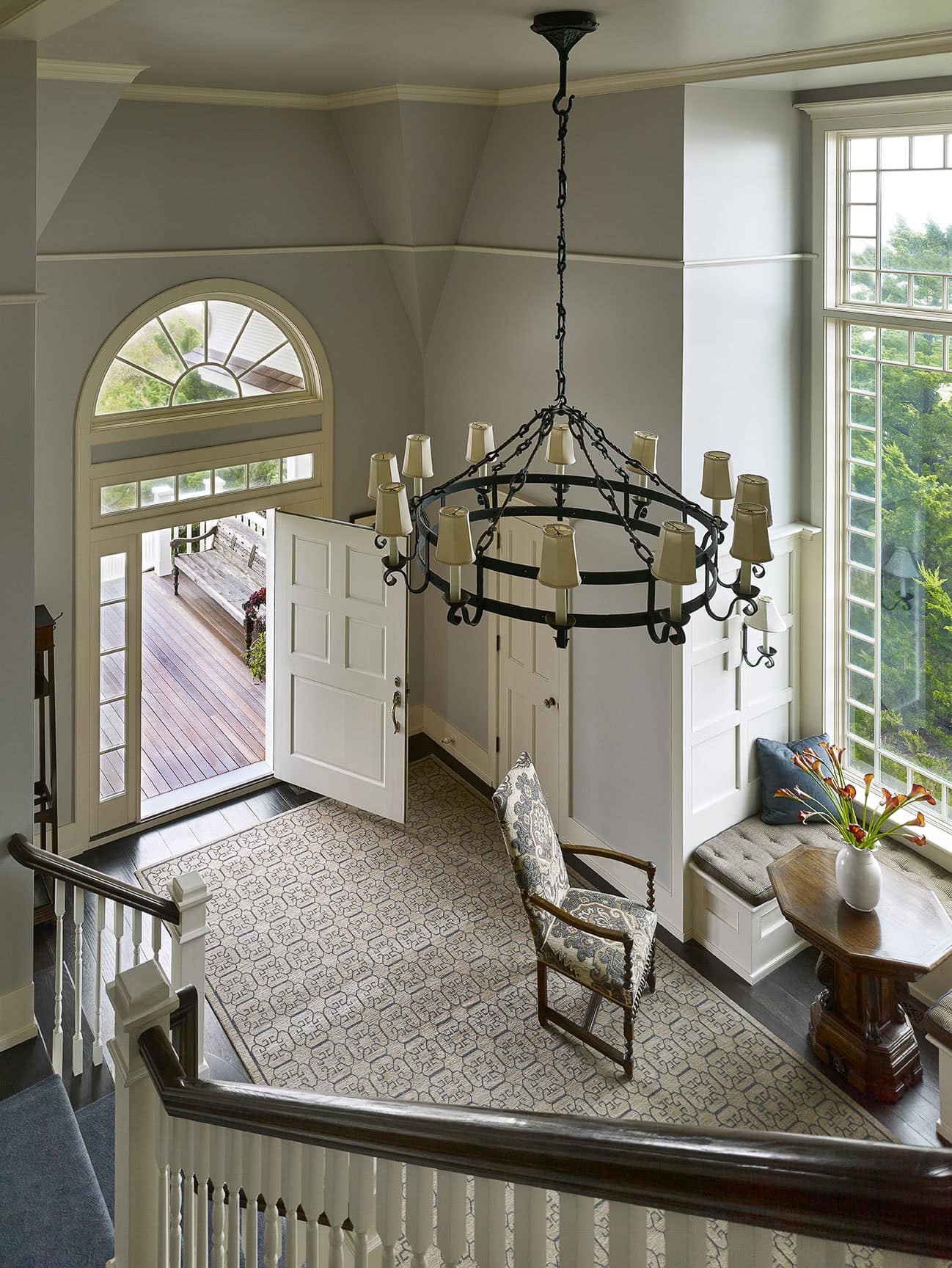
From the second-story landing, the view descends to the entry foyer, where a custom Doris Leslie Blau rug grounds the room beneath a dramatic double-story window. The 1920s iron chandelier illuminates the tableau, while an Italian table, tucked into a built-in window seat, invites contemplation of the vista just beyond the glass.
The side garden features a 19th-century urn in an established bed of pachysandra that came with the house. This is consistent with Glenn’s playful interpretation of classical tradition, which is part of the house’s Greek Revival roots.

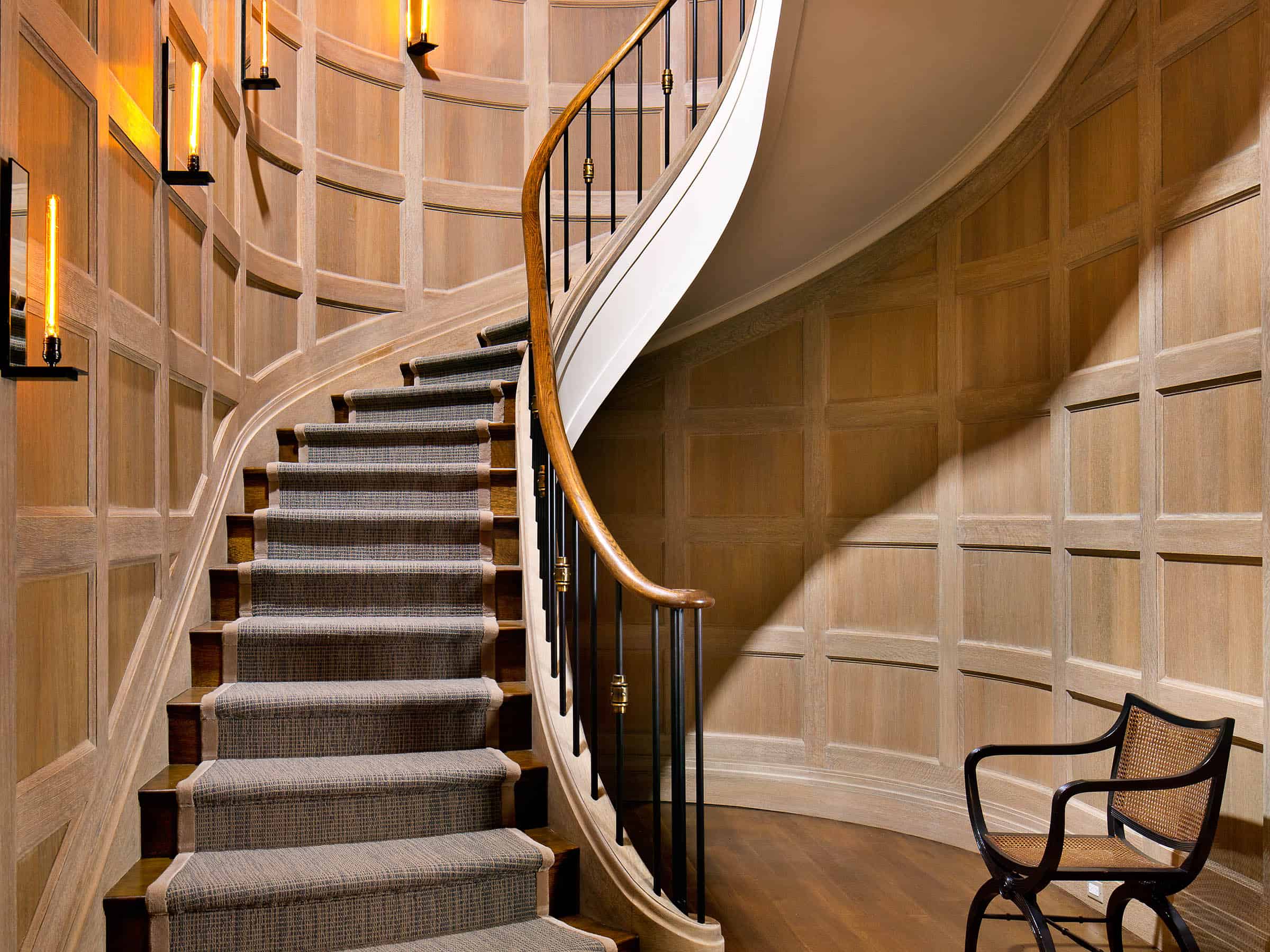
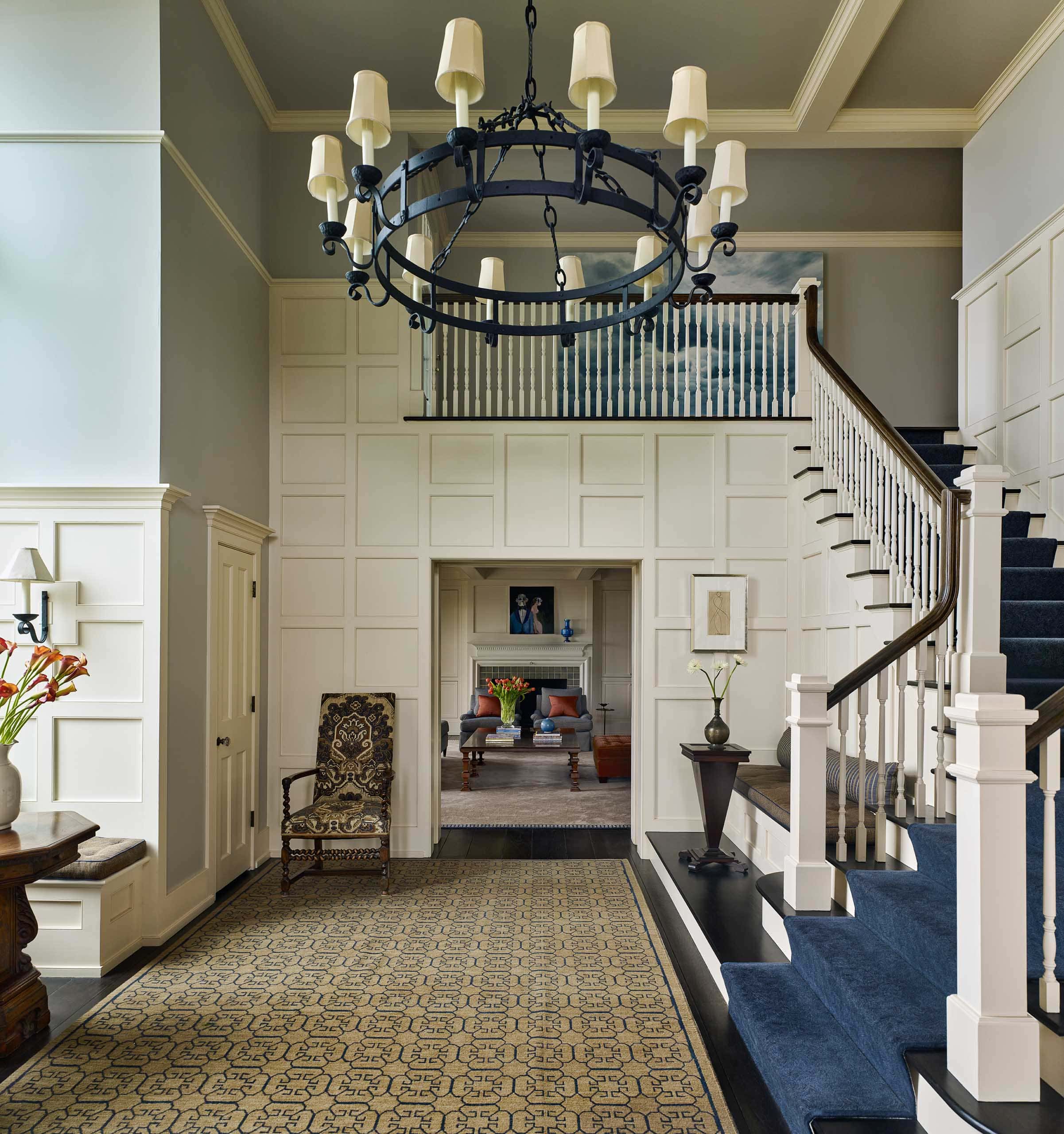
The sunlit paneled entryway reveals the home’s chromatic footprint of warm and cool neutrals, inspired by the sand and sea beyond. A custom hand-knotted stair runner from Martin Patrick Evans provides rich tonal contrast that effortlessly balances the dark wood treads and banister. The antique chair was covered in an antique textile.
The swimming pool was existing when Glenn purchased the house. He left the coping, but removed the awkward patios to allow it to fit quietly into the backyard landscape as a reflecting pool. The property expands beyond the back gate for some distance before connecting to hundreds of acres of the Roxbury Land Trust’s many preserves.

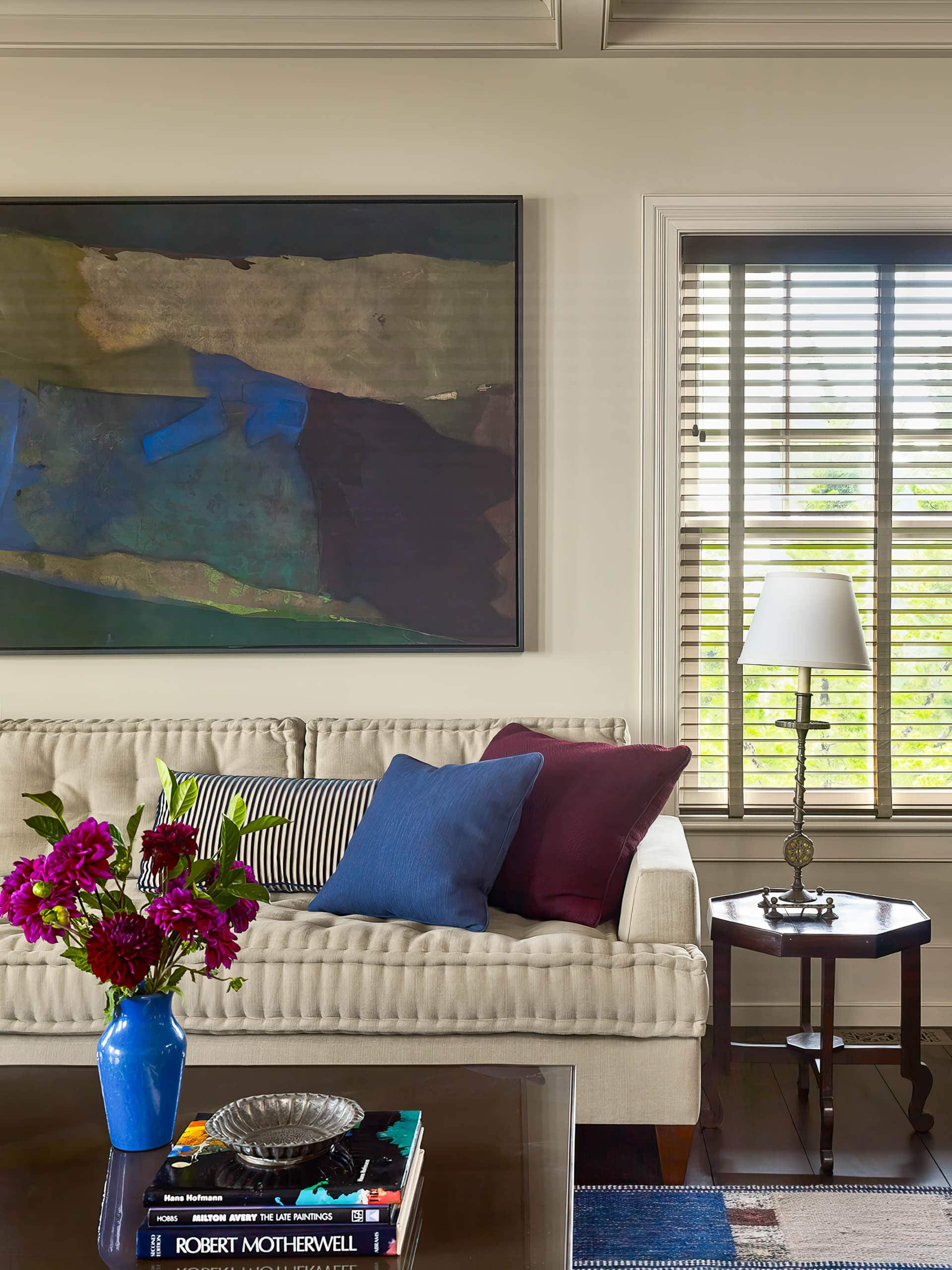
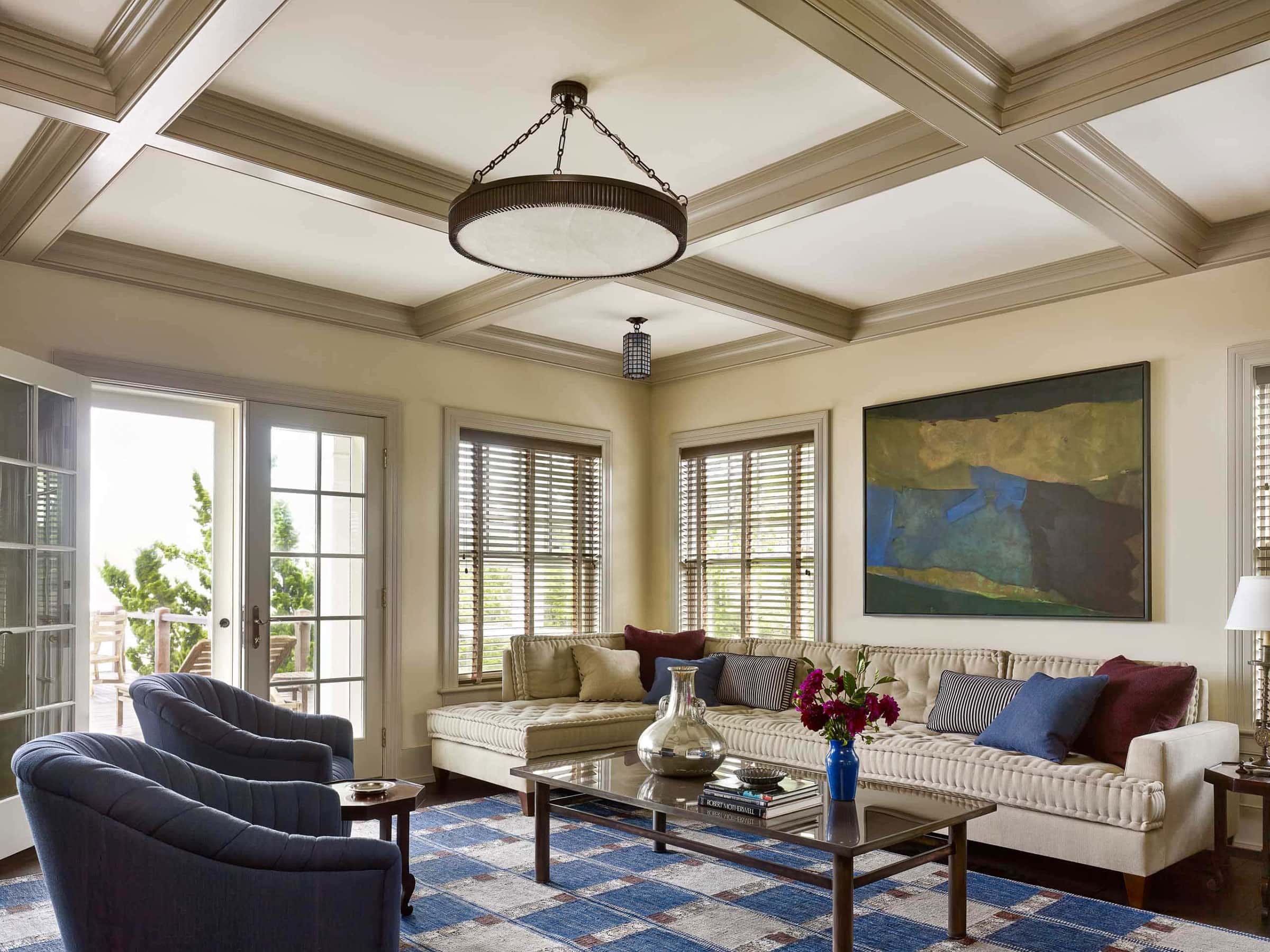
Lee Hall’s “Connecticut Night Horizon” enriches the Lounge’s neutral palette with invigorating blues and deep, earthy shades. The custom sectional, with its couture French mattress stitching, provides comfortable seating, while an Anglo-colonial side table and tape-trimmed blinds enhance the quiet ambiance.
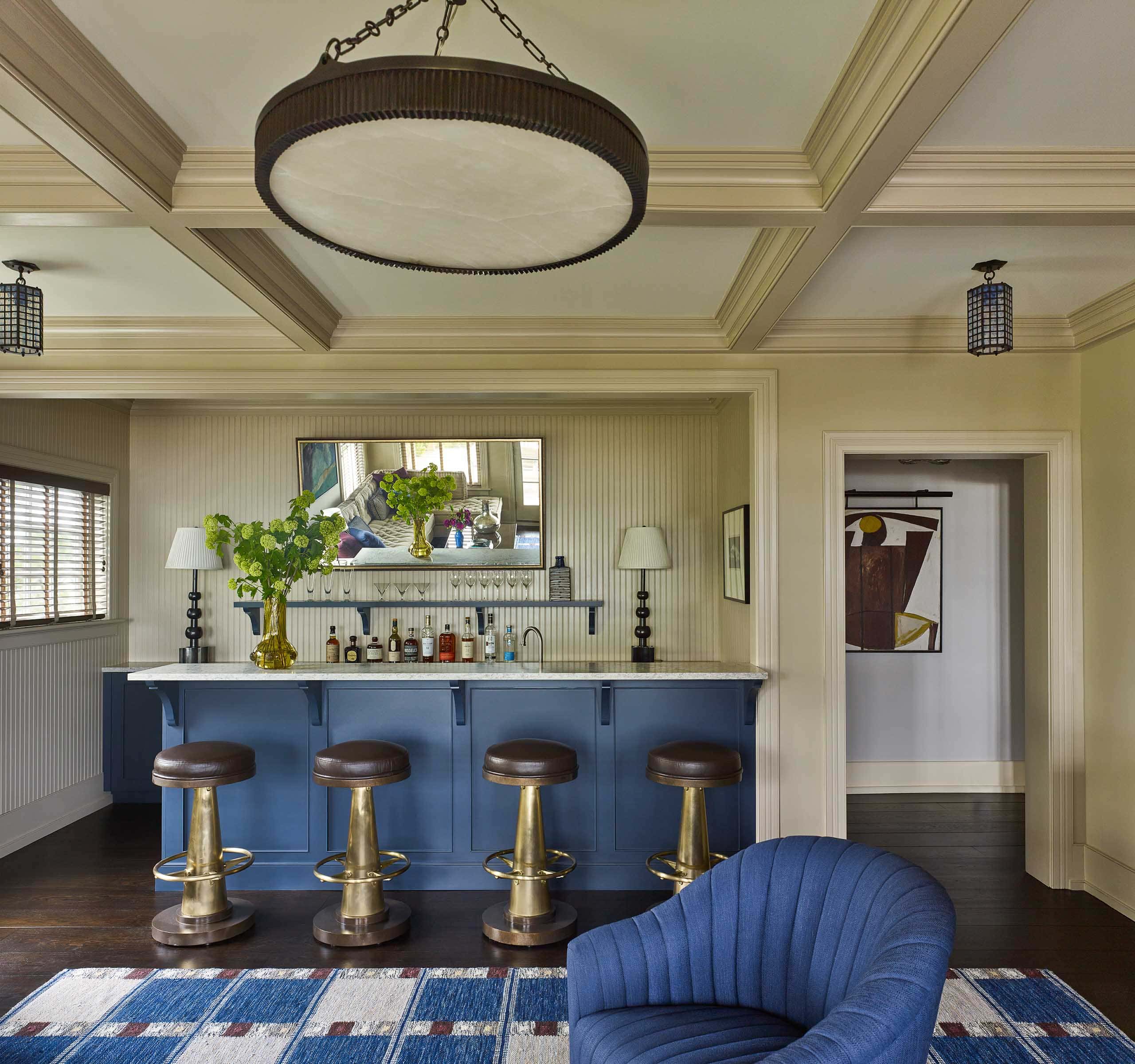
A custom bar fashioned by Bilotta Kitchen & Home transforms one side of this former guest bedroom into a space for cocktails and conversation, painted in a distinctive marine-blue finish. The brass and leather, nautically inspired, barstools provide seating for four. Through the right doorway, a 1947 painting by artist Robert Motherwell energizes the vestibule connecting to the living room.


Beyond the home’s backdoor and through a split rail fence, summer visitors are greeted by an unobtrusive pool and a former art studio dubbed the “Pleasure Pavilion,” where a swim follows rustic lunches. Several weathered Adirondack chairs rest below a mature Sugar Maple tree, providing a respite from the midday sun.

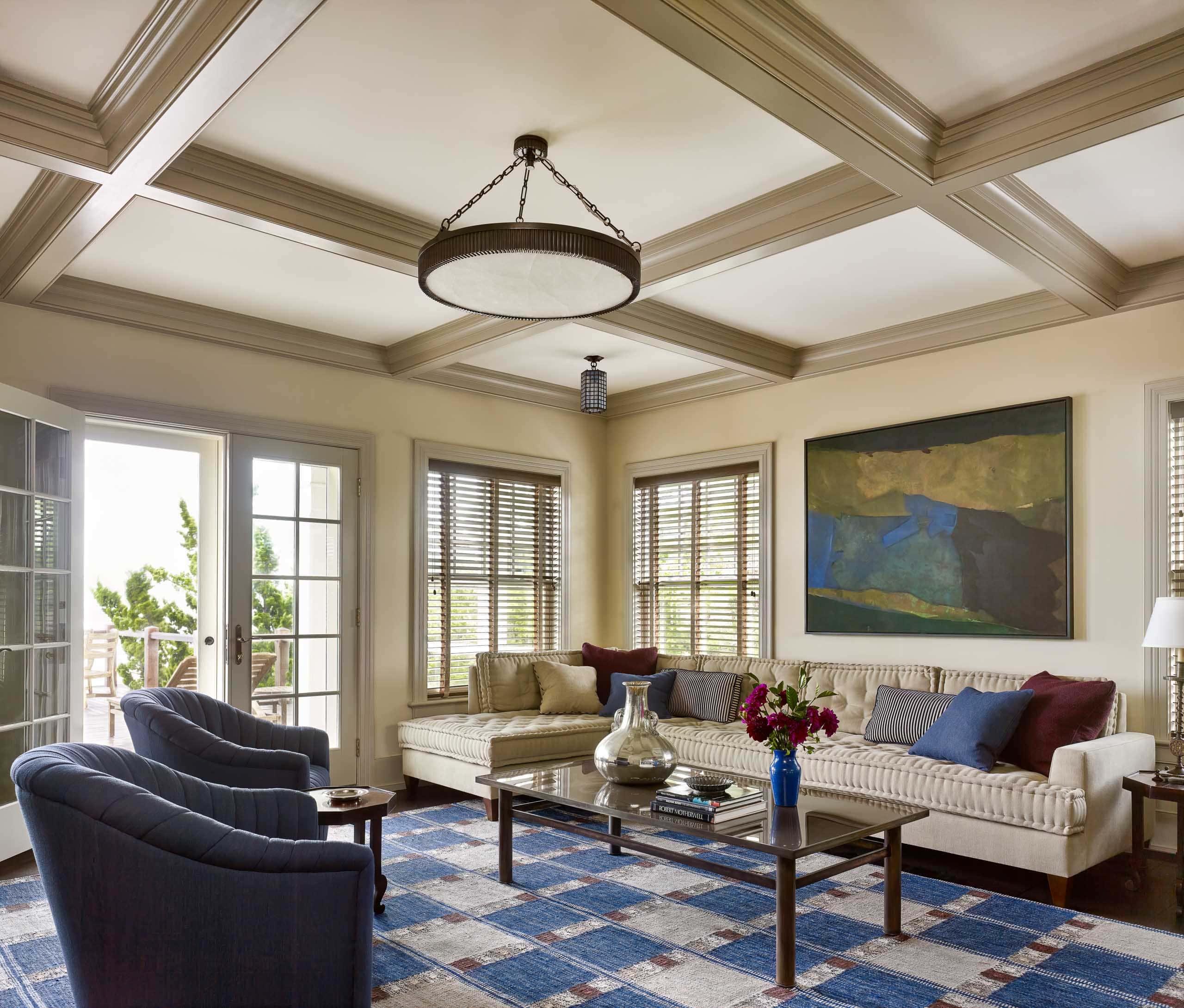
Hudson Valley Lighting’s “Lyden” chandelier, in distressed bronze with white Spanish alabaster, hangs just below the coffered ceiling in this view. Four McEwen Lighting Studio hex fixtures provide ambient light in the corners and add architectural interest. A Roman Thomas coffee table with chocolate brown back-painted glass offers space for books, drinks, and floral arrangements.
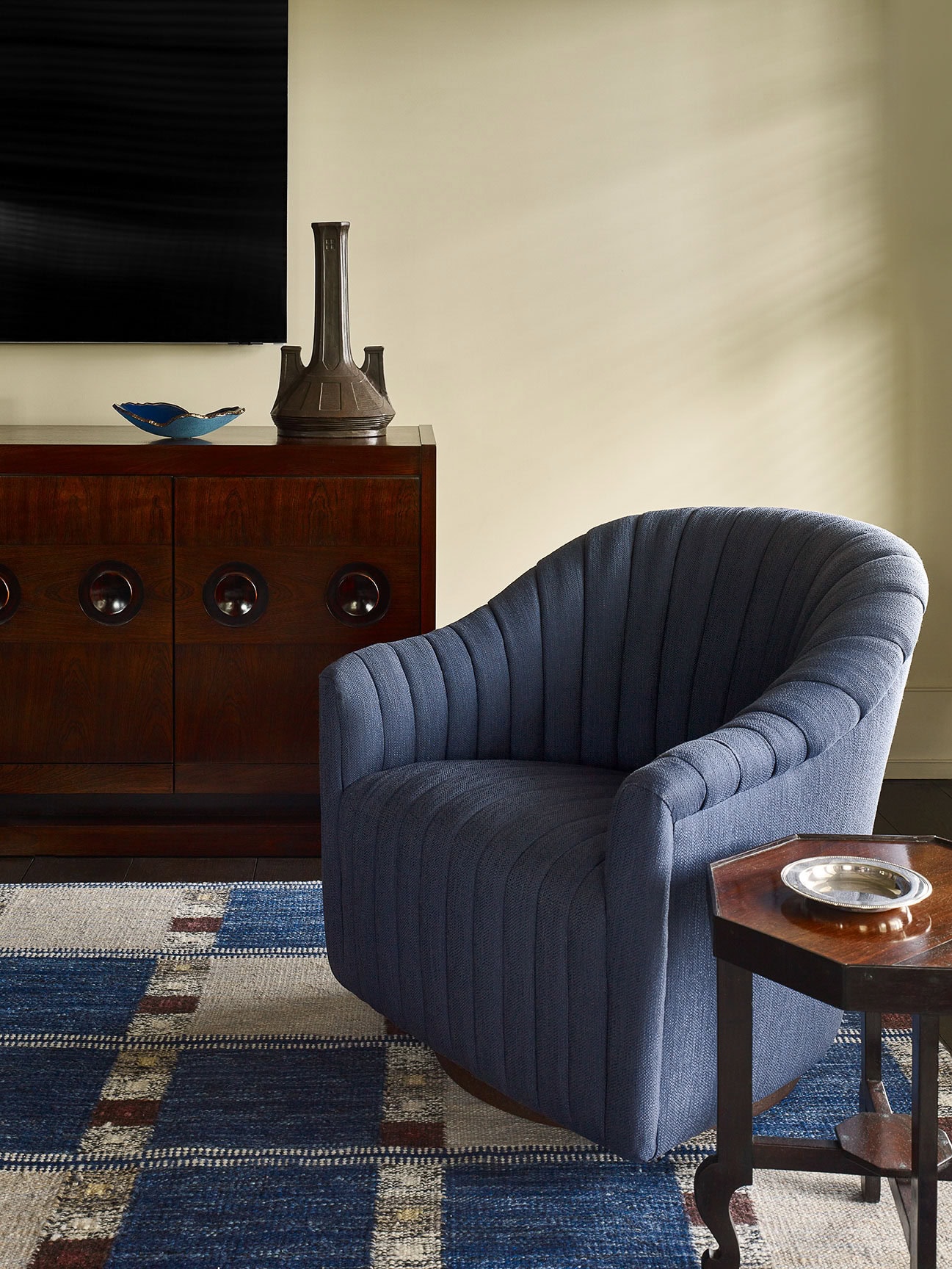
In this vignette, the iconic designer Ward Bennett’s channel-tufted lounge chair–one of a pair in the space–showcases his signature blend of clean-lined modernity and creature comfort in inky indigo upholstery. The wool flatweave rug was inspired by a Swedish design and produced by Doris Leslie Blau.
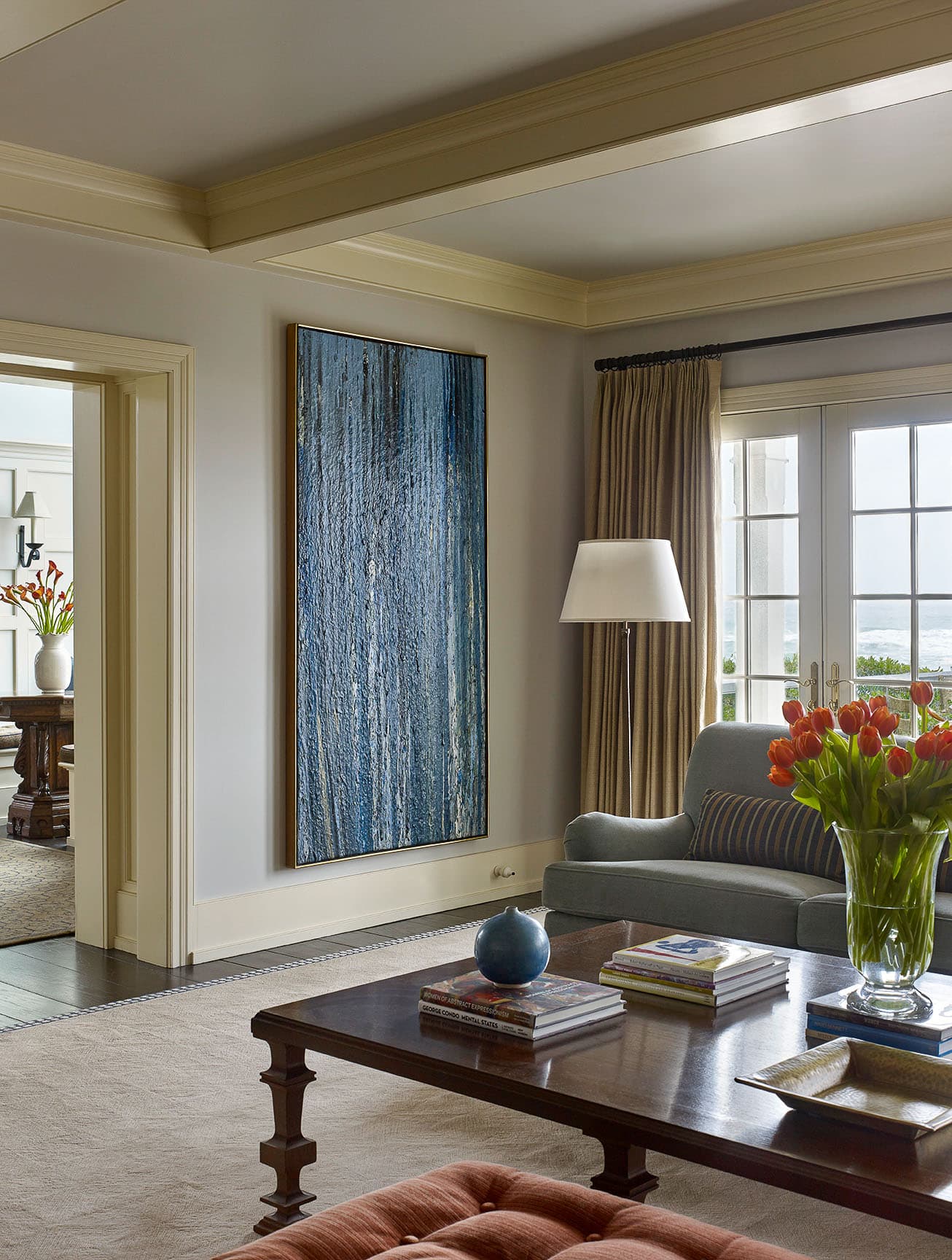
A vertical Larry Poons painting from the 1970s commands this corner of the living room. At the same time, a Gissler-designed Anglo-colonial coffee table provides an oversized surface for books and decorative objects. A tufted ottoman can be pressed into service for extra seating.
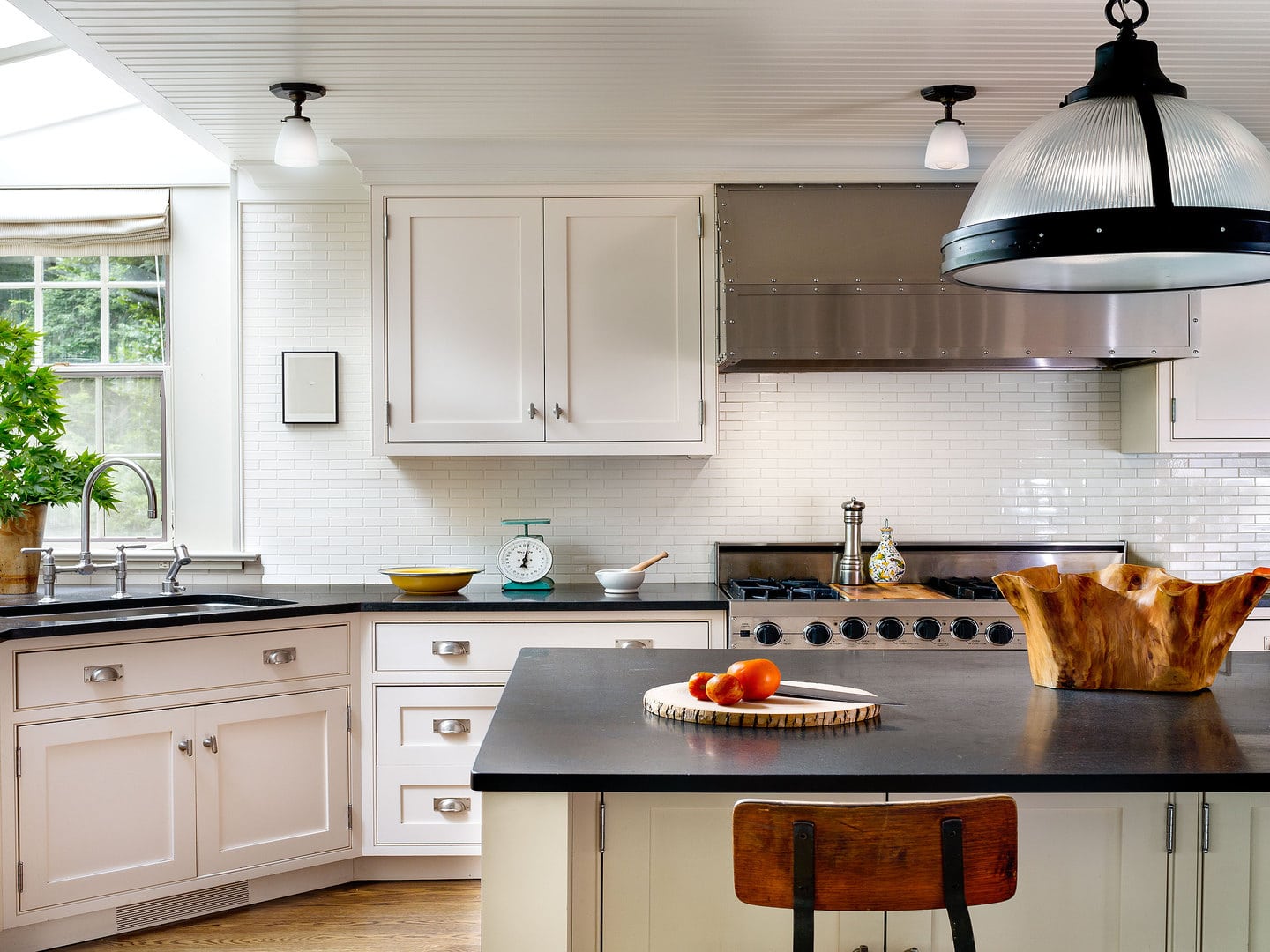
The kitchen retains its farmhouse sensibilities but was updated with modern appliances. Muted-sage green cabinetry and trim are offset by black granite counters and the original floors, which Glenn stained dark walnut throughout. Period-style fixtures and pendant lights hang from the beadboard ceiling to illuminate the space.

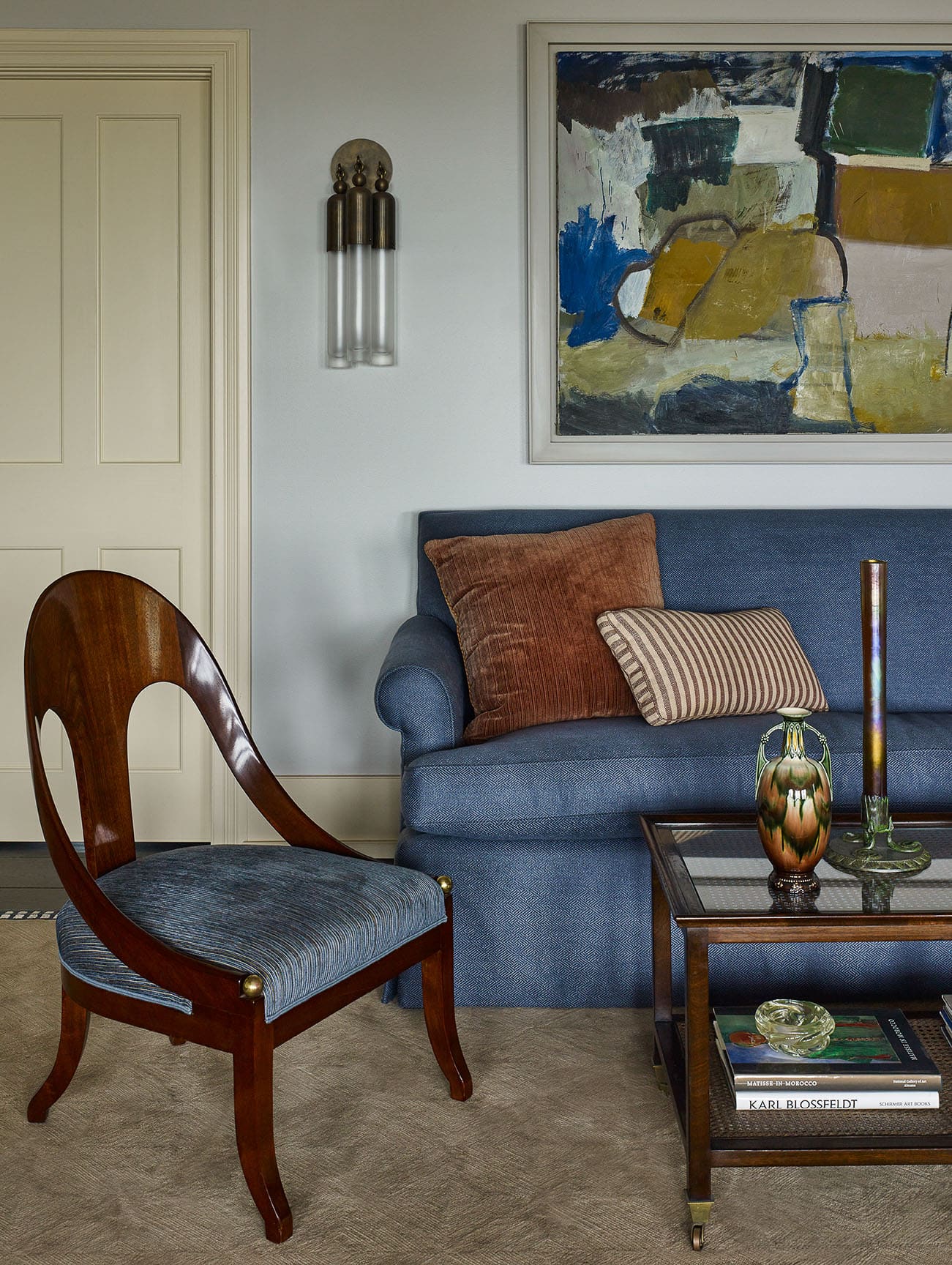
Against pale blue-gray walls, a vintage spoon-back chair arcs with graceful lines, upholstered in Osborne & Little’s striped chenille fabric that complements the room’s palette. The bronze and hand-blown glass sconce from Apparatus provides ambient lighting, showcasing Thomas’s abstract work. Walnut wood tones add visual warmth.
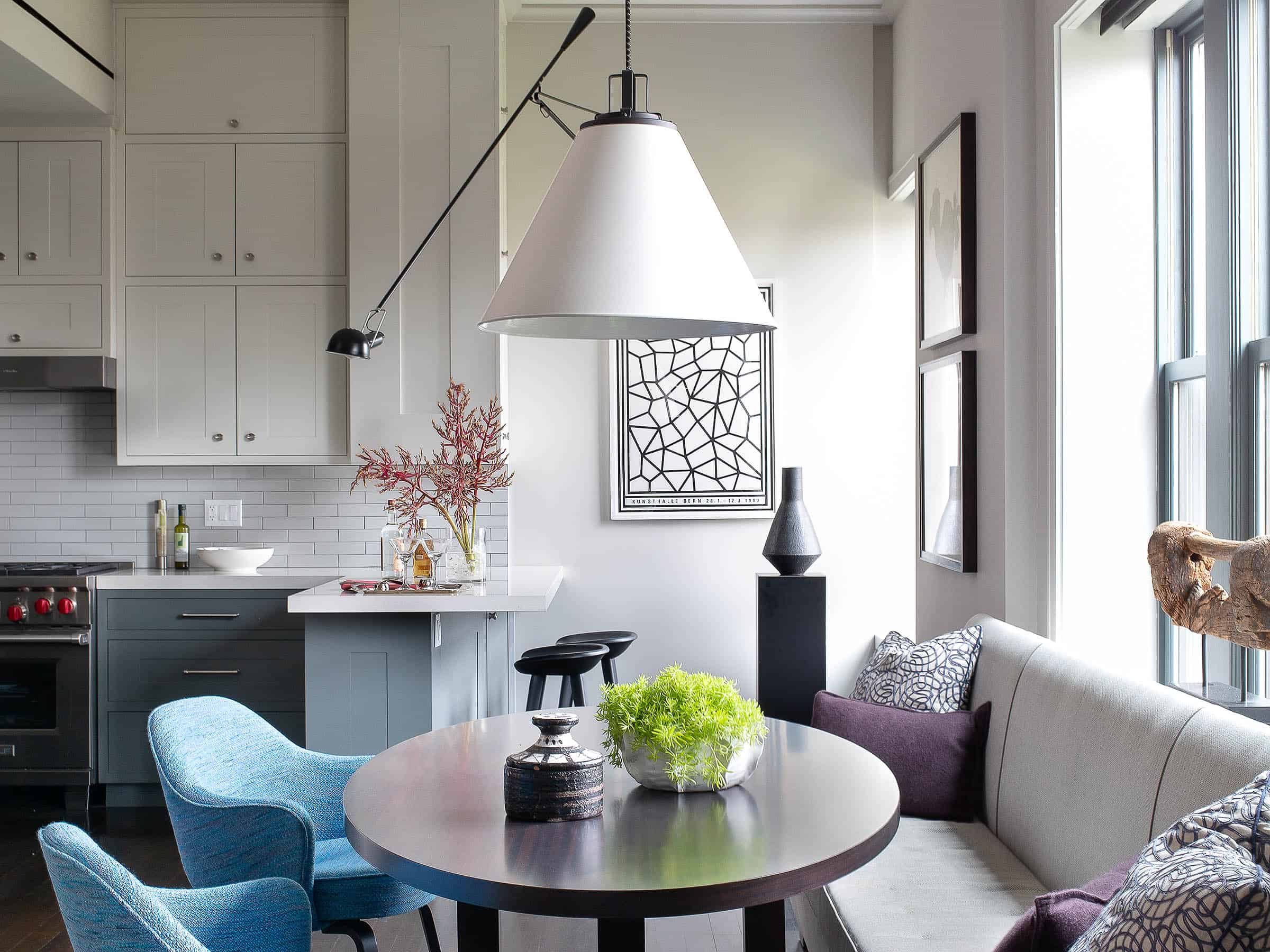
The breakfast room has a simple round pedestal table paired with directors’ chairs. The tableau is comfortable and unassuming, inviting guests to enjoy coffee while watching the mist burn off the morning landscape, the birds visit the feeder, and a few chipmunks scamper about. The Russell Wright servicewear is part of an extensive collection that could serve an expansive buffet dinner.

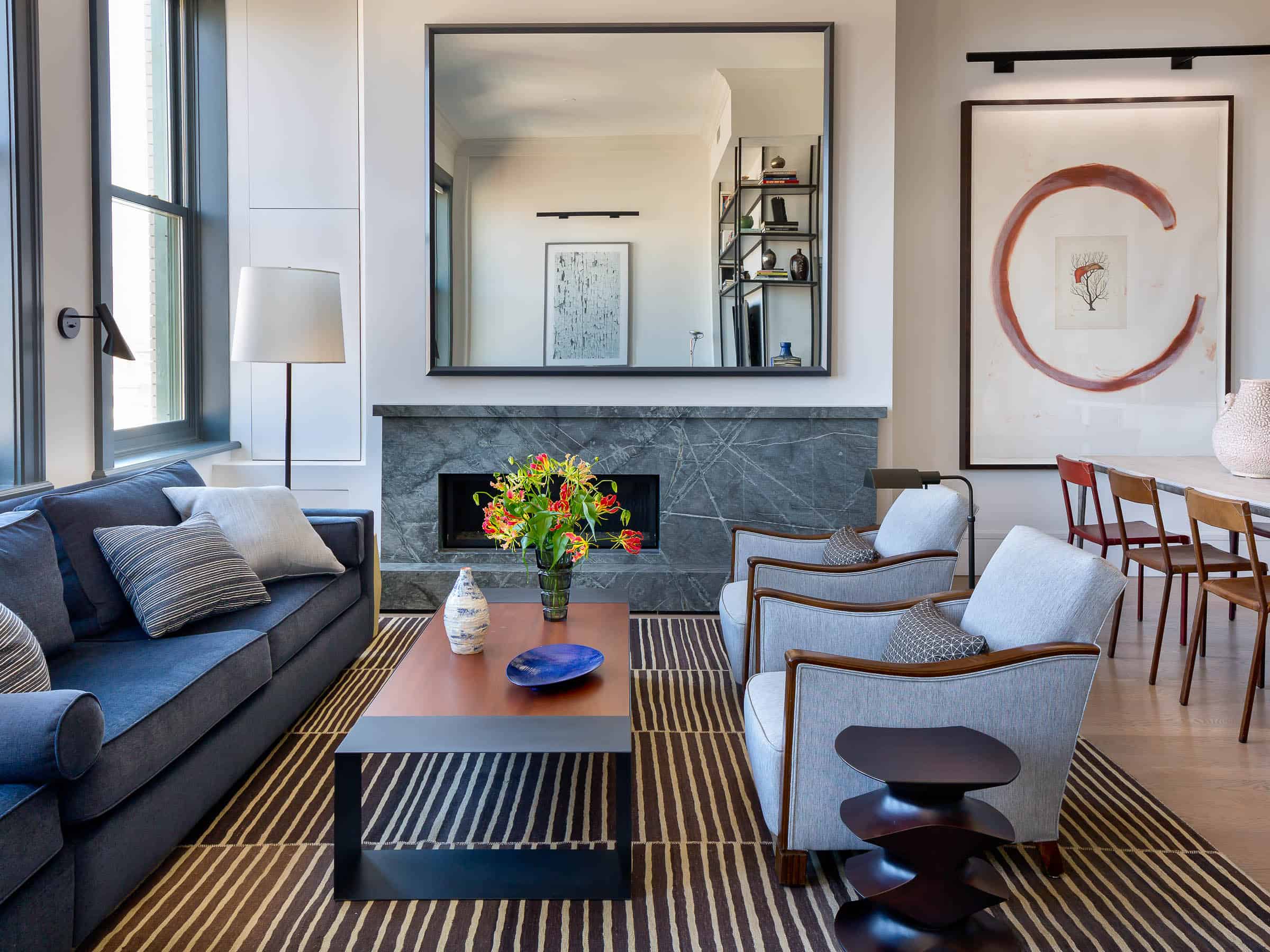
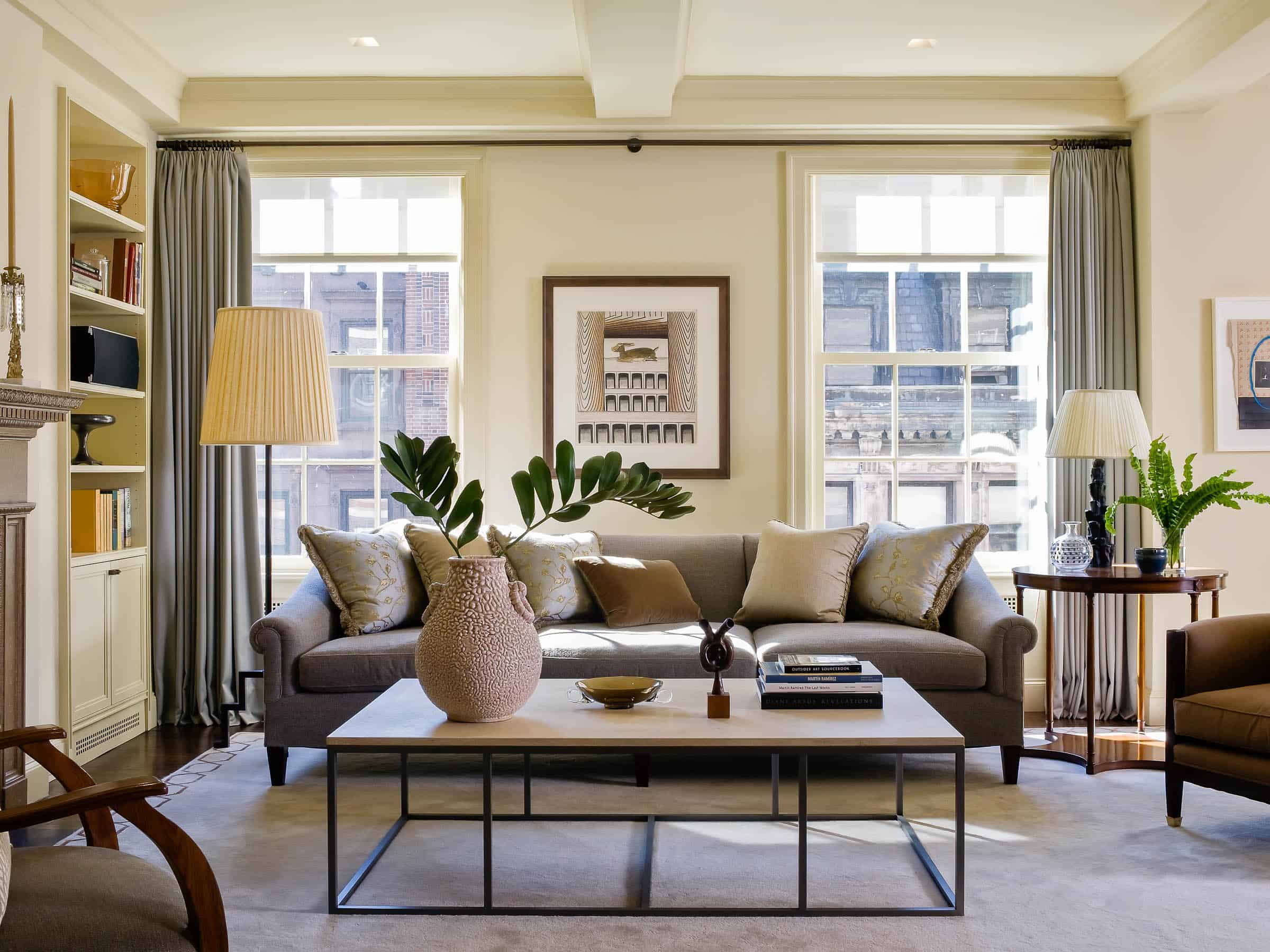
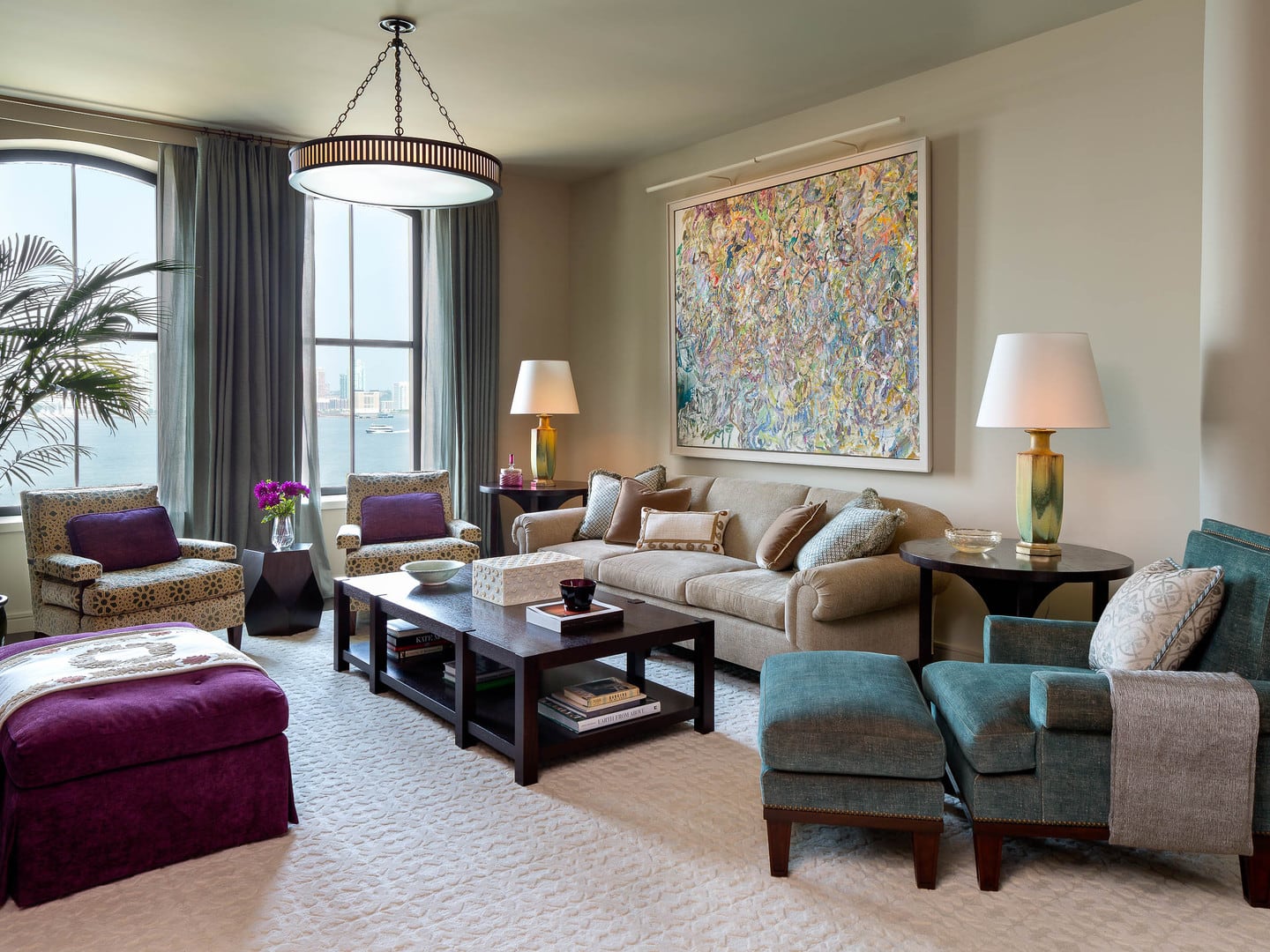
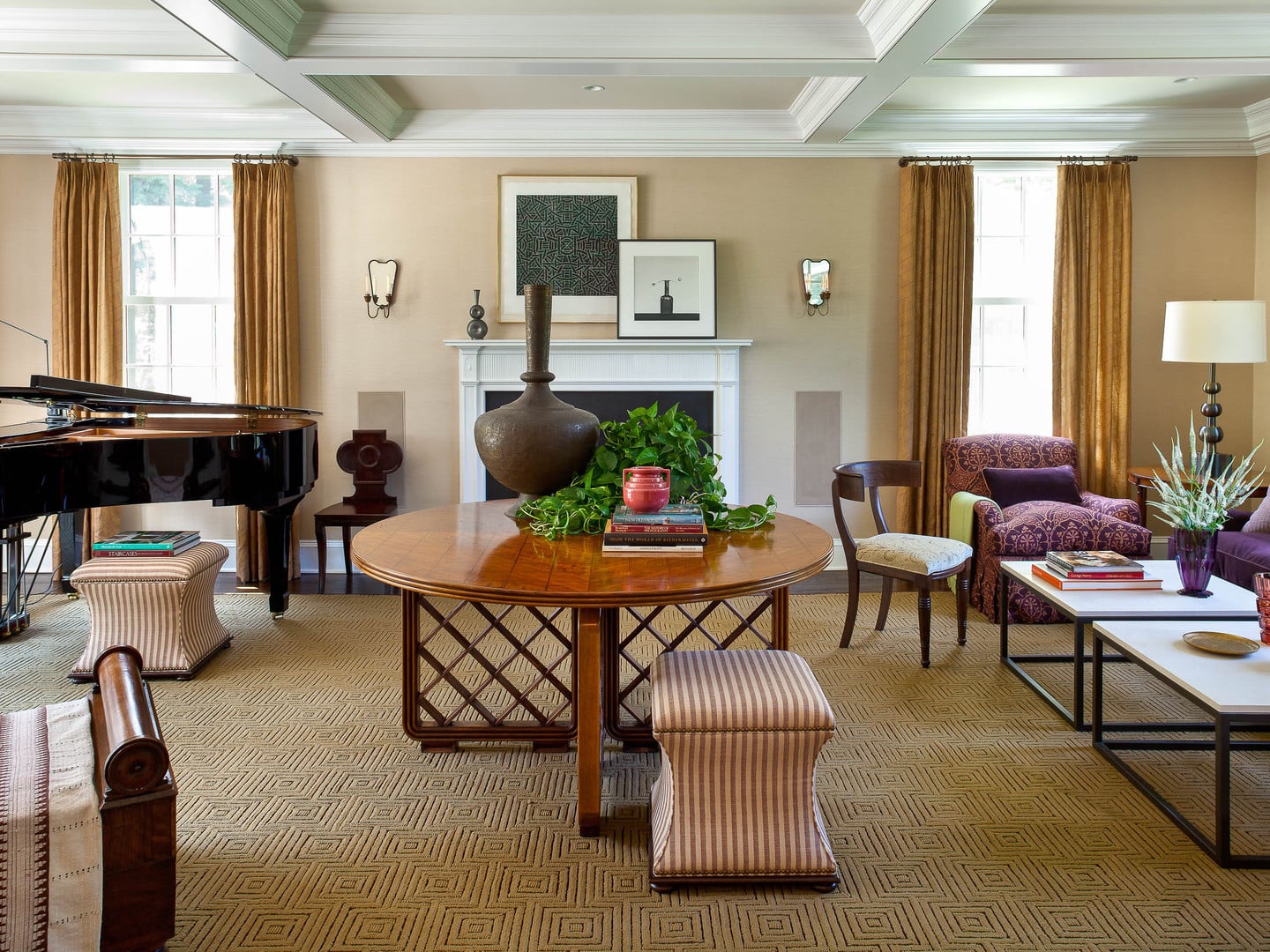
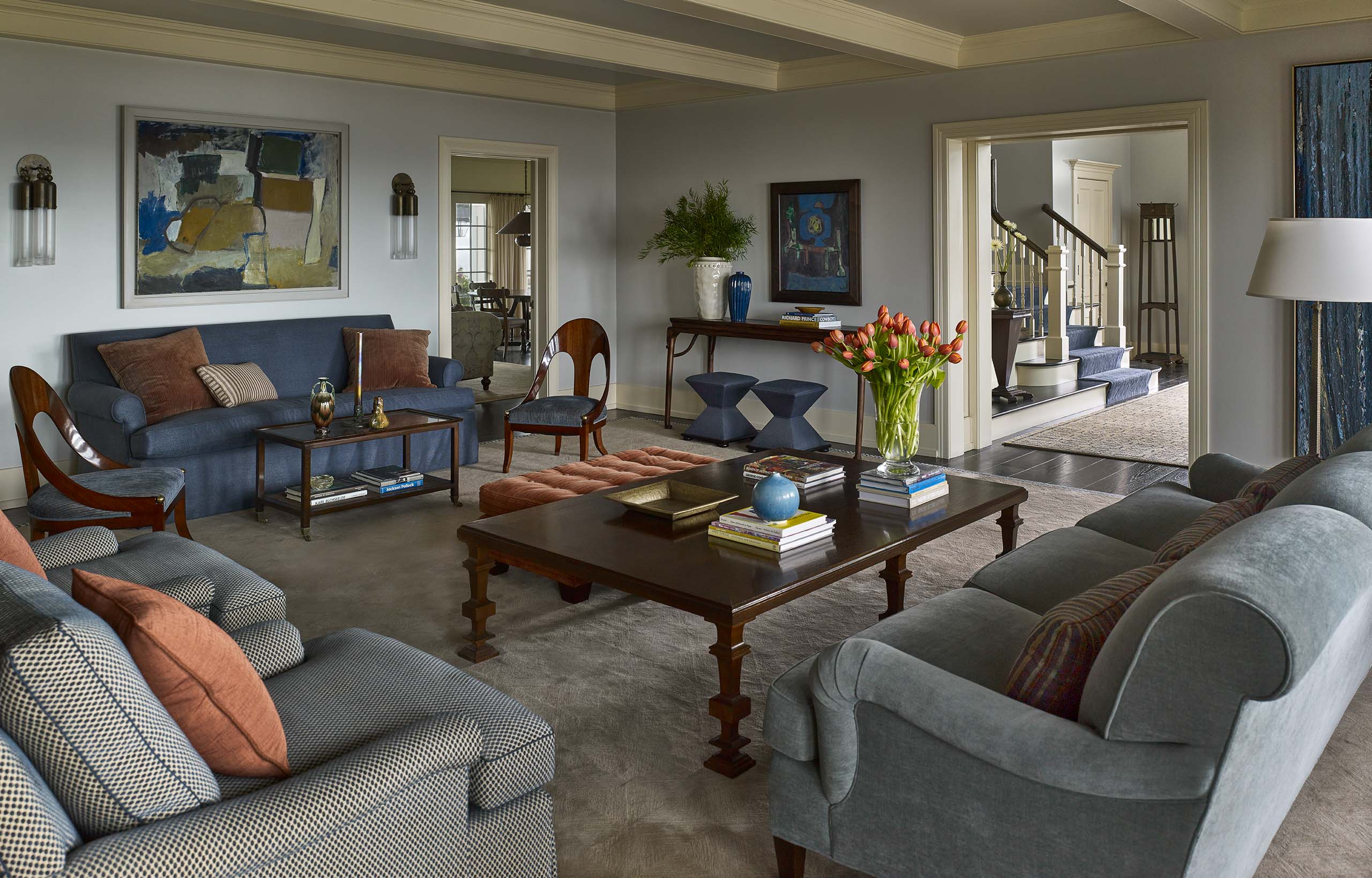
In this wide view of the living room, custom Ferrell + Mittman sofas and a pair of deep-seated club chairs secure spots for every guest. On the back wall, Apparatus sconces illuminate an abstract painting by Yvonne Thomas, “Untitled”, 1956. The handmade, tonal geometric rug from Martin Patrick Evan grounds the arrangement, lending a sense of purposeful restraint.
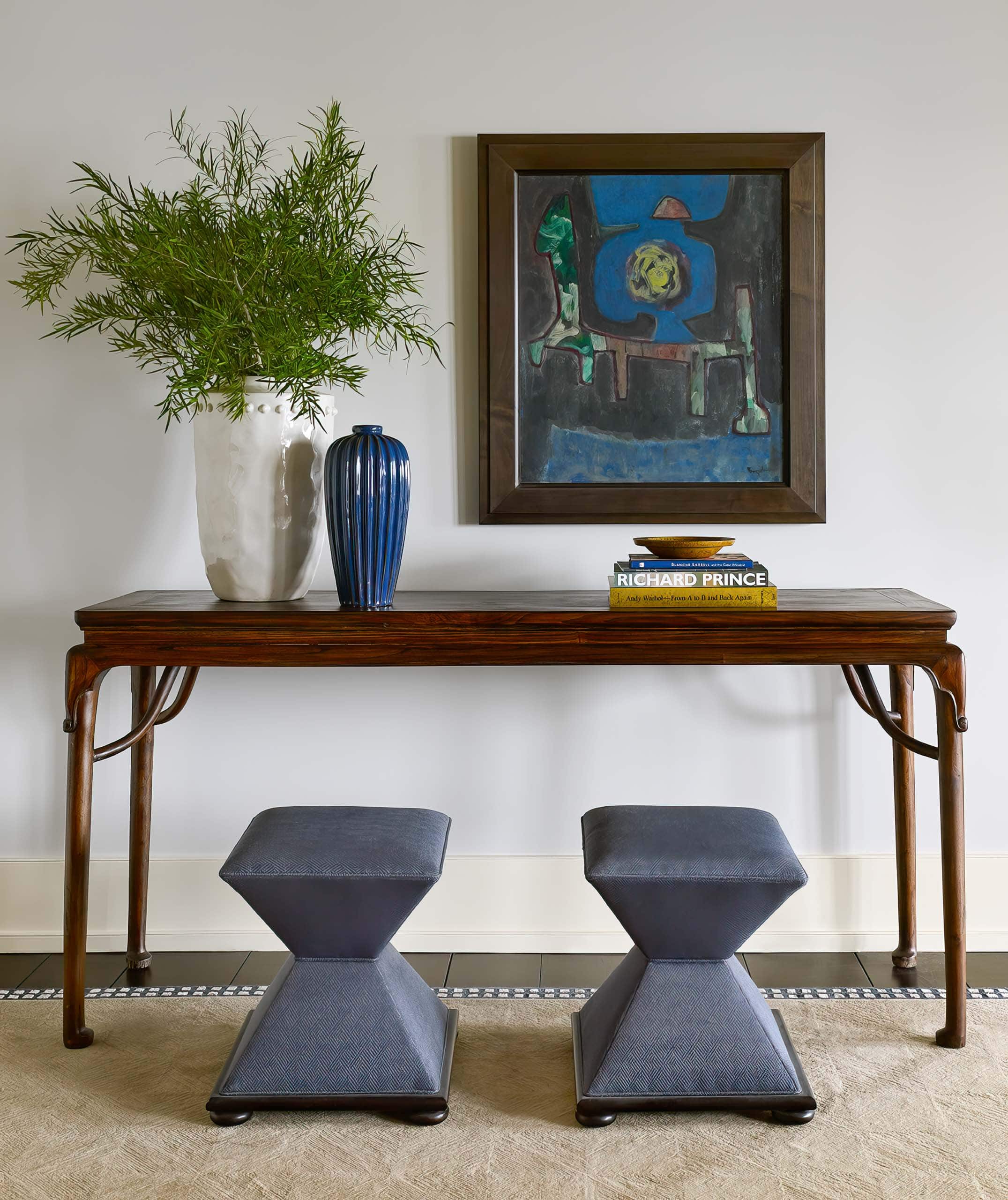
Fully upholstered angular occasional stools are positioned in front of a Chinese console table, creating a sophisticated vignette enlivened by the artist William Baziotes’ painting titled “Figures in the Night”, 1947. The custom carpet was bordered in a blue and cream check pattern.


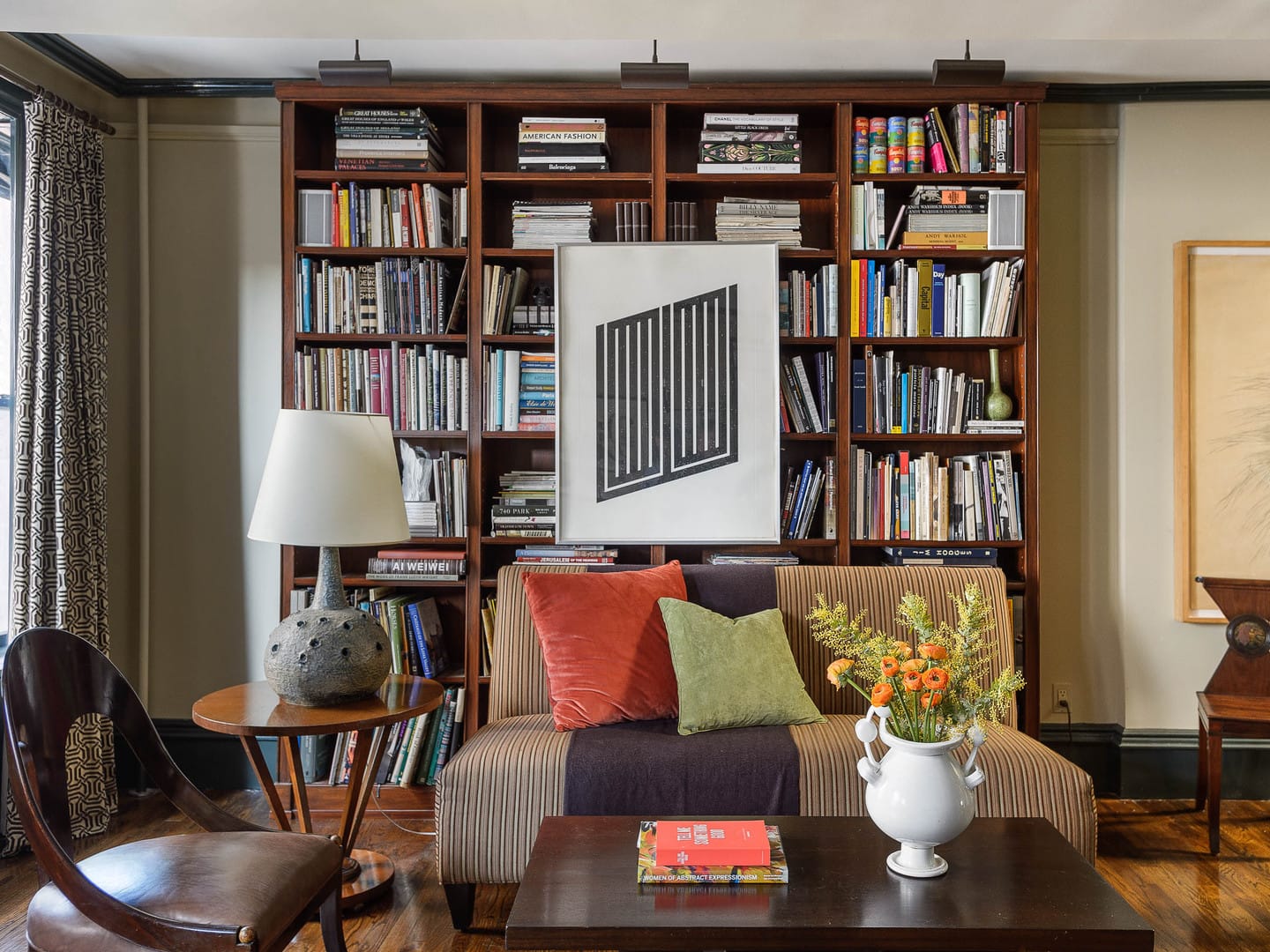
The library’s furnishings, woven together like a historical tapestry, tell the story of Glenn’s interest in 19th—and 20th-century design. Pieces include a coffee table by T.H. Robsjohn Gibbins for Widdcomb, a 1940s sloping-arm sofa draped in an antique Suzani, and a Greek temple model found at a yard sale perched atop a marble pedestal. Part of his collection of objects by late 19th-century designer Christopher Dresser is presented on the top shelf of the etageres. The ceiling is covered in Farrow & Ball bumblebee paper.

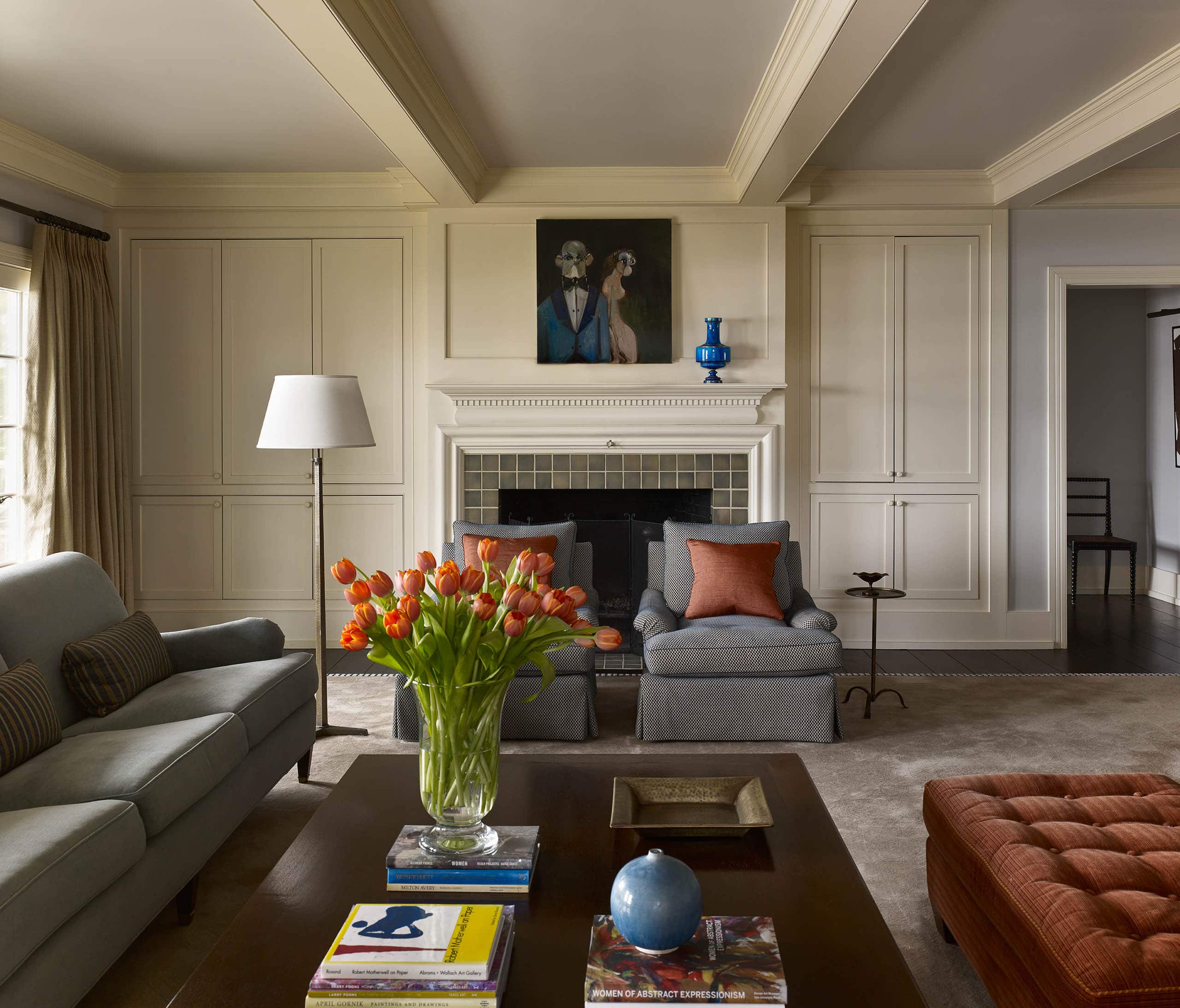
This converging perspective view of the living room, visible from the entry foyer, draws the visitor’s eye to painter George Condo’s “The Butler” (2011), which hangs above the glazed-tile and millwork mantle.
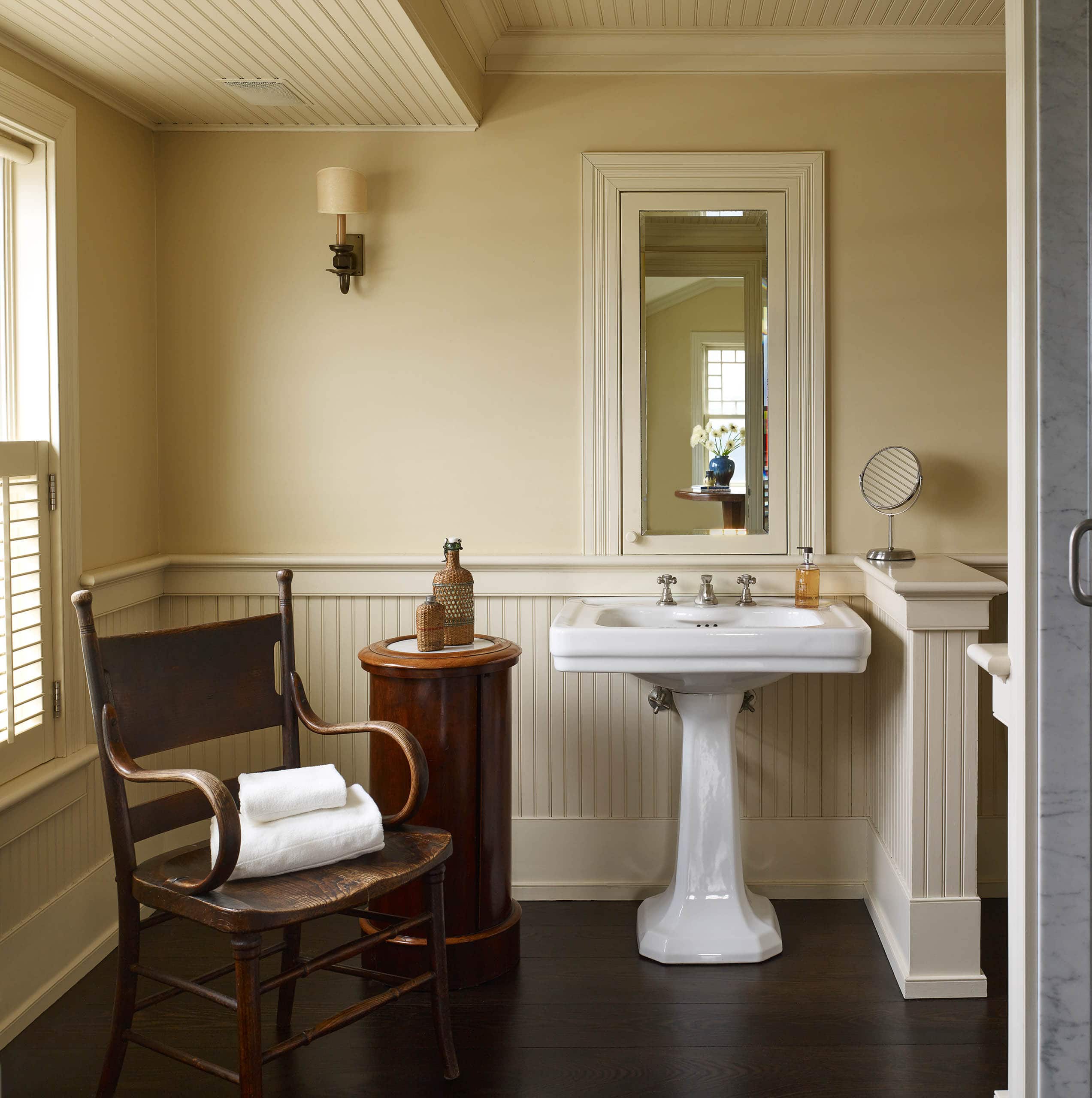
Beadboard wainscoting paired with dark-stained floors establishes an authentic shingle-style character in this bathroom, where an antique cylindrical marble-topped shaving stand and a 19th-century bentwood chair blend historical detail with timeless functionality. Plantation shutters add privacy while allowing ambient light to pass through.
Just inside the library, a circa 1820 Biedermeier Bar Cabinet is stocked with spirits, where guests are encouraged to help themselves to a cocktail. Hanging above are works on paper by Wilfred Zogbaum (left) and Tomas Eldred (right). The Klismos Chair, one of a pair, is attributed to T.H. Robsjohn-Gibbings.

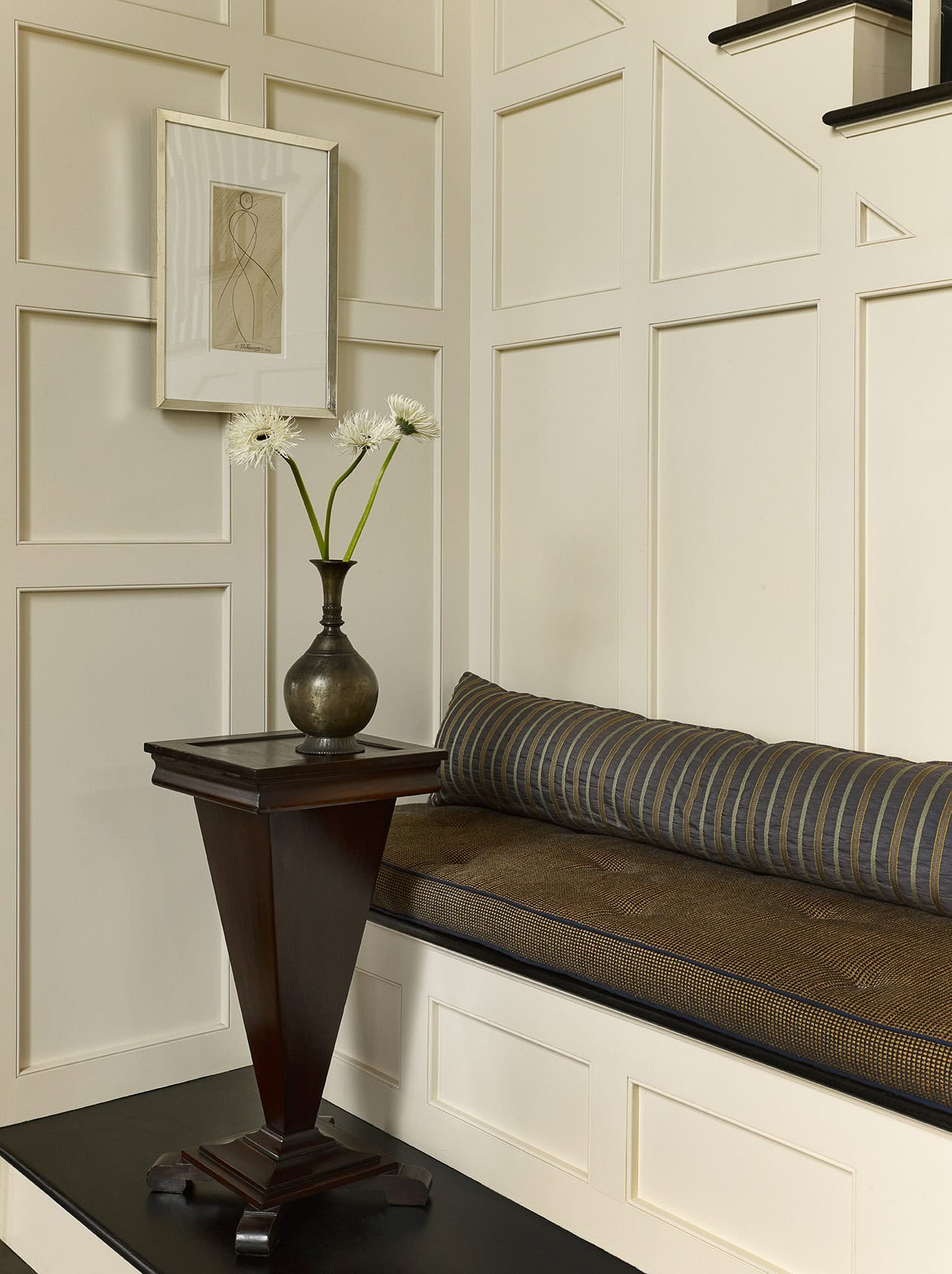
A built-in bench with a striped lumbar cushion creates an intimate seating nook enveloped by painted paneling. Abraham Walkowitz’s gestural drawing of Isadora Duncan hangs above a repurposed 18th-century sewing table. The top would open to reveal notions, needles, and thread.
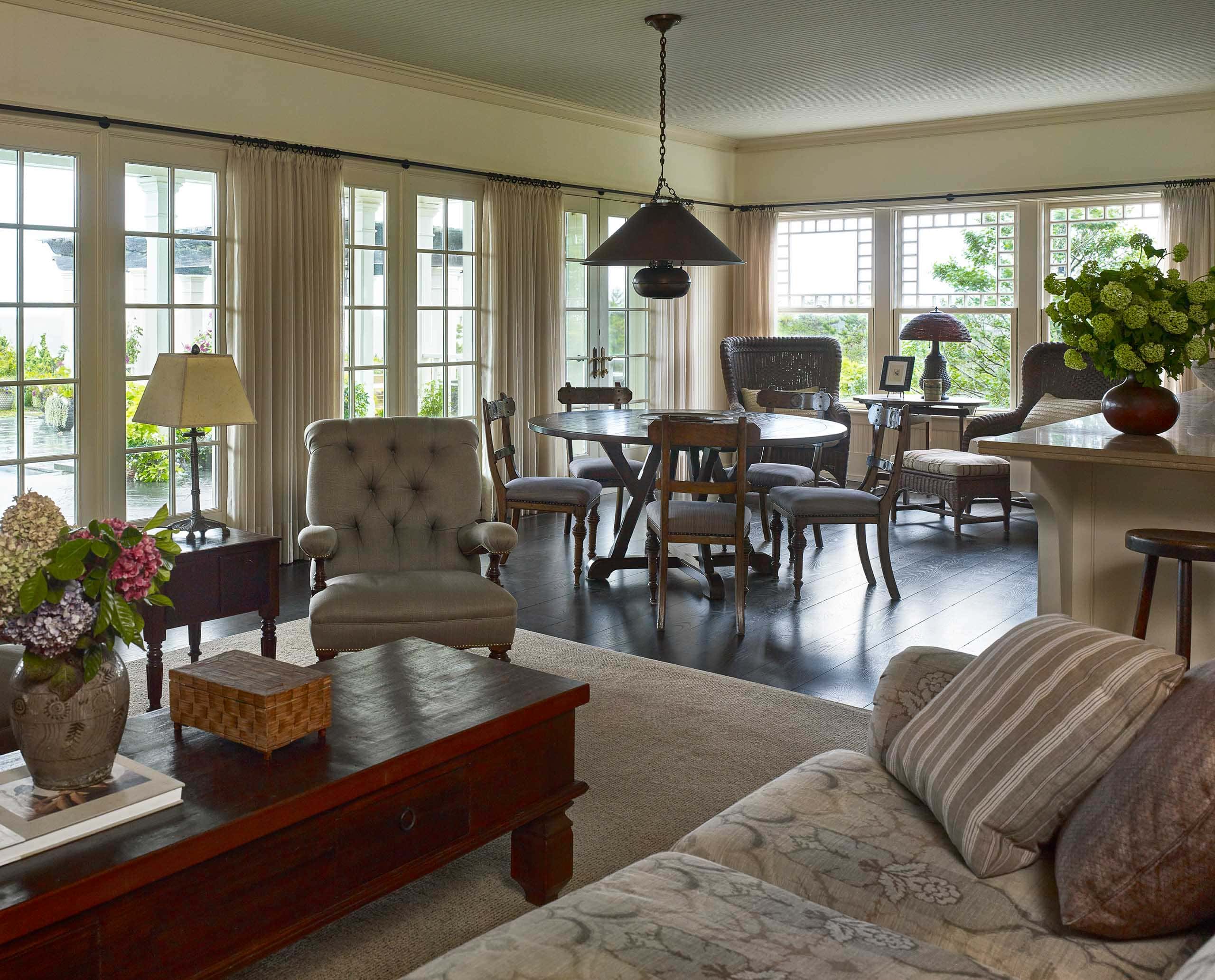
The kitchen boasts a large island, wicker reading chairs placed near the windows, and a stick-style breakfast table. The French doors overlook the pool, pergola, and the bay beyond. A vintage kerosene lantern from Vincent Mulford in Hudson, New York, was repurposed into an electrified ceiling fixture. The adjacent seating area includes reupholstered pieces that maintain the room’s relaxed, East End character.
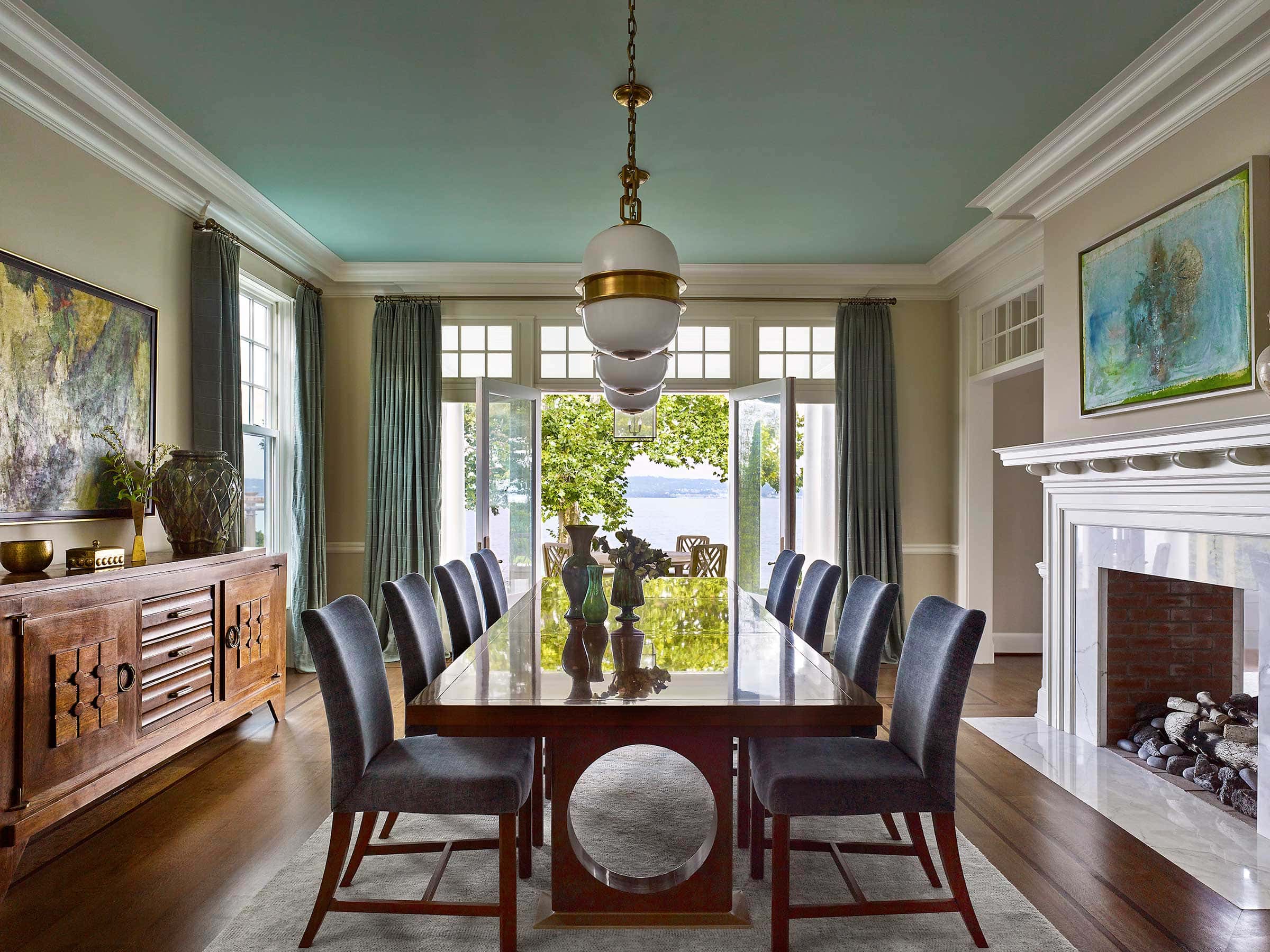
A large-scale painting on paper by Melinda Stickney-Gibson takes pride of place at one end of the dining room, which is furnished with a 10-foot antique table and a set of leather-covered Anglo-Colonial X-back chairs that have been in Glenn’s possession for more than thirty years. At left, an 18th-century English server rests beneath a large mirror that amplifies the glow of a chandelier that Glenn designed.

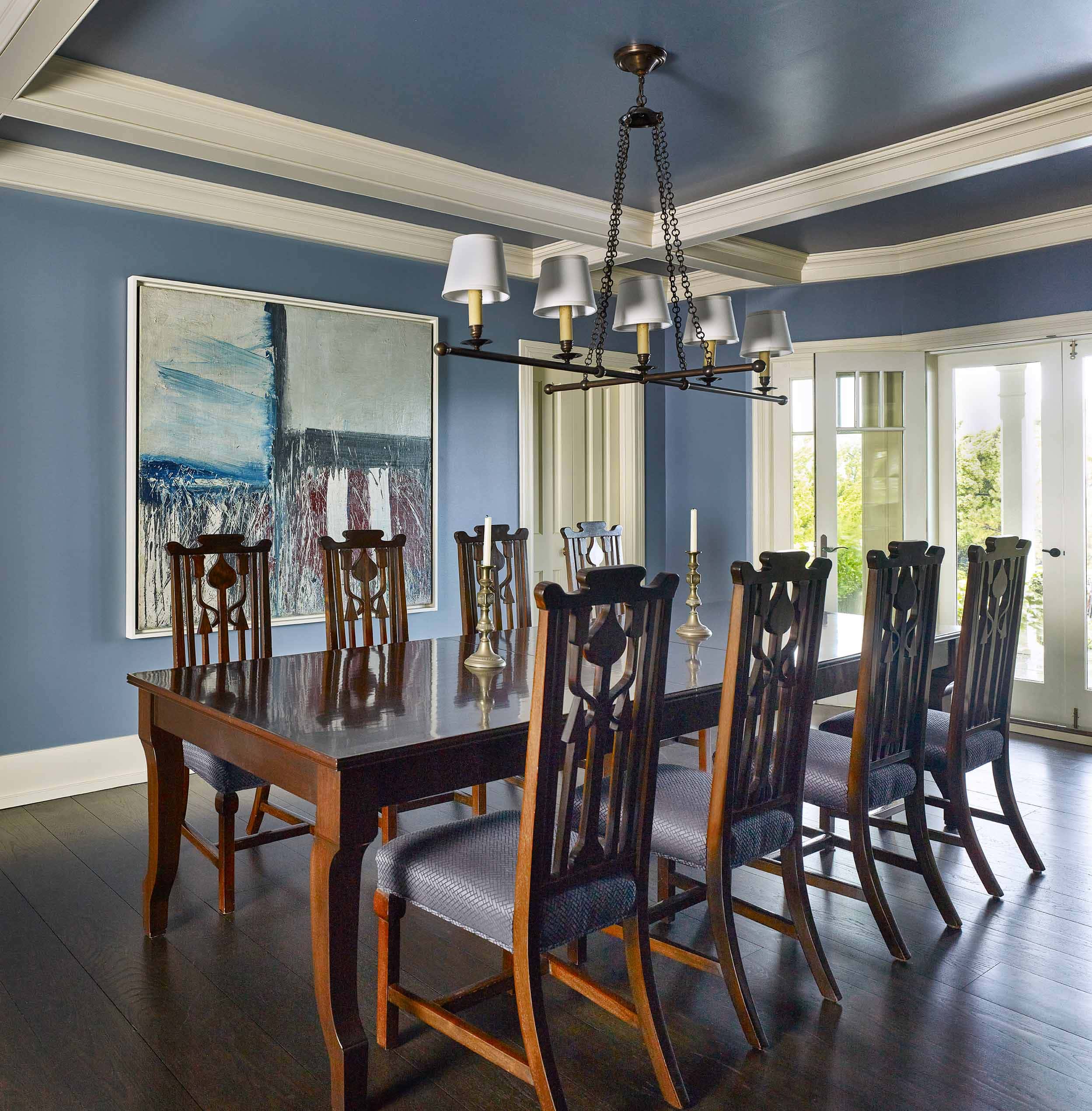
The dining room is furnished with late 19th-century English Arts and Crafts chairs from Newel Gallery, upholstered in a fabric from Hermès, and surrounded by a custom table made by Joseph Biunno. Alfred Leslie’s painting #44, 1959, anchors the blue walls painted in Donald Kaufman’s “Dusty Grape,” while a custom-designed chandelier illuminates the room in the evening.
Vintage Siapo Tapas rendered on barkcloth from Samoa, encircled in a broad gilt frame, add a cross-cultural reference on the opposite side of the dining room. The pattern is meant to depict Oceana’s flora and fauna stylistically. For Glenn, it also recalls Indian tantric paintings for meditation and barn decoration by Amish farmers.

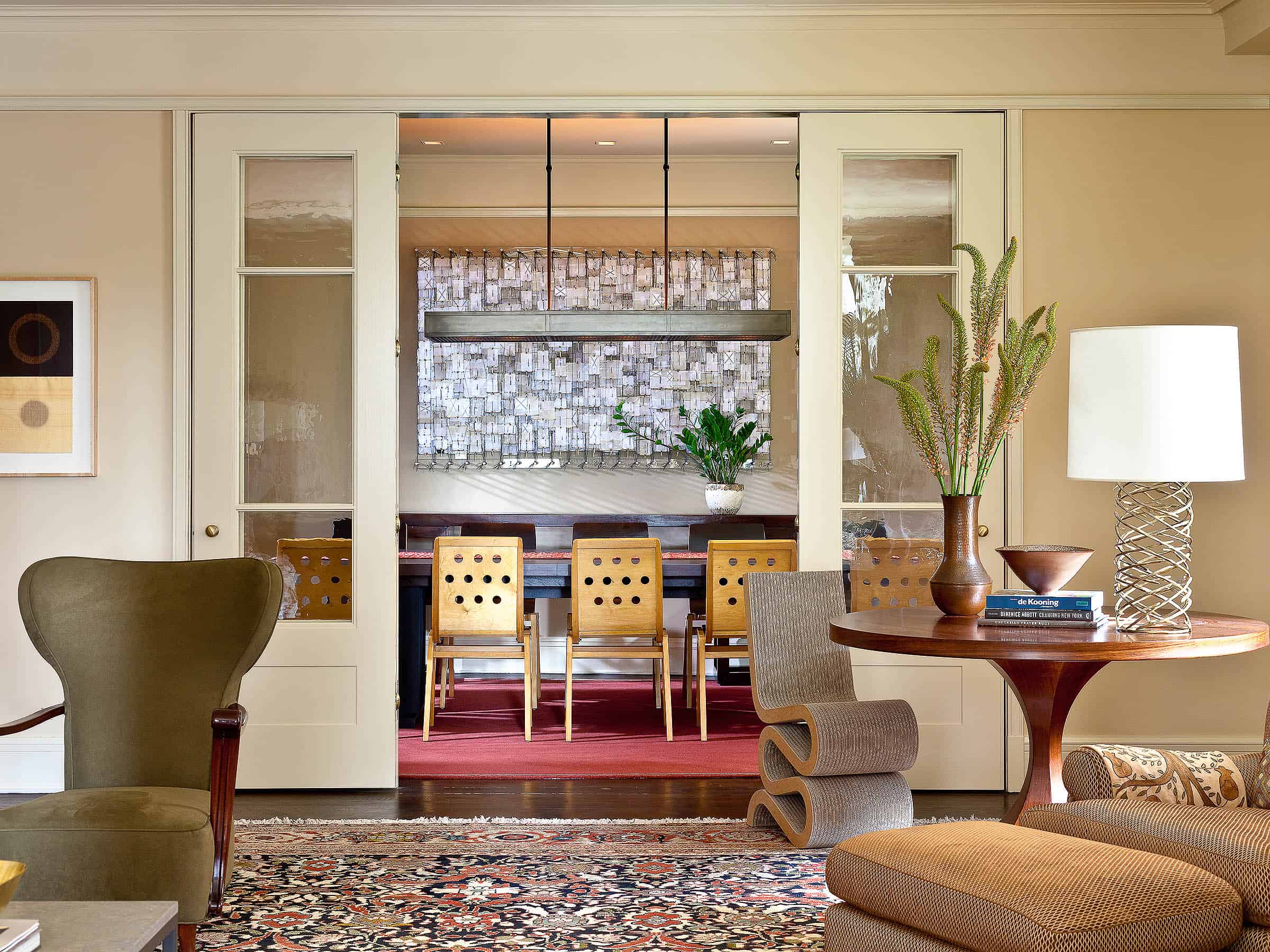
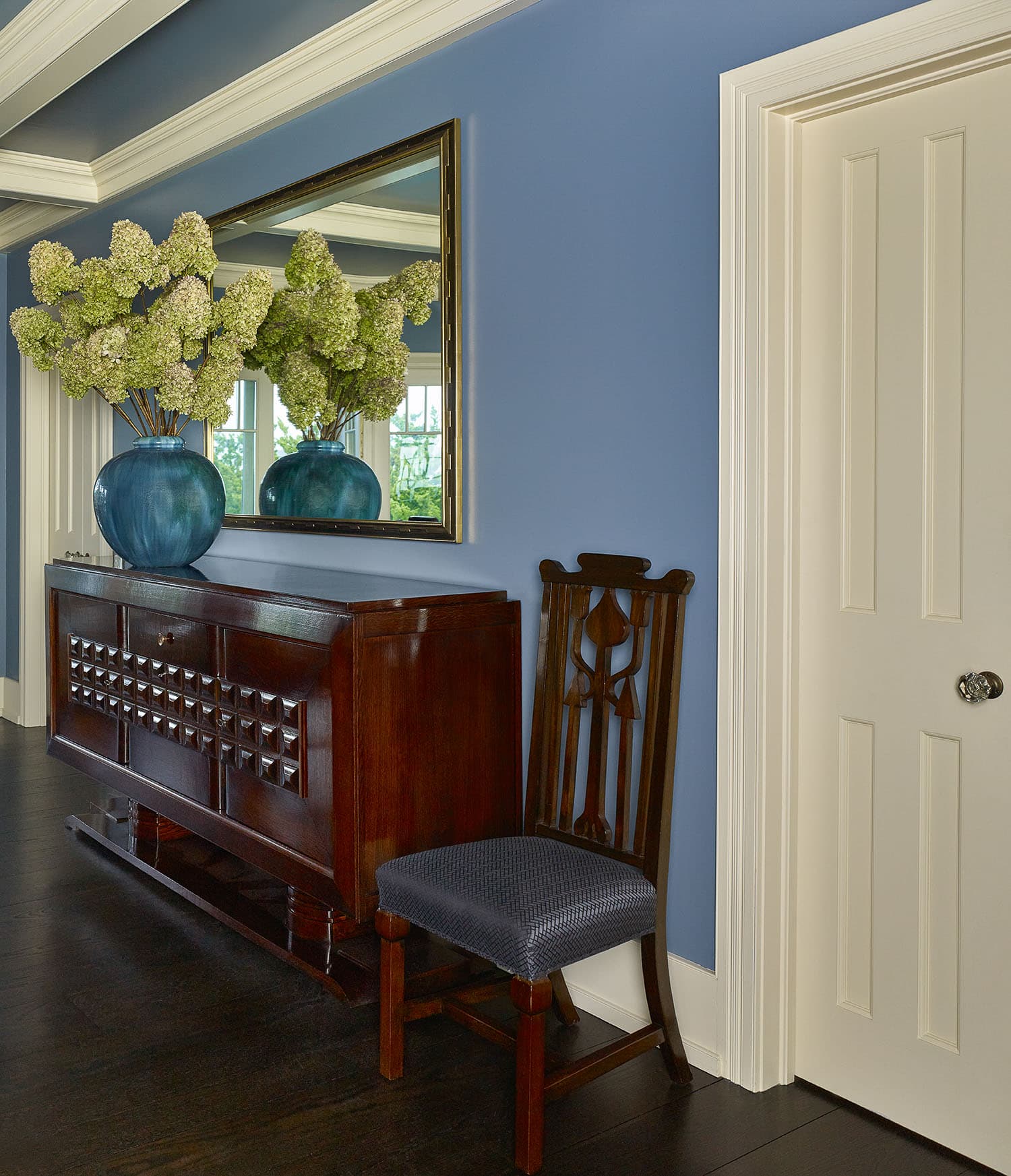
A 1940s French sideboard, tucked beneath a custom mirror, creates an elegant serving station that connects the dining room to both the kitchen and living areas through the dining room’s symmetrical doorways.
In this view of the living room, an unusual 19th-century Thebes chair fashioned from slender bamboo branches sits in front of a pair of cocktail tables by T.H. Robsjohn-Gibbings. Directly above the fireplace is Untitled (Dollar Bill) 2000 by Thomas Friedman; to its left is a portrait by the late Donald Baechler, which was Glenn’s first art purchase after arriving in New York.

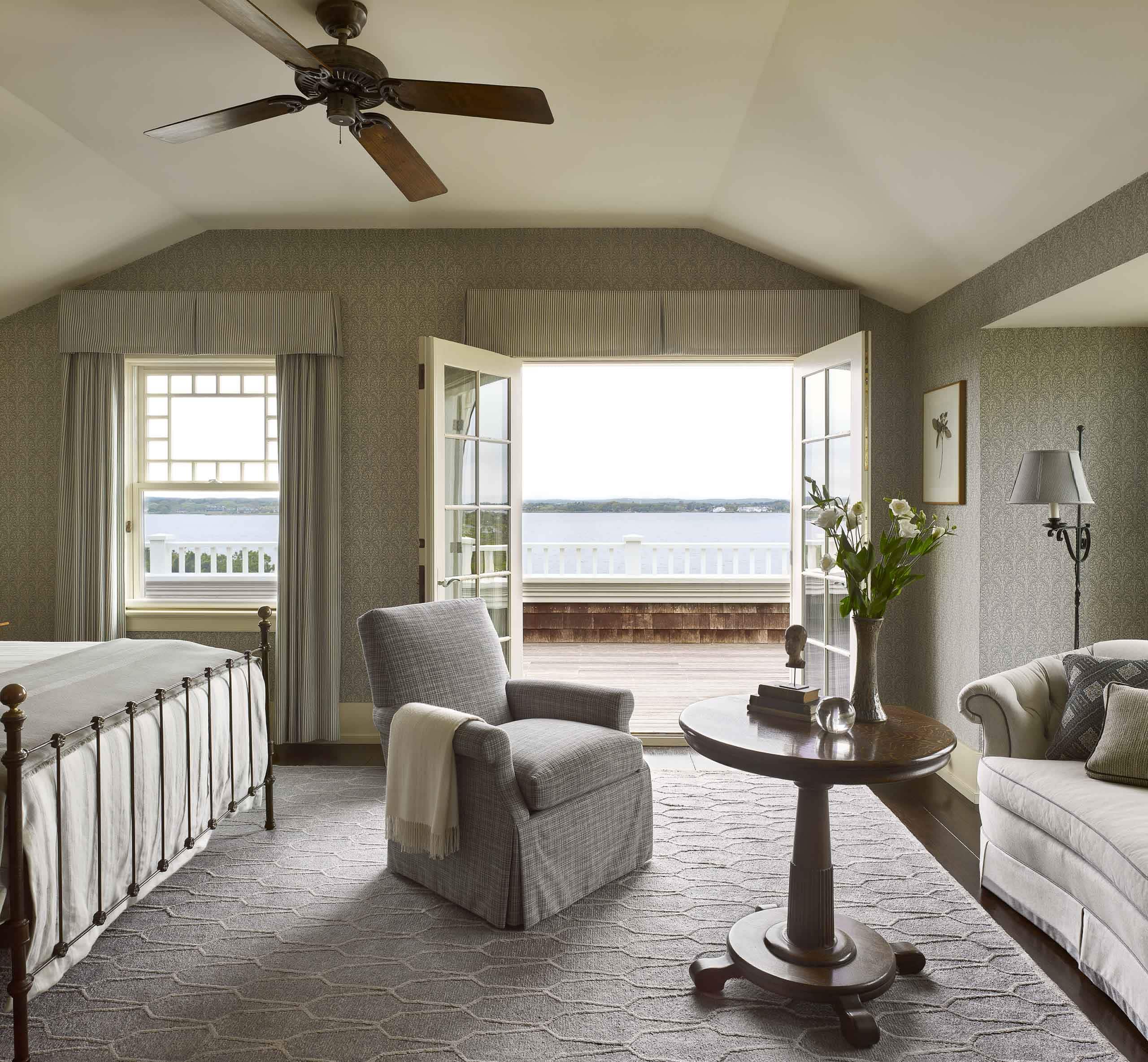
The upstairs guest bedroom boasts remarkable water views to the bay and ocean from its corner position, with French doors opening to an inviting deck. A skirted armchair from Lillian August provides comfortable seating, while the antique Persian rug and paper-backed textile wallpaper combine to shape a soothing retreat for guests.
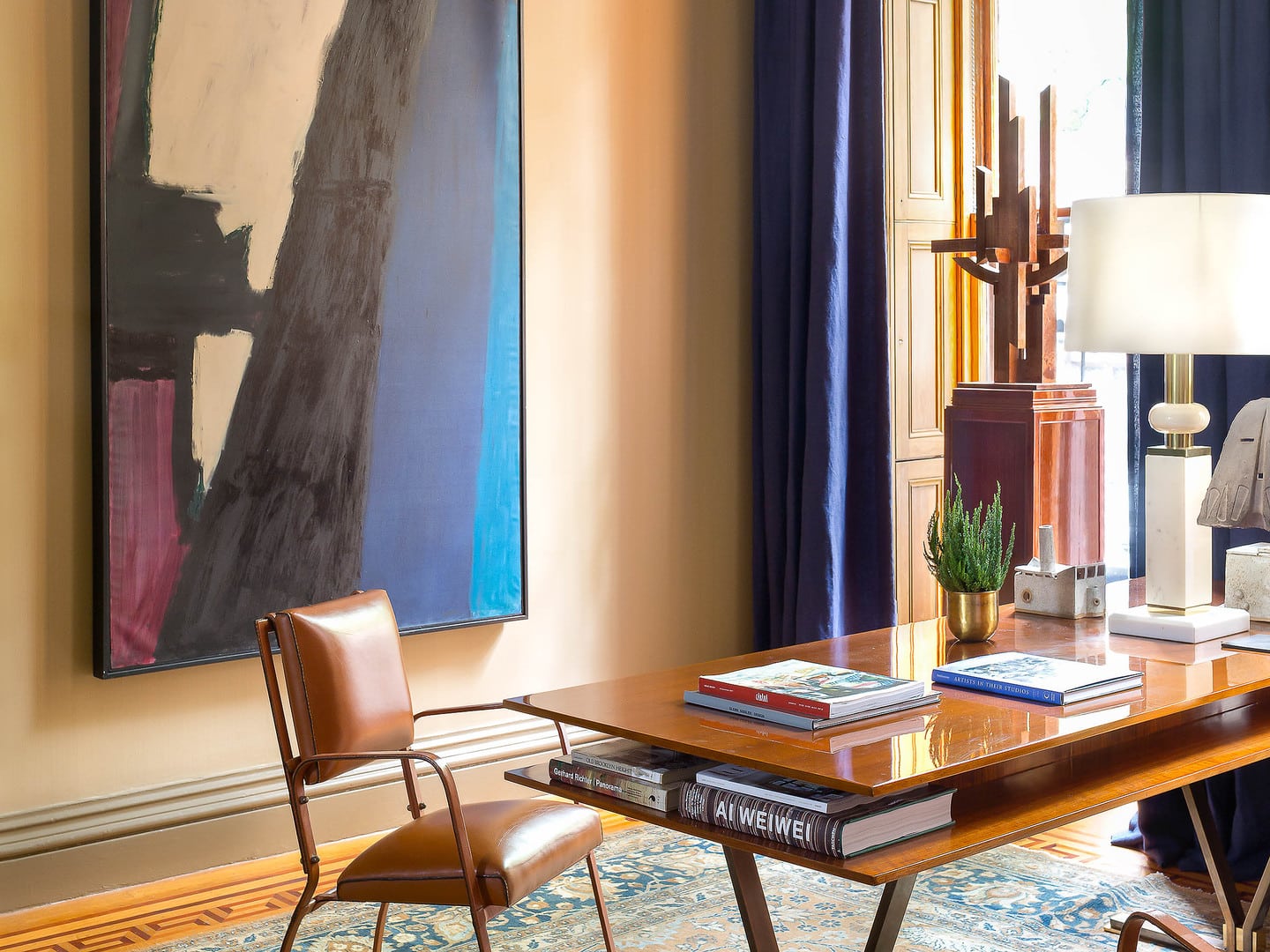
The furnishings in this corner of the living room include an English Arts & Crafts table, a pair of 1940s French Bergeres covered in lush velvet, and a vintage industrial-inspired lamp. It’s the perfect spot for an intimate dinner for two or as a sun-splashed work desk. The art includes a piece by David Dupuis (left) and an anonymous tantric work from India (right).

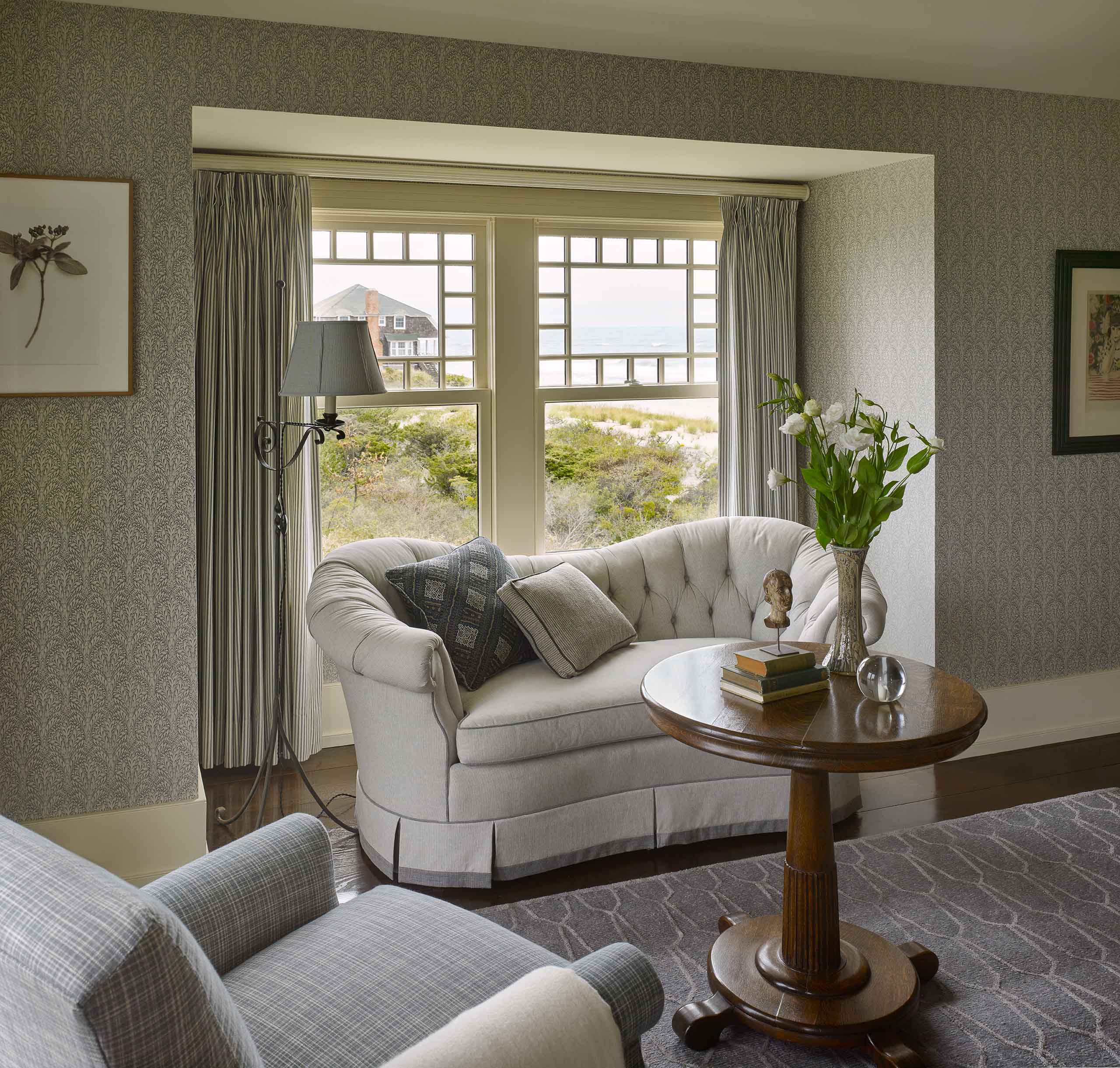
A curvaceous chaise by Jonas Upholstery offers a luxurious perch for contemplation, positioned to capture ocean views through the geometric windows, which are indicative of shingle-style homes. The curved silhouette softens the room’s interior architecture.
With a flat-screen TV hanging on the adjacent wall, this armless corner sofa affords ample seating for movie viewing, especially on chilly winter evenings with a crackling fire. Chunky seagrass matting underfoot grounds the tableau.

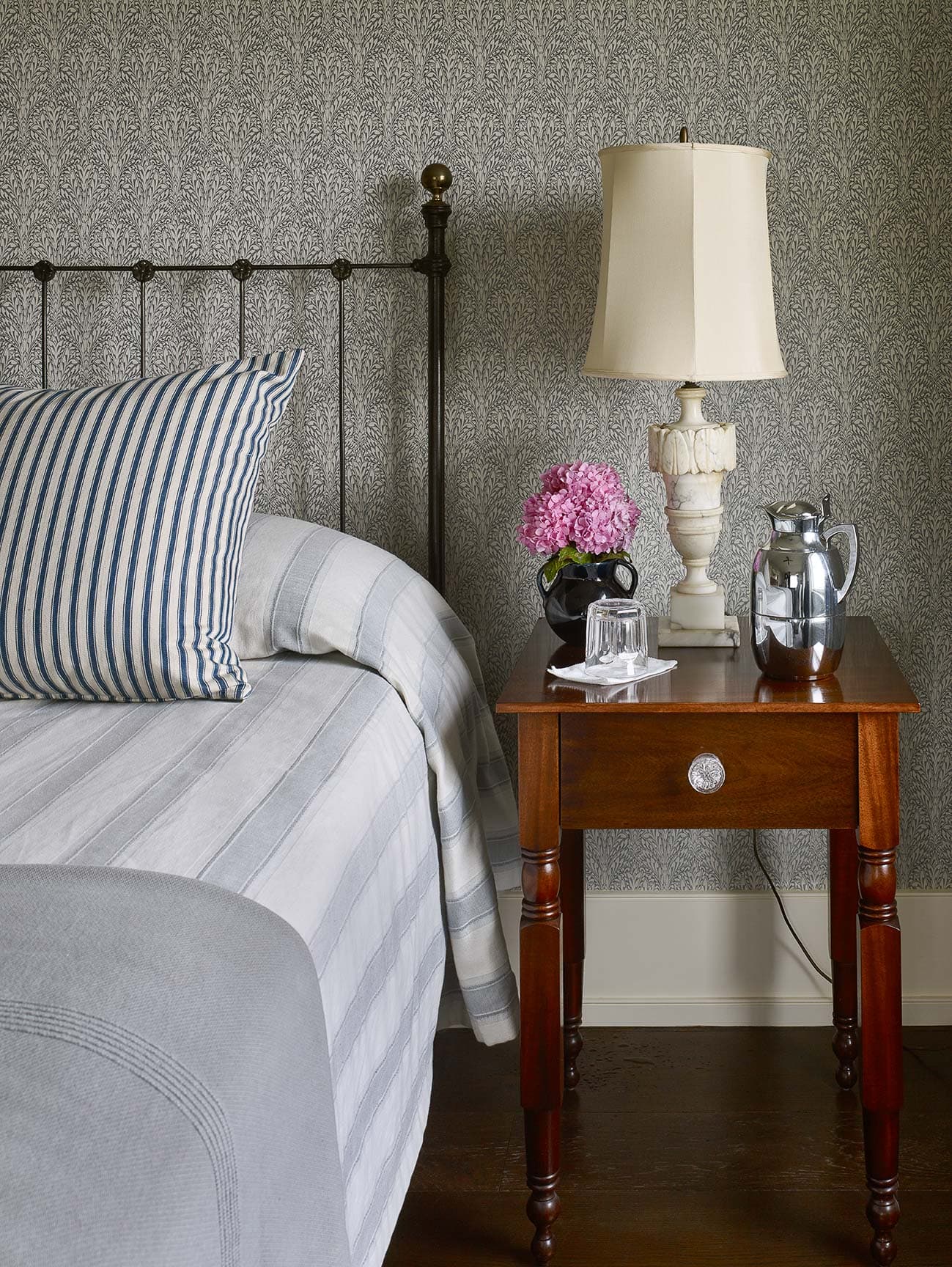
An antique bed dressed with classic mattress ticking bedding invites a restful night’s sleep in the guest room, complemented by a 19th-century American oak bedside table topped with a carved alabaster lamp.
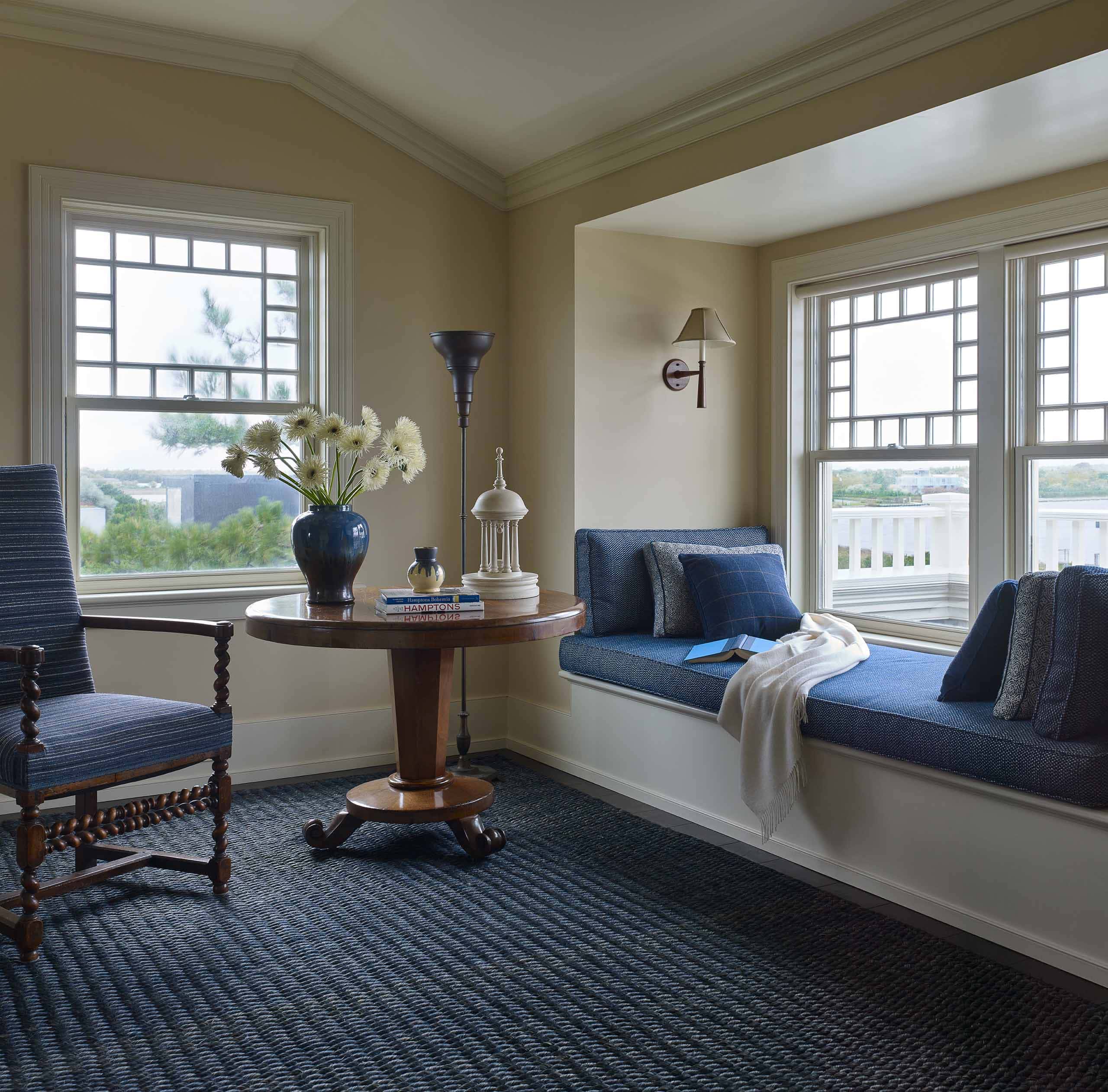
The gentleman’s dressing room incorporates a custom window bench overlooking Mecox Bay and the pool, paired with an antique table and a twisting carved chair upholstered in Zack and Fox fabric. A chunky seagrass matting was dyed to match the palette and to add a rich, muscular note.
A second custom-designed hook rug rests on the upstairs landing, which features the home’s original spindles and handrail. A pair of African masks adds a tribal note.

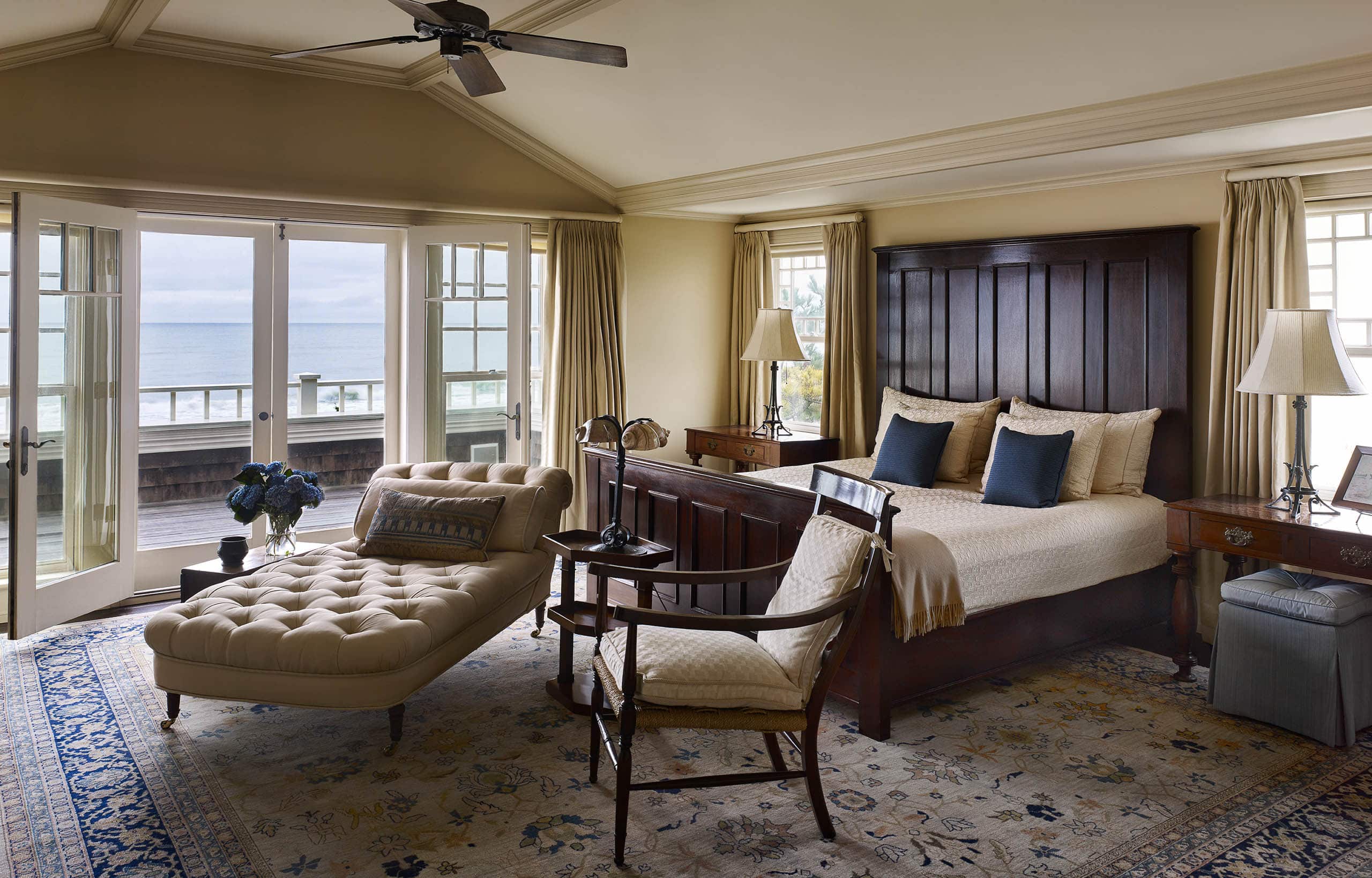
The primary bedroom is outfitted with a bespoke mahogany king bed by Joseph Biunno, accompanied by an antique Sultanabad rug beneath it. A custom tufted chaise by Jonas Upholstery and an armchair from Rose Tarlow add an intimate conversation space, while 19th-century iron finial lamps provide light for reading. French doors open to an expansive oceanfront deck.


Artworks by Roberto Matta hang above an 18th c. William & Mary bureau purchased at auction in this bedroom, which features a minimalistic four-poster bed dressed in vintage textiles. To the right of the window is a work by artist Nancy Spero. Because the room has no closet, Glenn attached shaker knobs at intervals around a high molding so that guests could hang their travel clothes. Two boudoir wing chairs provide seating.

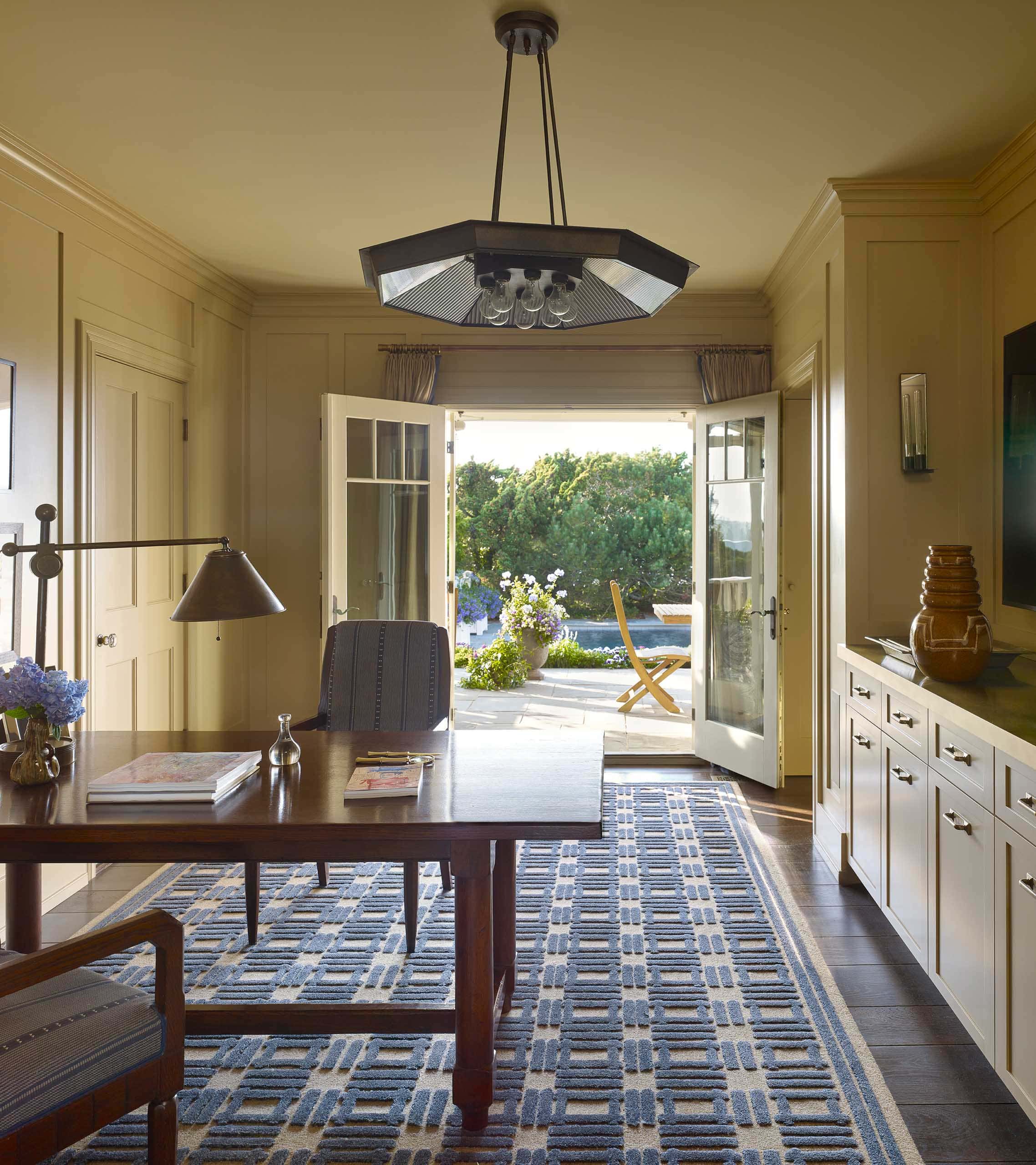
The home office serves as a shared workspace, featuring an antique desk and chairs, which create a suitably collaborative work environment. French doors open to the pool, while a custom textural rug from Martin Patrick Evan and a rare I.P. Frank eight-light chandelier add another layer of geometric details. A large flatscreen TV hangs above the cabinetry at right.
Maintaining a through line between the house’s past and present was paramount, so Glenn kept the existing mustard-yellow toile wallpaper in the primary bedroom to acknowledge the previous owners. By day, ample sunlight streams through the room’s large casement windows; in the evening, a pair of James Mont’s Open Helix Lamps from the 1950s illuminate the space.

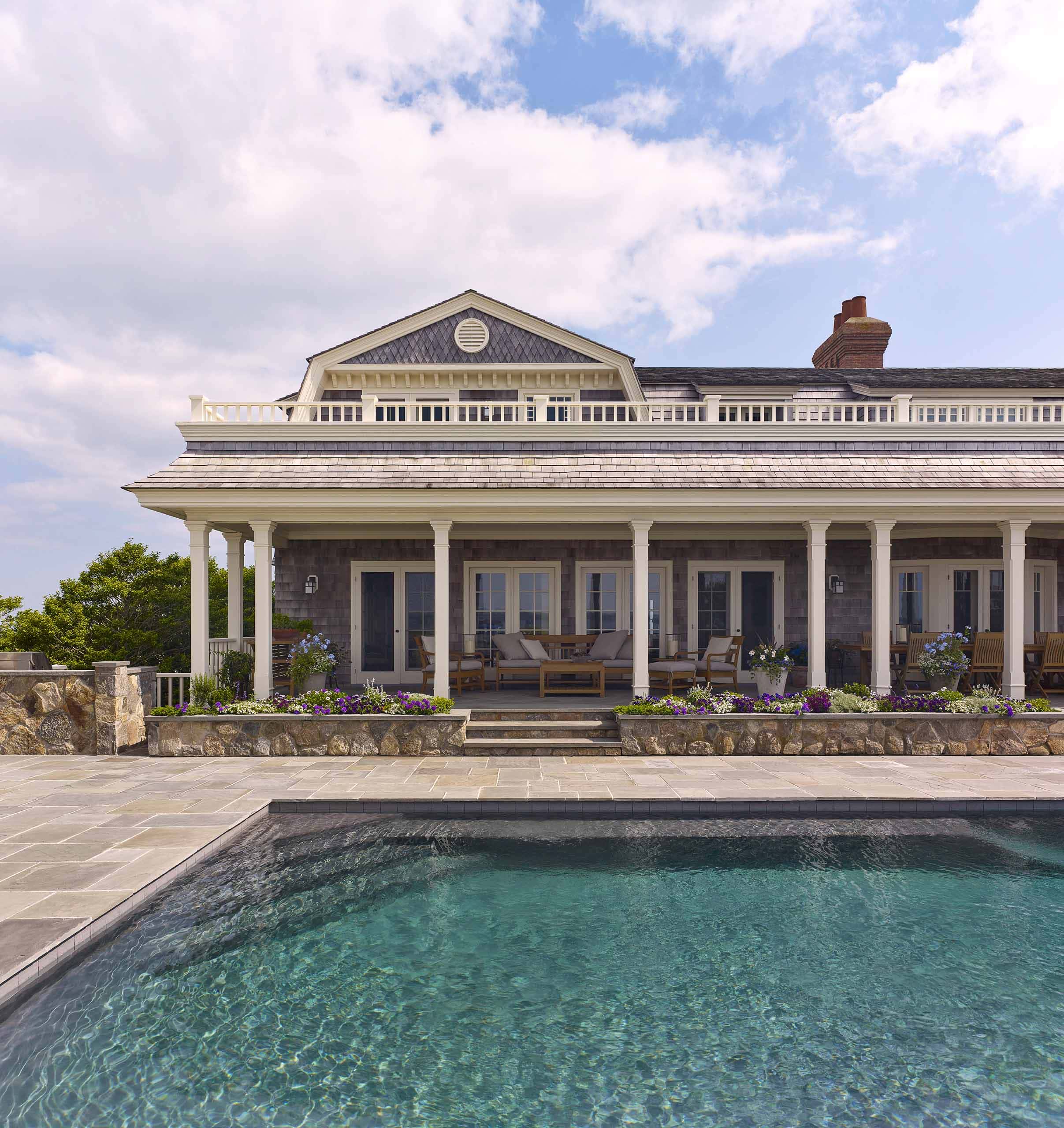
The extended covered porch, designed in collaboration with Fleetwood McMullan & Sanabria, runs the full length of the house and accommodates outdoor dining for up to fifty guests. Teak folding chairs and eight folding tables are stored on the home’s lower level, creating an impressive outdoor entertaining venue that overlooks the saturated gray-bottomed pool.
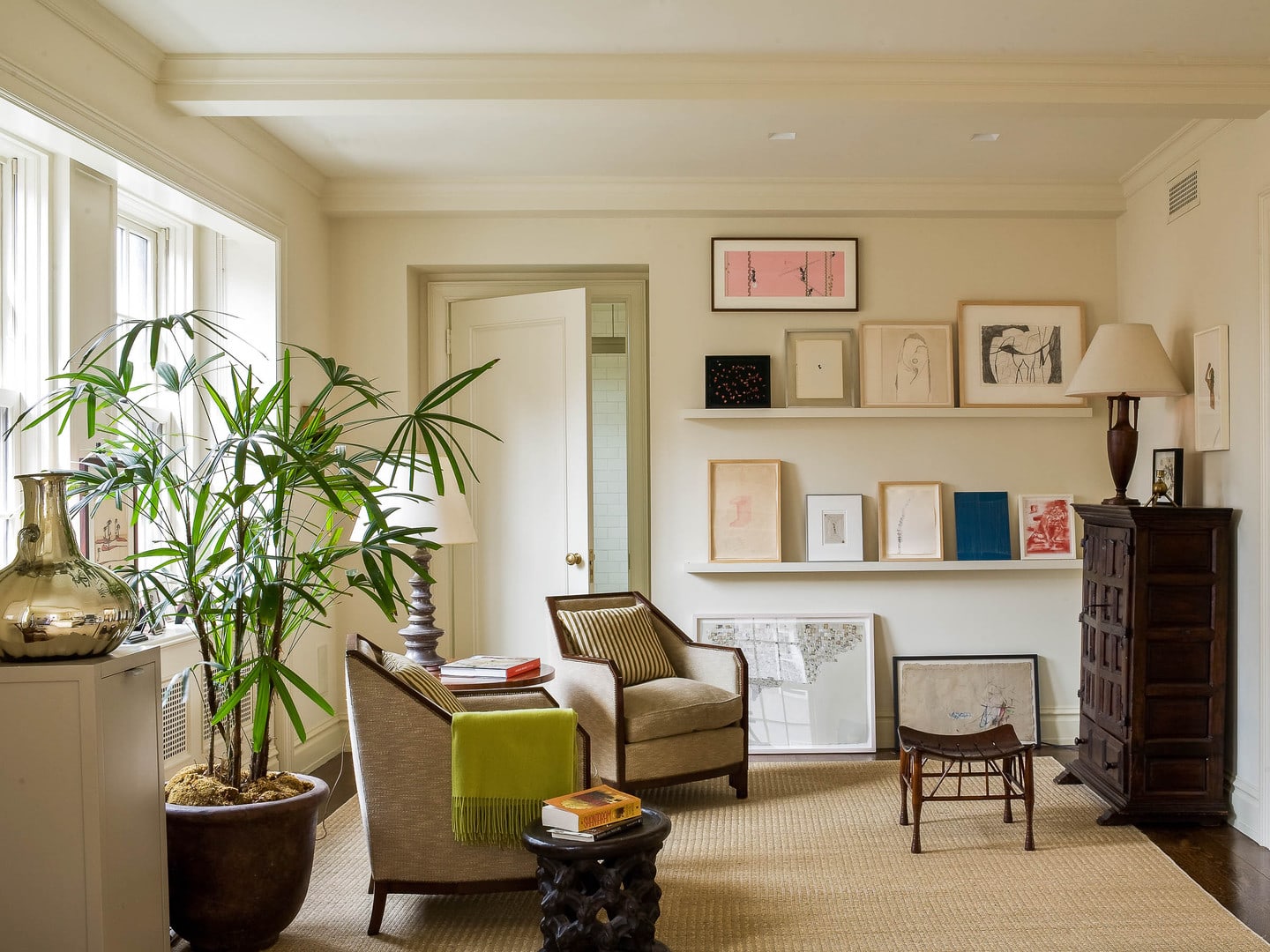
An ever-expanding collection of surrealist artworks animates the room, including works by Leon Golub, Alphonse Osorio, Gary Gissler, Pidder Auberger, James Siena, Hans Bellmer, Jacqueline Lamba, and Richard Tuttle. Also in the mix is a work by artist David Hare, a previous house owner. The framed works are installed almost randomly, referencing how the late Peggy Guggenheim displayed art in the Surrealist Gallery at her groundbreaking New York gallery, Art of This Century.

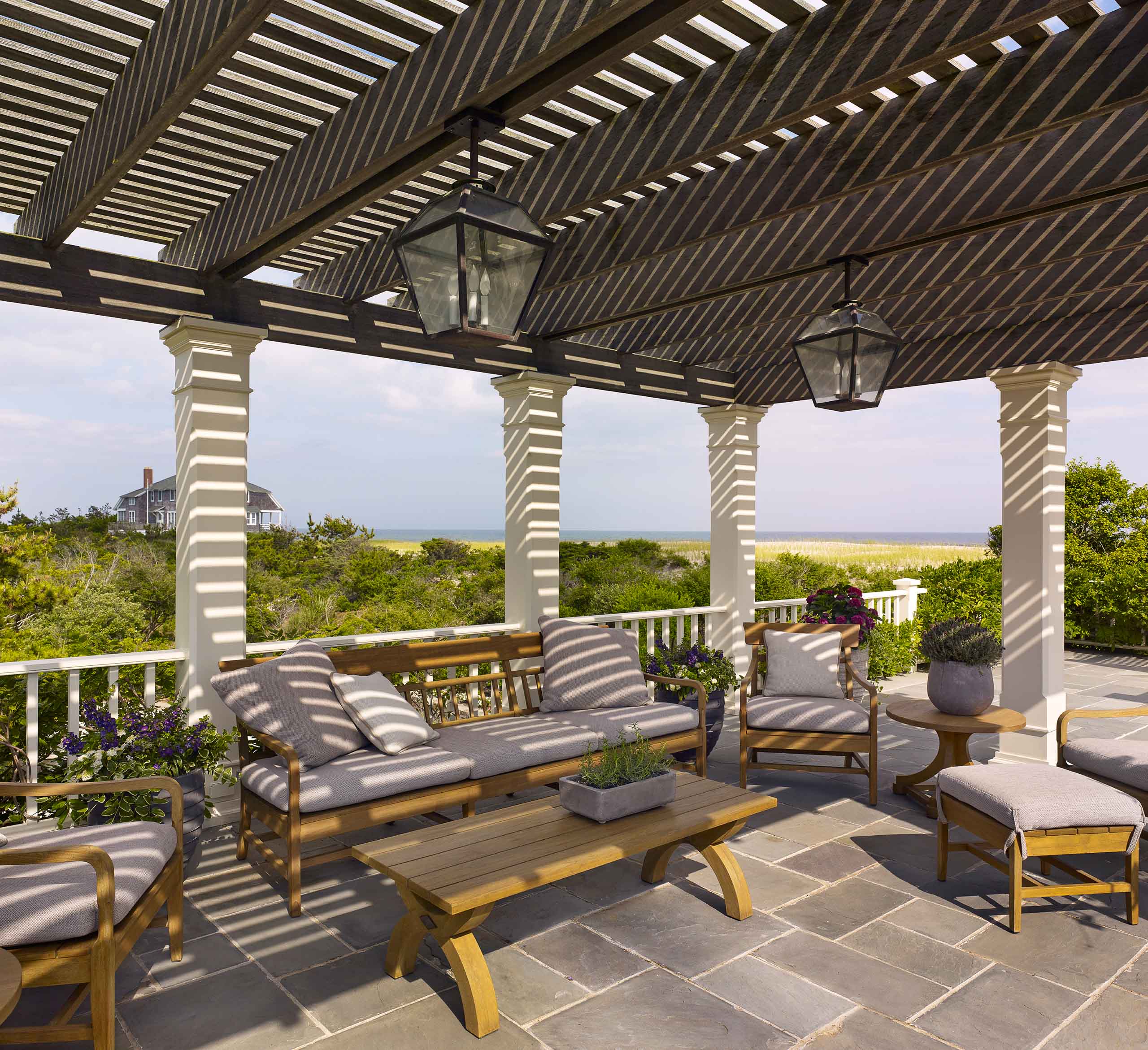
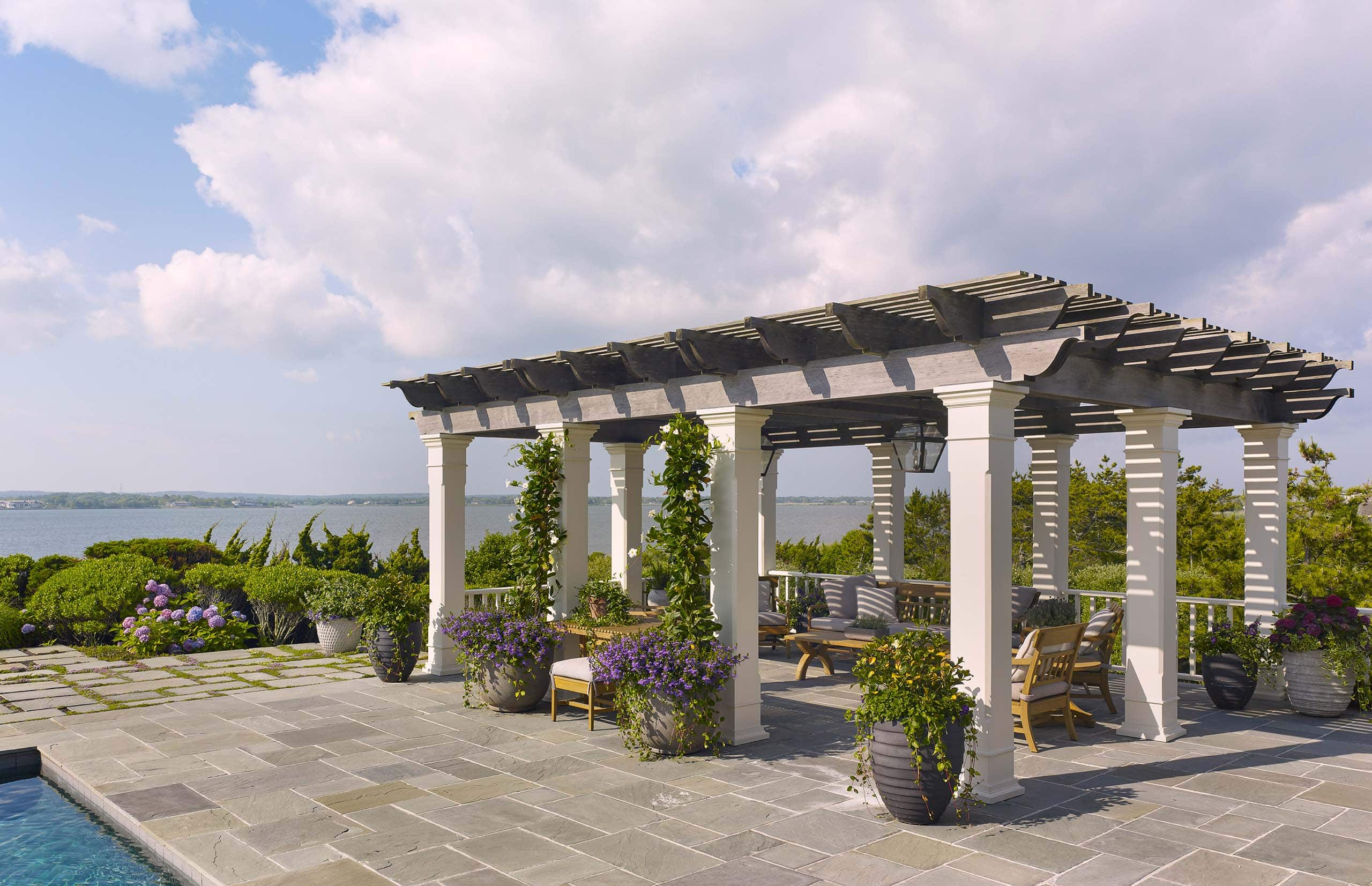
The elevated pergola functions as a temple-like pavilion designed with overhead slats that offer a respite from the sun. It was strategically positioned above the garage to capture panoramic views of both the Atlantic Ocean and Mecox Bay. Munder Skiles teak furniture creates comfortable seating areas resting on bluestone.
The breakfast room has a simple round pedestal table paired with directors’ chairs. The tableau is comfortable and unassuming, inviting guests to enjoy coffee while watching the mist burn off the morning landscape, the birds visit the feeder, and a few chipmunks scamper about. The Russell Wright servicewear is part of an extensive collection that could serve an expansive buffet dinner.

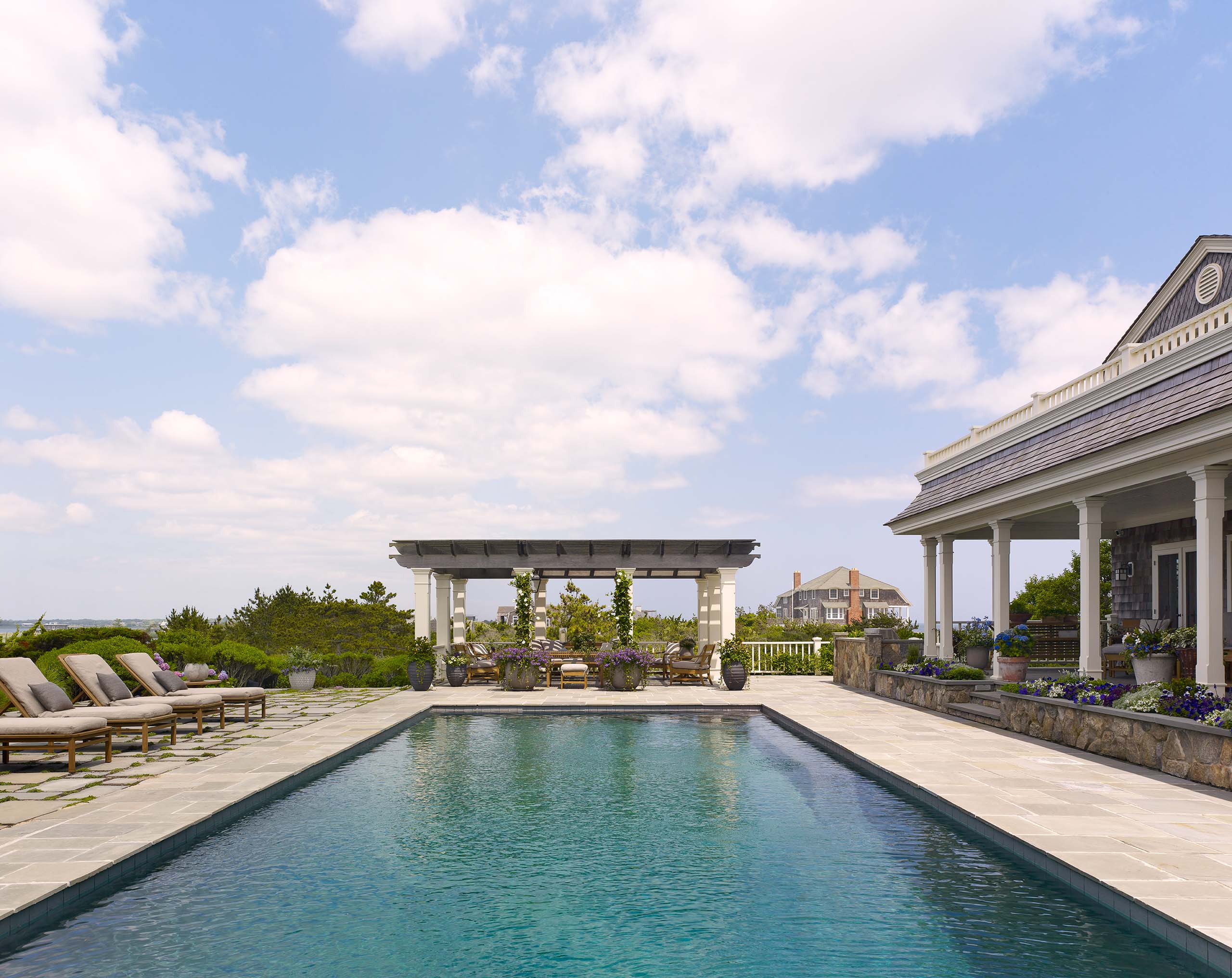
The expansive gunite pool stretches toward the elevated pergola, which serves as a dramatic focal point centered at the pool’s terminus. From this perspective, the rich blue-green water creates a striking contrast against the limestone terrace, while the temple-like structure beckons guests to a moment of post-swim relaxation.
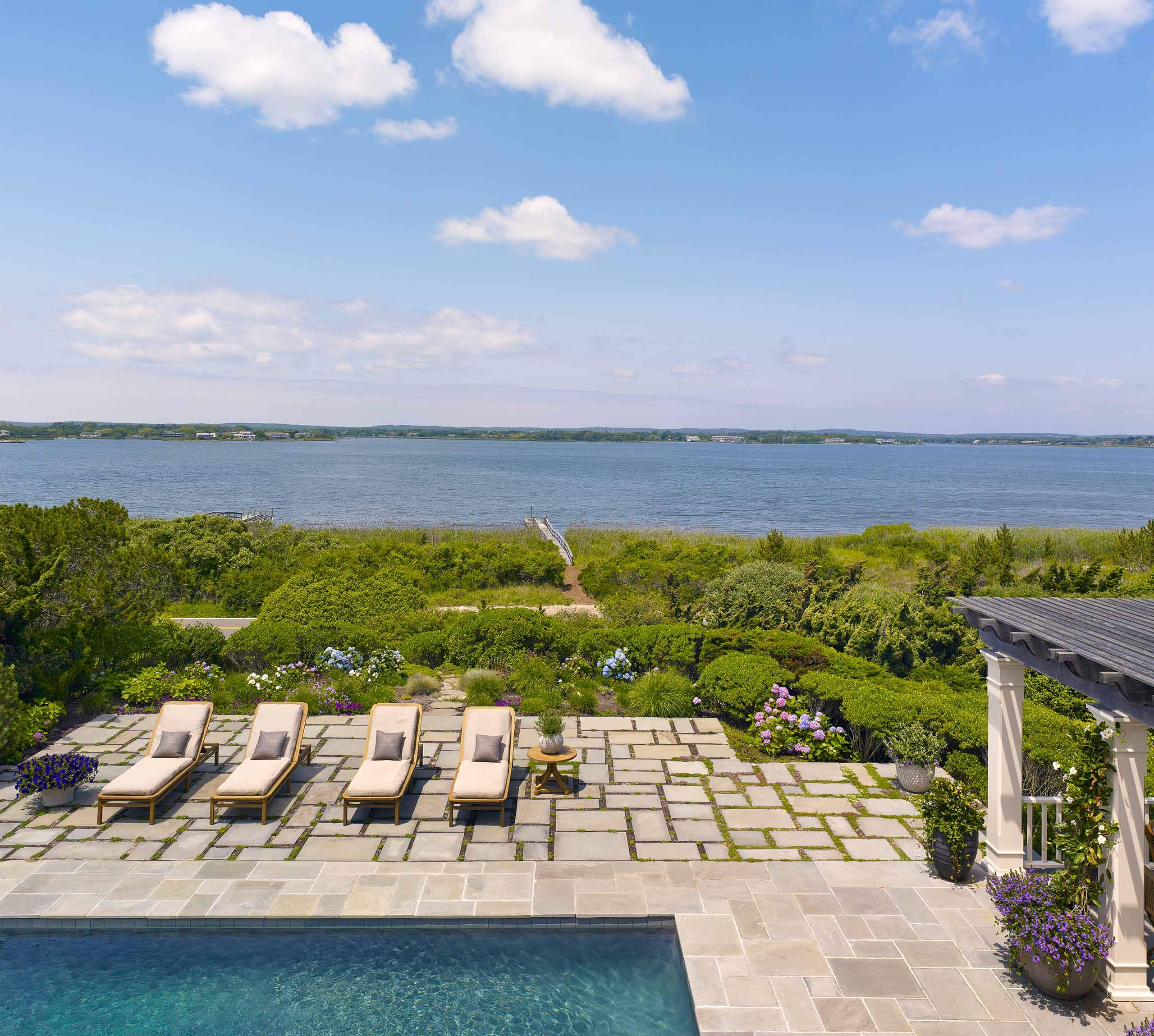
The property extends from house to bay, where a private dock marks the water’s edge. Teak lounge chairs accommodate sun worshippers on the bluestone terrace, which transitions seamlessly into a grass-interspersed paver area, leading to the naturalized landscape. The variation creates a subtle visual bridge between the formal architecture and the waterfront setting.


The kitchen retains its farmhouse sensibilities but was updated with modern appliances. Muted-sage green cabinetry and trim are offset by black granite counters and the original floors, which Glenn stained dark walnut throughout. Period-style fixtures and pendant lights hang from the beadboard ceiling to illuminate the space.

The expansive gunite pool stretches toward the elevated pergola, which serves as a dramatic focal point centered at the pool’s terminus. From this perspective, the rich blue-green water creates a striking contrast against the limestone terrace, while the temple-like structure beckons guests to a moment of post-swim relaxation.
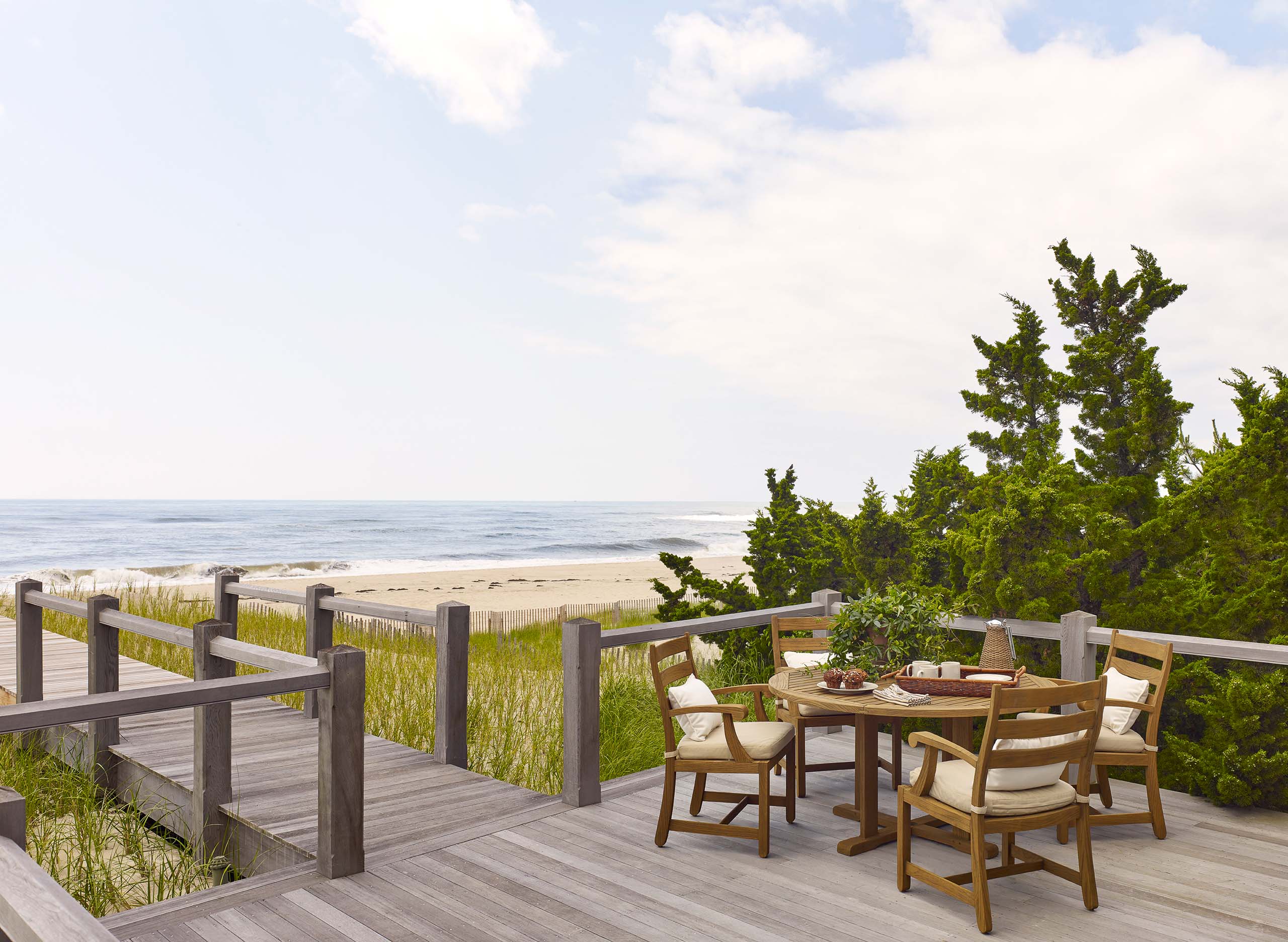
A weathered teak table shapes a quiet retreat on the oceanfront deck, where the circular form provides a gentle contrast to the boardwalk’s linear geometry. This secluded spot offers the perfect setting for morning coffee before descending the dunes to enjoy the incredible beach below.

Senior Designer Craig Strulovitz
Photos by Peter Murdock

West End Apartment

Built in 1840, the Greek Revival farmhouse would become a haven for some of the 20th century’s most celebrated artists. Designer Glenn Gissler removed the shutters from the home’s windows to achieve an “ecclesiastical purity [for] the Greek temple front” that offers a more contemporary appearance.

In the dining area of the open-plan living space, a panel from the calligraphic work, ‘Roman Notes’ by Cy Twombly, engages in a compelling dialogue with a Jacob Hashimoto dimensional collage. The composed scene is anchored by an area rug from Stark Carpet and illuminated by Lindsey Adelman’s smoked-glass ‘Branching Bubble’ chandelier. Iconic Eero Saarinen armchairs provide comfortable seating and a curvaceous counterpoint to the multiple geometries.

West End, NYC

West End Apartment

An expansive apartment residence on Manhattan’s Upper West Side offers the best of contemporary urban living. Its generously scaled, sun-drenched rooms are set within a newly constructed building with all the desirable modern amenities and gracious layouts reminiscent of pre-war apartments.

Glenn Gissler Design was commissioned to create a sanctuary for a couple seeking a fresh, calm living environment. Thoughtful architectural details that balance traditional and modernist sensibilities help create a transitional environment grounded in the 21st century, resulting in a sophisticated interplay between metropolitan vistas and natural light while integrating architectural elements that skirt stylistic boundaries. 

We collaborated with our clients to establish a chromatic narrative inspired by the neutral hues taken from beach rocks and sand. The nuanced palette weaves tonal whites and cool-toned grays inflected with subdued organic hues. The first agreed-upon selection was a Scandinavian flat-weave carpet, further defining the design sensibility and palette direction.

The furniture and furnishing we assembled have clean lines and graceful modern proportions, creating understated spaces that eschew ornamentation in favor of pure form. Against this backdrop, the couple’s art collection becomes the focal point as you move between the rooms.


Beyond the home’s backdoor and through a split rail fence, summer visitors are greeted by an unobtrusive pool and a former art studio dubbed the “Pleasure Pavilion,” where a swim follows rustic lunches. Several weathered Adirondack chairs rest below a mature Sugar Maple tree, providing a respite from the midday sun.

In the entry gallery, a bespoke runner–crafted in homage to a vintage Swedish flat-weave carpet–establishes the residence’s tonal language. A series of flush-mount fixtures punctuate the ceiling, while picture lights, conceived by modernist master Paul Rudolph, provide discrete art lighting for the side walls. An artwork by Gary Gissler takes pride of place at the far end of the space, while a series of c.1960 ink-on-paper works by Al Held are hung on the left wall.

The side garden features a 19th-century urn in an established bed of pachysandra that came with the house. This is consistent with Glenn’s playful interpretation of classical tradition, which is part of the house’s Greek Revival roots.

A wall-hung cabinet by modern master George Nakashima, fashioned in black walnut and pandanus cloth, floats below a figurative work by the American abstract expressionist painter James Brooks. The silhouette of the undulating vase contrasts with the geometry of the cabinet and the cubist composition.

Just inside the library, a circa 1820 Biedermeier Bar Cabinet is stocked with spirits, where guests are encouraged to help themselves to a cocktail. Hanging above are works on paper by Wilfred Zogbaum (left) and Tomas Eldred (right). The Klismos Chair, one of a pair, is attributed to T.H. Robsjohn-Gibbings.

A striking work on paper by the legendary artist Pablo Picasso hangs above a console table at one end of the living area. The vase, vessel, and branches provide a counterpoint to the table’s geometry.

In the entry hall, a pair of circa 1830 hall chairs rest atop a custom ‘falling block’ patterned hook rug, which Glenn designed for the space. Above the chairs, in what amounts to a mid-20th-century artistic dialog, are works by Alexander Calder (left) and Le Corbusier (right). The Calder is the first work inside the house, which Glenn chose because Calder’s homestead and studio–still maintained by the late artist’s family–are less than two miles away.

In this art-filled view, a pair of swivel armchairs from Holly Hunt, upholstered in a nuanced textile, balance two framed collages by Conrad Marca-Relli, a celebrated modernist whose works are in the permanent collections of many museums. A sculptural lamp, ‘Tornade’ by Hervé van der Straeten, articulates the composition, with a view into the gallery with works on paper by Al Held.

The swimming pool was existing when Glenn purchased the house. He left the coping, but removed the awkward patios to allow it to fit quietly into the backyard landscape as a reflecting pool. The property expands beyond the back gate for some distance before connecting to hundreds of acres of the Roxbury Land Trust’s many preserves.

Diaphanous curtains, suspended from custom-crafted hardware, diffuse natural light and help soften the room’s acoustics. The architecturally refined stepped ceiling detail was introduced to add a pre-war plaster detail to this new construction apartment.

The side garden features a 19th-century urn in an established bed of pachysandra that came with the house. This is consistent with Glenn’s playful interpretation of classical tradition, which is part of the house’s Greek Revival roots.

A John Saladino glass table lamp, circa 1970,  graces a bespoke cabinet with a stone top. The recessed cabinet panels are covered in grass cloth, adding dimensionality.

Beyond the home’s backdoor and through a split rail fence, summer visitors are greeted by an unobtrusive pool and a former art studio dubbed the “Pleasure Pavilion,” where a swim follows rustic lunches. Several weathered Adirondack chairs rest below a mature Sugar Maple tree, providing a respite from the midday sun.

Quiet geometric forms and horizontal planes, emblematic of modernist design, are balanced against the sweeping curves of the circling chairs in this layered space. The interplay of lustrous woods–from the hand-finished flooring to the walnut dining table and accent furnishings–creates a pleasing interplay with the blue-grey textiles.

In the entry hall, a pair of circa 1830 hall chairs rest atop a custom ‘falling block’ patterned hook rug, which Glenn designed for the space. Above the chairs, in what amounts to a mid-20th-century artistic dialog, are works by Alexander Calder (left) and Le Corbusier (right). The Calder is the first work inside the house, which Glenn chose because Calder’s homestead and studio–still maintained by the late artist’s family–are less than two miles away.

Two tailored sofas complement the living area’s club chairs, providing generous seating for intimate gatherings while framing rich urban vistas through an expansive wall of windows. A bespoke coffee table and streamlined ottoman center the layout. The custom ceramic ceiling fixture is from Dumais Made.

The swimming pool was existing when Glenn purchased the house. He left the coping, but removed the awkward patios to allow it to fit quietly into the backyard landscape as a reflecting pool. The property expands beyond the back gate for some distance before connecting to hundreds of acres of the Roxbury Land Trust’s many preserves.

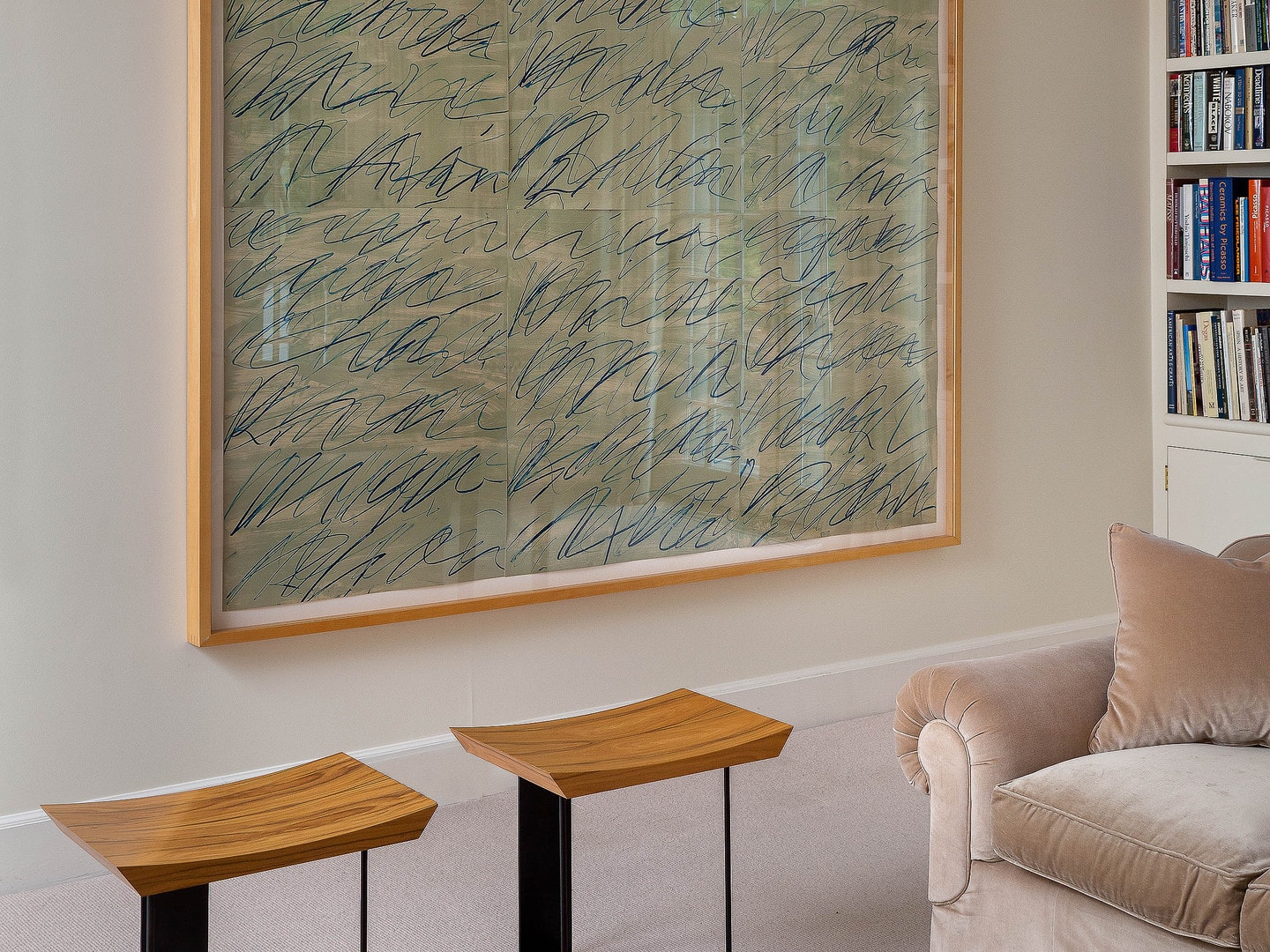
An Ethiopian carved chair, circa 1900, pecan-toned herringbone floorboards, and the gestural marks of a Cy Twombley work on paper forge a sophisticated interplay of linear patterns in this vignette.

Just inside the library, a circa 1820 Biedermeier Bar Cabinet is stocked with spirits, where guests are encouraged to help themselves to a cocktail. Hanging above are works on paper by Wilfred Zogbaum (left) and Tomas Eldred (right). The Klismos Chair, one of a pair, is attributed to T.H. Robsjohn-Gibbings.

Subtle adjacencies draw your eyes around a space. These proximities can transform individual pieces into an alchemical relationship where each element enhances its neighbors. Such is the case with Rispal’s ‘Giraffe’ floor lamp from the 1950s and the architectural turret visible just beyond the window. The side table is by Warren Platner for Knoll.

With a flat-screen TV hanging on the adjacent wall, this armless corner sofa affords ample seating for movie viewing, especially on chilly winter evenings with a crackling fire. Chunky seagrass matting underfoot grounds the tableau.

A pleasing geometric tension emerges between a linear-patterned carpet and mosaic-inspired wall covering. A tuxedo arm sofa provides primary seating in this intimate retreat. Artist David Shapiro created the suite of works on paper.

The furnishings in this corner of the living room include an English Arts & Crafts table, a pair of 1940s French Bergeres covered in lush velvet, and a vintage industrial-inspired lamp. It’s the perfect spot for an intimate dinner for two or as a sun-splashed work desk. The art includes a piece by David Dupuis (left) and an anonymous tantric work from India (right).

One corner of the Library is animated by Architect Frank Gehry’s iconic ‘Wiggle Chair,’ fashioned from corrugated cardboard. The graphic, curvaceous silhouette breaks free of the room’s geometric order. The custom-designed bookcases accommodate part of the couple’s book collection.

The furnishings in this corner of the living room include an English Arts & Crafts table, a pair of 1940s French Bergeres covered in lush velvet, and a vintage industrial-inspired lamp. It’s the perfect spot for an intimate dinner for two or as a sun-splashed work desk. The art includes a piece by David Dupuis (left) and an anonymous tantric work from India (right).

In the gentleman’s study, bespoke cabinetry finished in a soft earth tone provides a backdrop for a lifetime’s collection of books and cherished artifacts. Bold picture lights cast light across the curated assemblages, lending depth and intimacy.

In this view of the living room, an unusual 19th-century Thebes chair fashioned from slender bamboo branches sits in front of a pair of cocktail tables by T.H. Robsjohn-Gibbings. Directly above the fireplace is Untitled (Dollar Bill) 2000 by Thomas Friedman; to its left is a portrait by the late Donald Baechler, which was Glenn’s first art purchase after arriving in New York.

The silhouette of a vintage ceramic Kelby lamp with hand-applied modernist decoration sits on a richly grained walnut side table. Linen curtains with a subtle woven texture frame the composition.

A second custom-designed hook rug rests on the upstairs landing, which features the home’s original spindles and handrail. A pair of African masks adds a tribal note.

A suspended pendant hangs in front of the powder room mirror. The linear rhythm of the powder room’s linear wallcovering contrasts with the matte solid marble washstand.

The kitchen retains its farmhouse sensibilities but was updated with modern appliances. Muted-sage green cabinetry and trim are offset by black granite counters and the original floors, which Glenn stained dark walnut throughout. Period-style fixtures and pendant lights hang from the beadboard ceiling to illuminate the space.

Earthtones ranging from sandstone to rich brown punctuate this guest bedroom. A ceramic lamp by Dumais Made–one of a pair in the room–rests atop a vintage nightstand.

The breakfast room has a simple round pedestal table paired with directors’ chairs. The tableau is comfortable and unassuming, inviting guests to enjoy coffee while watching the mist burn off the morning landscape, the birds visit the feeder, and a few chipmunks scamper about. The Russell Wright servicewear is part of an extensive collection that could serve an expansive buffet dinner.

In the guest bedroom, wall-spanning Belgian linen curtains are suspended from custom hardware. A bespoke bench harmonizes with the upholstered bed, while above, a multi-branched chandelier cascades light. Two framed works on paper provide an artistic focal point.

In this view of the living room, an unusual 19th-century Thebes chair fashioned from slender bamboo branches sits in front of a pair of cocktail tables by T.H. Robsjohn-Gibbings. Directly above the fireplace is Untitled (Dollar Bill) 2000 by Thomas Friedman; to its left is a portrait by the late Donald Baechler, which was Glenn’s first art purchase after arriving in New York.

Lyrical, calligraphic works on paper by the late Brice Marden hang above a bespoke upholstered bed in the primary suite; their gestural forms find a counterpoint in David Shapiro’s composition on the opposing wall. A simple yet sophisticated three-tiered paper pendant by Ingo Maurer bathes the space in gentle light.

The furnishings in this corner of the living room include an English Arts & Crafts table, a pair of 1940s French Bergeres covered in lush velvet, and a vintage industrial-inspired lamp. It’s the perfect spot for an intimate dinner for two or as a sun-splashed work desk. The art includes a piece by David Dupuis (left) and an anonymous tantric work from India (right).

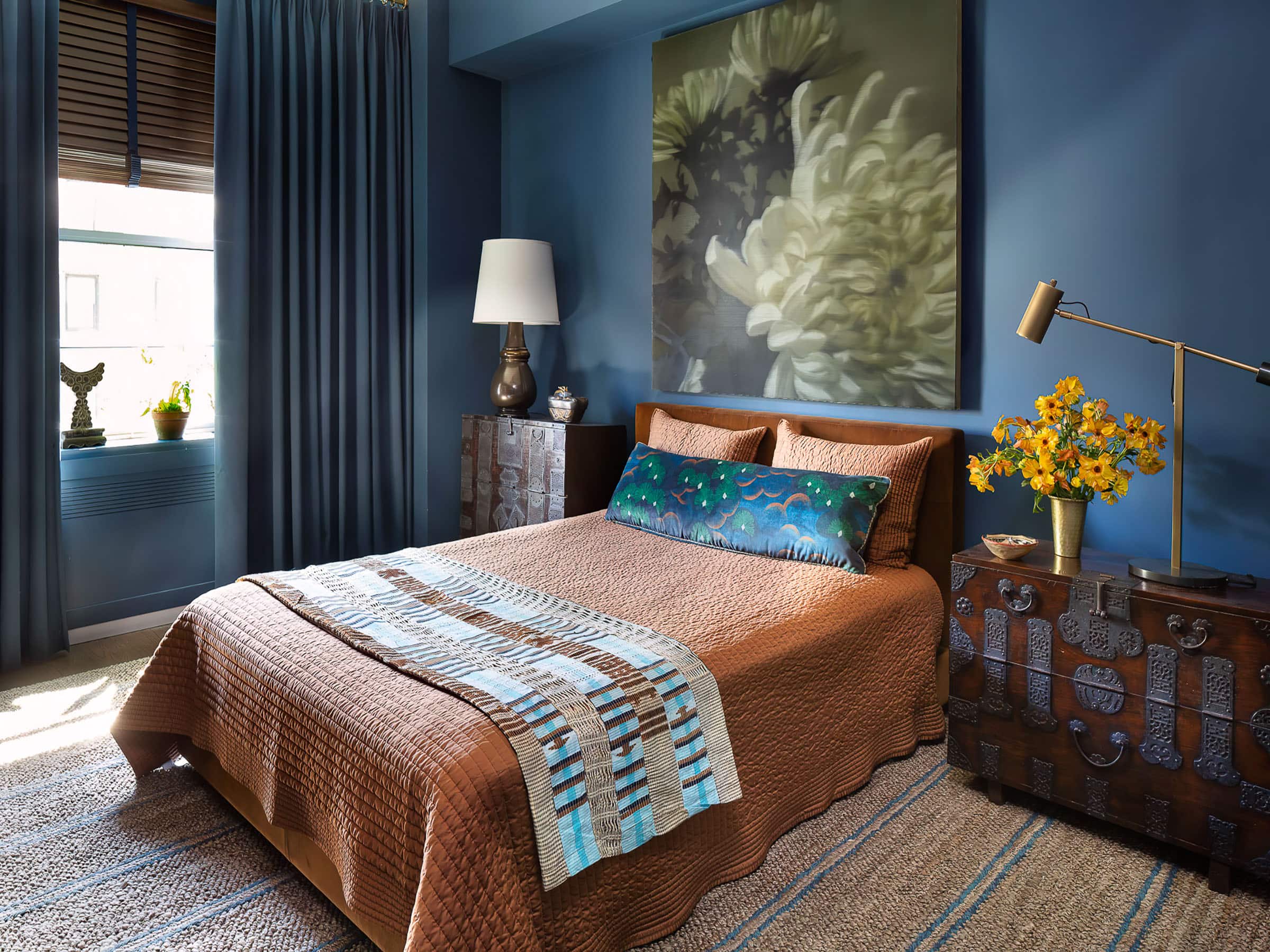
Upon observation, the nuanced textures of the bedding and bespoke curtain fabric emerge, evidencing an interplay between warm and cool neutrals. 

With a flat-screen TV hanging on the adjacent wall, this armless corner sofa affords ample seating for movie viewing, especially on chilly winter evenings with a crackling fire. Chunky seagrass matting underfoot grounds the tableau.

Handcrafted Danny Kaplan Studio table lamps grace twin bespoke walnut nightstands, flanking a custom upholstered bed. The furnishings rest on a quietly graphic area that inspired the room’s color palette.

Senior Designer: Craig Strulovitz
Photos by Alexandra Rowley

Moderne

Built in 1840, the Greek Revival farmhouse would become a haven for some of the 20th century’s most celebrated artists. Designer Glenn Gissler removed the shutters from the home’s windows to achieve an “ecclesiastical purity [for] the Greek temple front” that offers a more contemporary appearance.

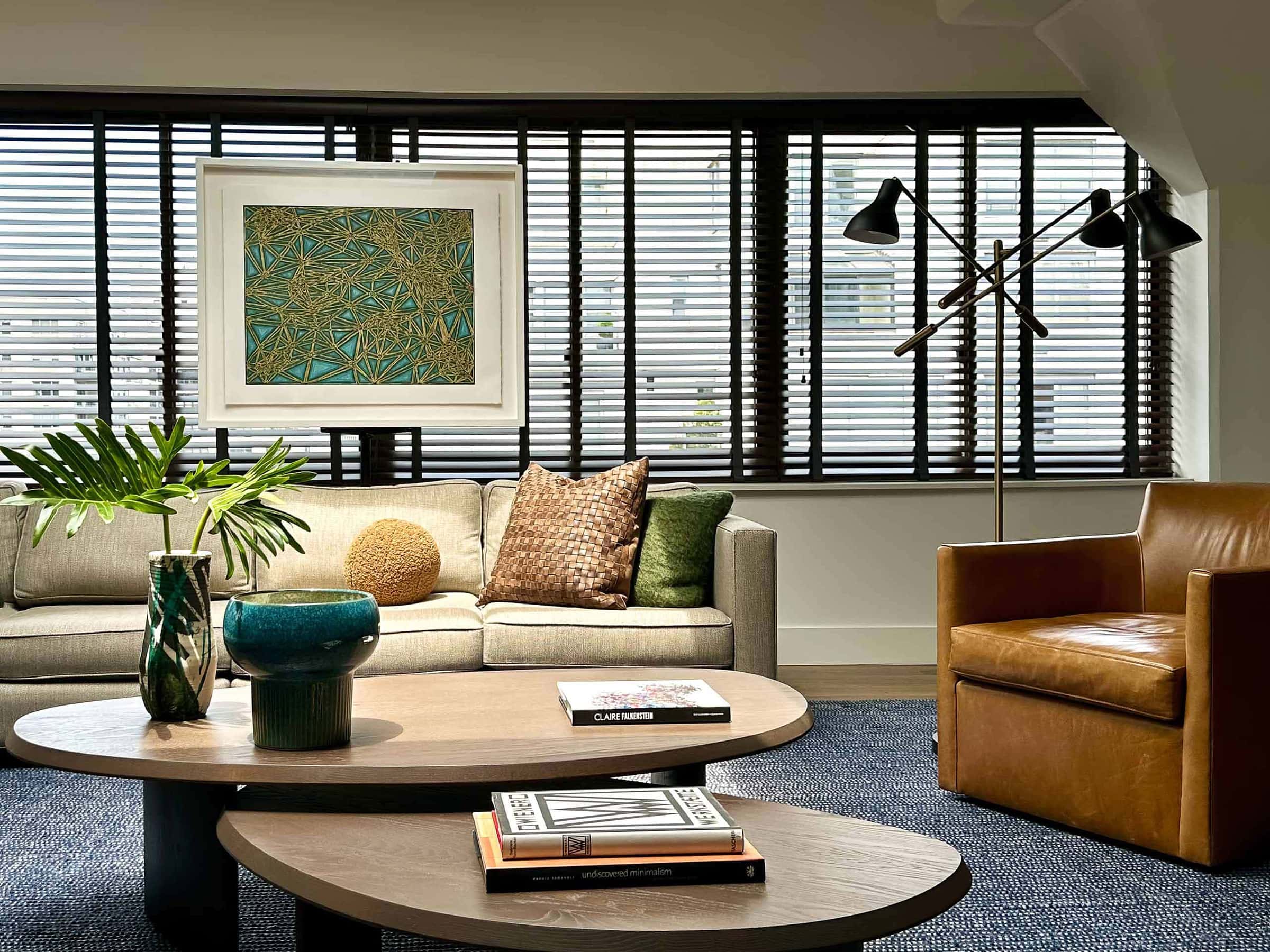
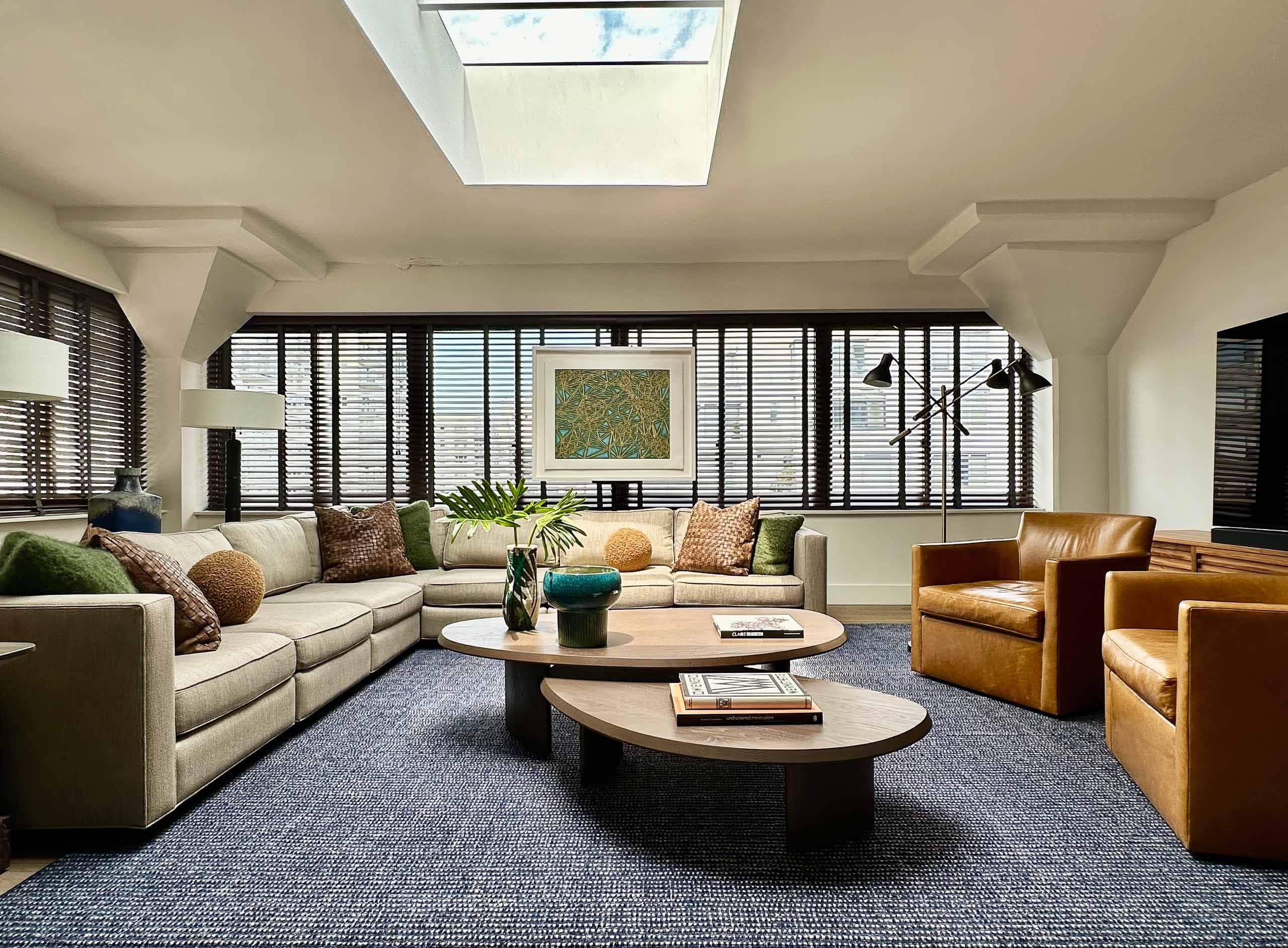
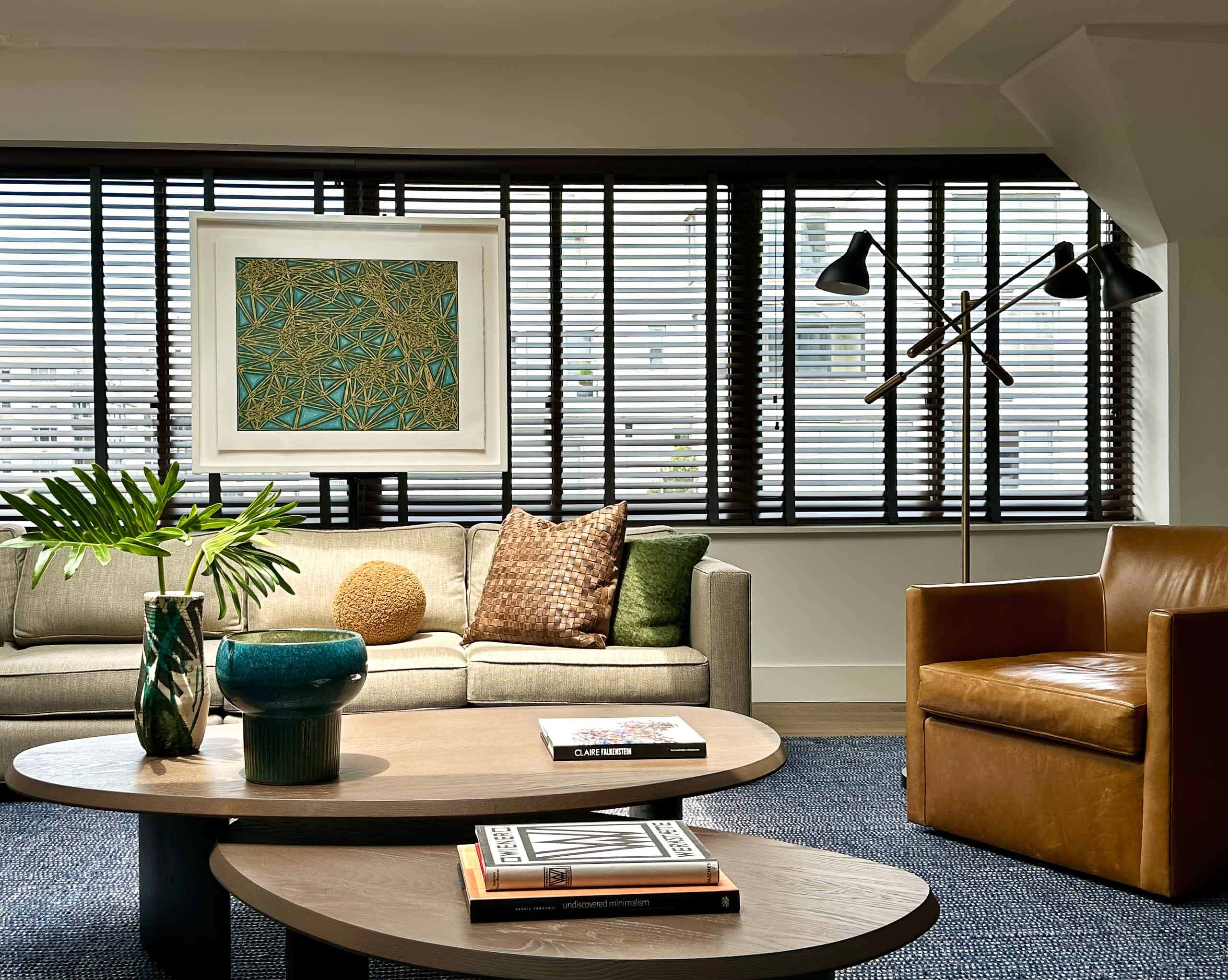
A generous skylight bathes the open-plan living area with natural light. A Restoration Hardware sectional and leather swivel chairs provide an ample seating area, defined by a textured rug from Stark. Maiden House’s Vestry nesting coffee tables are layered in the center of the space. James Siena’s “Shifted Lattice” screenprint is featured on a picture stand behind the sofa.

NYC

Lenox Hill

A young tech professional made the bold decision to move to Manhattan and wanted some help for his fresh start. He decided that this skylit duplex with a large terrace near the Park Avenue Armory was the right choice. The home was built on top of an existing building—it had the right bones for his landing pad, but he was overwhelmed by the prospect of selecting furnishings, and wanted it done ASAP. Wraparound ribbon windows, exposed beams, and structural columns at the corners: the modernist aesthetic would guide us in choosing furniture and furnishings.

The raw loft telegraphed restraint, so we dressed the windows with Venetian blinds to provide a tailored, modernist way to manage light and privacy, while adding the warmth of wood. We then introduced furniture with clean, modern lines and textural materials; the furniture placement was arranged to maintain the open plan while feeling balanced and anchored. 

To expedite the project, numerous items were sourced from established premium retailers, including Restoration Hardware, Design Within Reach, and Maiden House, with custom pieces interspersed throughout.

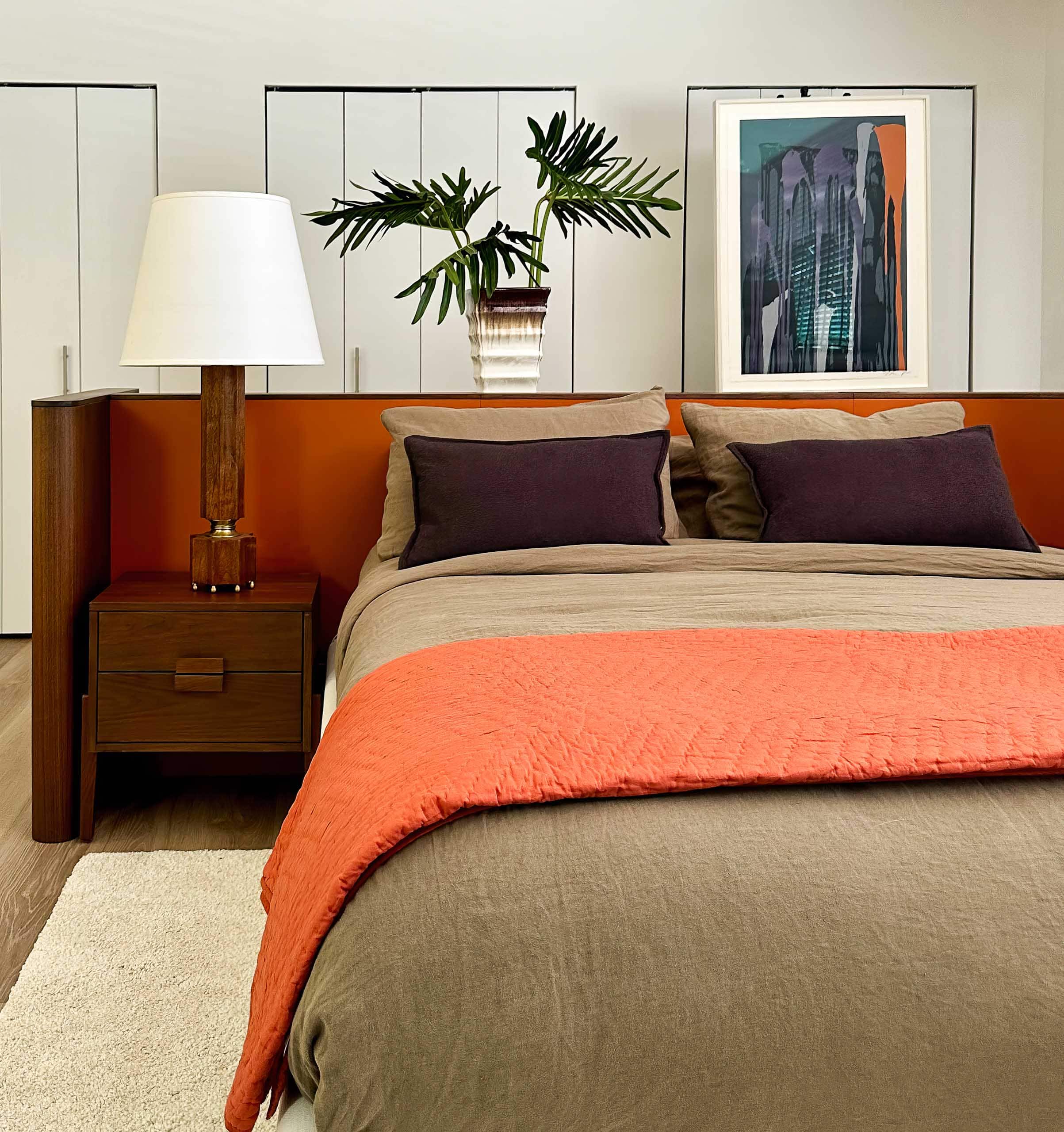
The bedroom presented a unique organizational challenge, as closets occupied one entire wall and stairs took up another. Our solution was to build a bespoke headboard that floats in the space, which functions as a desk on the reverse side, allowing the bed to face a large, open terrace.

We are now onto the next project for the same client – a townhouse in Greenpoint, Brooklyn!


The library’s furnishings, woven together like a historical tapestry, tell the story of Glenn’s interest in 19th—and 20th-century design. Pieces include a coffee table by T.H. Robsjohn Gibbins for Widdcomb, a 1940s sloping-arm sofa draped in an antique Suzani, and a Greek temple model found at a yard sale perched atop a marble pedestal. Part of his collection of objects by late 19th-century designer Christopher Dresser is presented on the top shelf of the etageres. The ceiling is covered in Farrow & Ball bumblebee paper.

In this perspective view, robust painted concrete structural corbels bracket the window wall. Table lamps from Circa lighting were placed on a table behind the sofa, while woven leather pillows, evoking Bottega Veneta’s Intrecciato weave, add a layer of tactile richness.

Just inside the library, a circa 1820 Biedermeier Bar Cabinet is stocked with spirits, where guests are encouraged to help themselves to a cocktail. Hanging above are works on paper by Wilfred Zogbaum (left) and Tomas Eldred (right). The Klismos Chair, one of a pair, is attributed to T.H. Robsjohn-Gibbings.

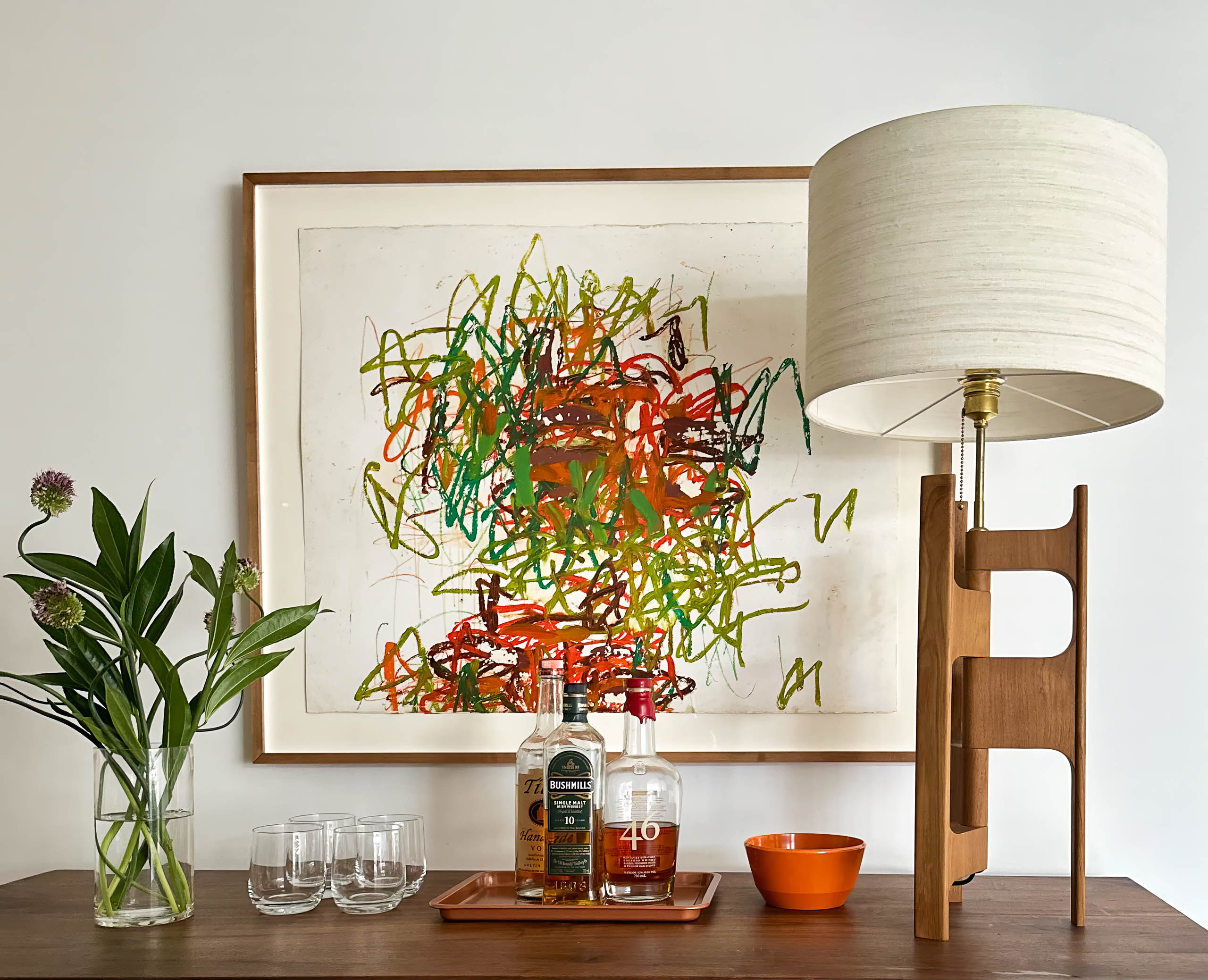
Louisa Chase’s “Tyger Tyger #3” an acrylic and oil pastel from 2002, hangs above the bar. The Phantom Hands lamp beside it uses hand-carved upcycled teak blocks topped with raw silk; each lamp in the series is shaped and polished individually. Whiskey bottles and glassware complete the tableau.

A multi-arm floor lamp reminiscent of 1950s Italian design—all geometric black metal and mechanical joints—plays against the rounded pottery on nesting coffee tables below. Their curvaceous notes are the perfect counterpoint to the room’s linear geometry.

The swimming pool was existing when Glenn purchased the house. He left the coping, but removed the awkward patios to allow it to fit quietly into the backyard landscape as a reflecting pool. The property expands beyond the back gate for some distance before connecting to hundreds of acres of the Roxbury Land Trust’s many preserves.

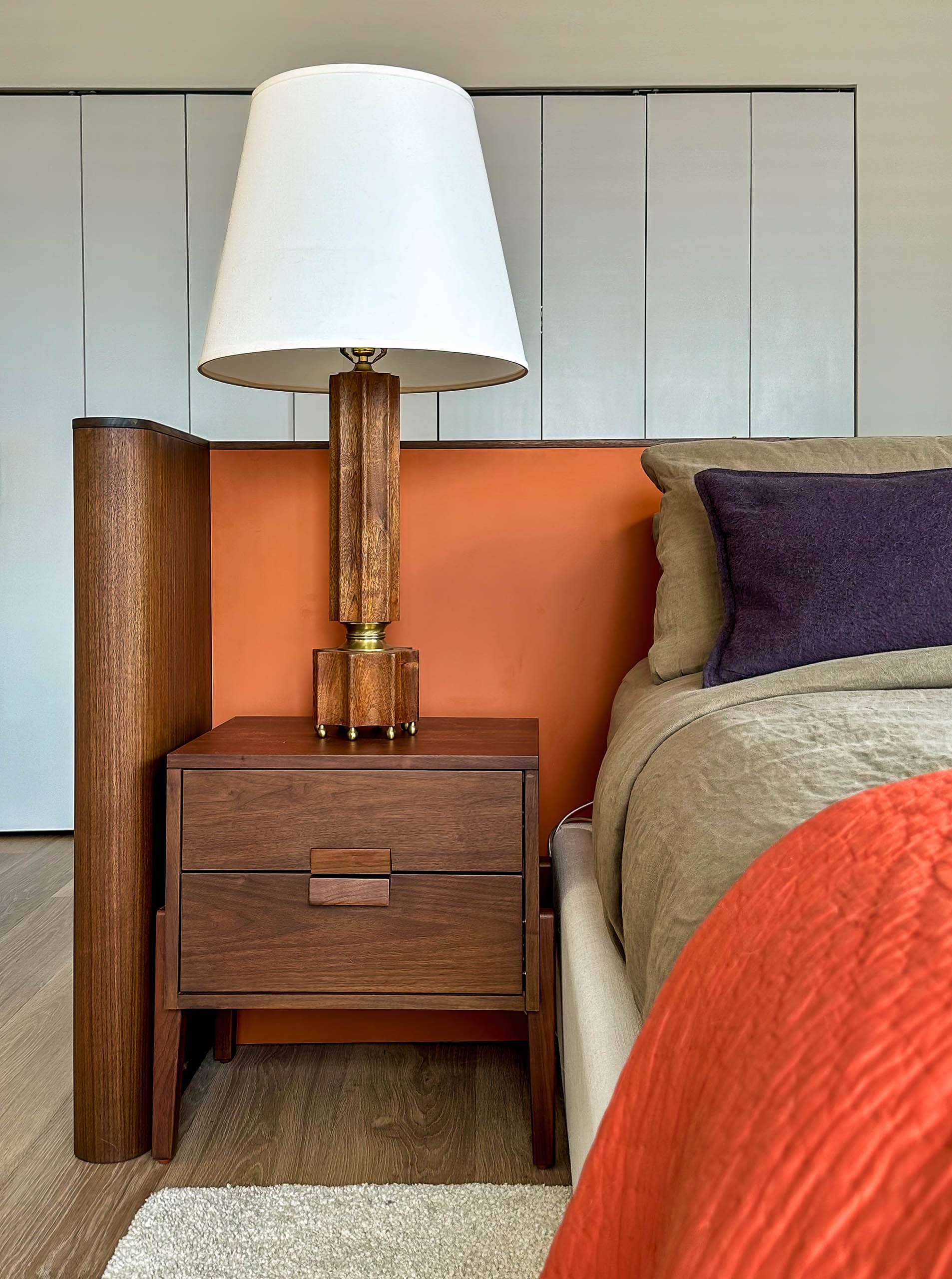
A custom-designed I-beam headboard—articulated in walnut with a laminate back—solves the primary bedroom’s spatial puzzle by hiding a desk on the reverse side. This lets the bed float, facing the terrace instead of a wall. Larry Poons’ “Series 2” screenprint from 1979 sits on an easel positioned on the desk side of the headboard unit.

Beyond the home’s backdoor and through a split rail fence, summer visitors are greeted by an unobtrusive pool and a former art studio dubbed the “Pleasure Pavilion,” where a swim follows rustic lunches. Several weathered Adirondack chairs rest below a mature Sugar Maple tree, providing a respite from the midday sun.

A 1940s machinist lamp, featuring dark wood and brass fittings, sits on a two-drawer bedside table. The orange laminate headboard, reminiscent of the hue favored by modernist master Eero Saarinen, strikes a vibrant note, which is echoed in the bedding.

Senior Designer Craig Strulovitz

Kent, CT

Built in 1840, the Greek Revival farmhouse would become a haven for some of the 20th century’s most celebrated artists. Designer Glenn Gissler removed the shutters from the home’s windows to achieve an “ecclesiastical purity [for] the Greek temple front” that offers a more contemporary appearance.

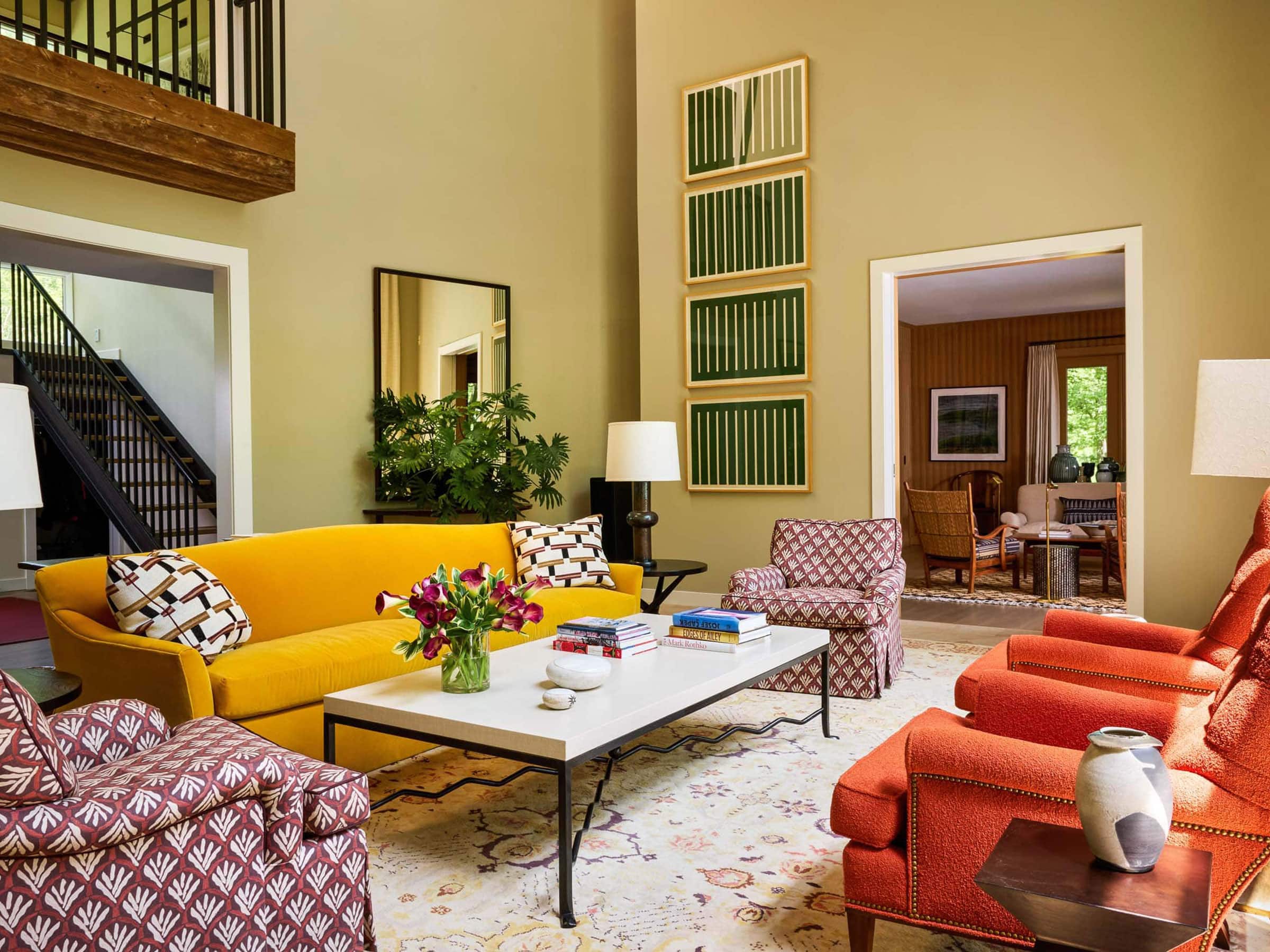
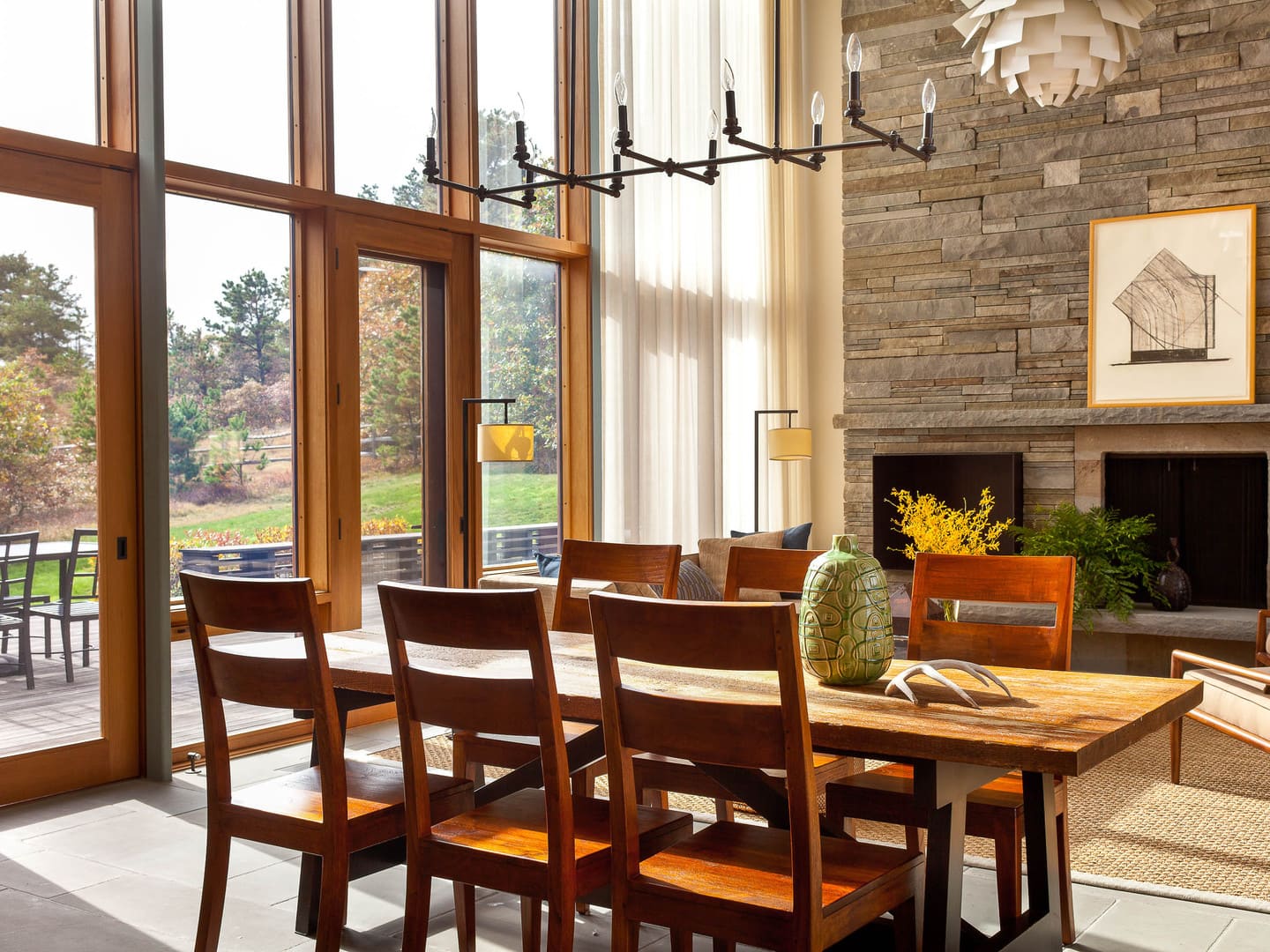
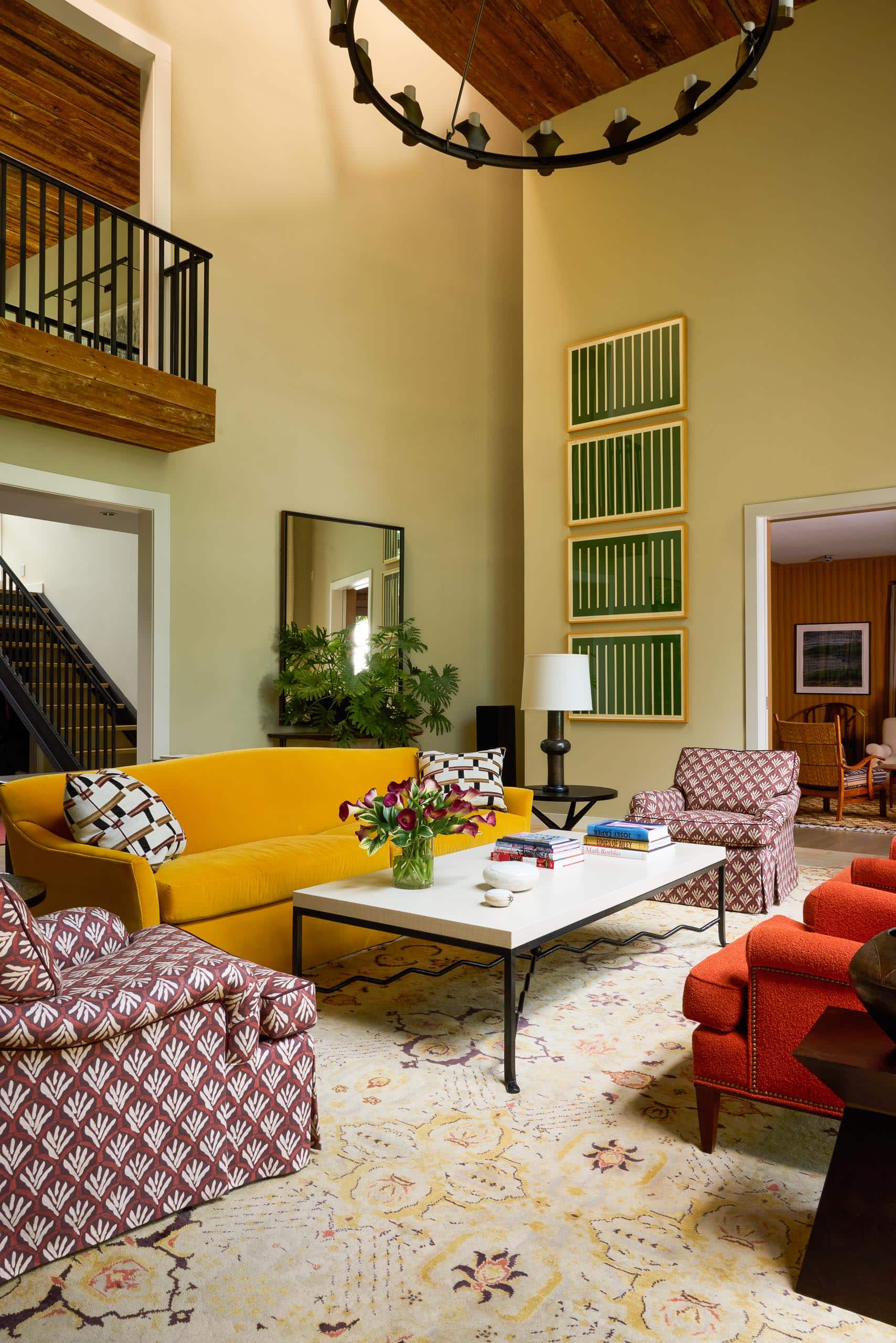
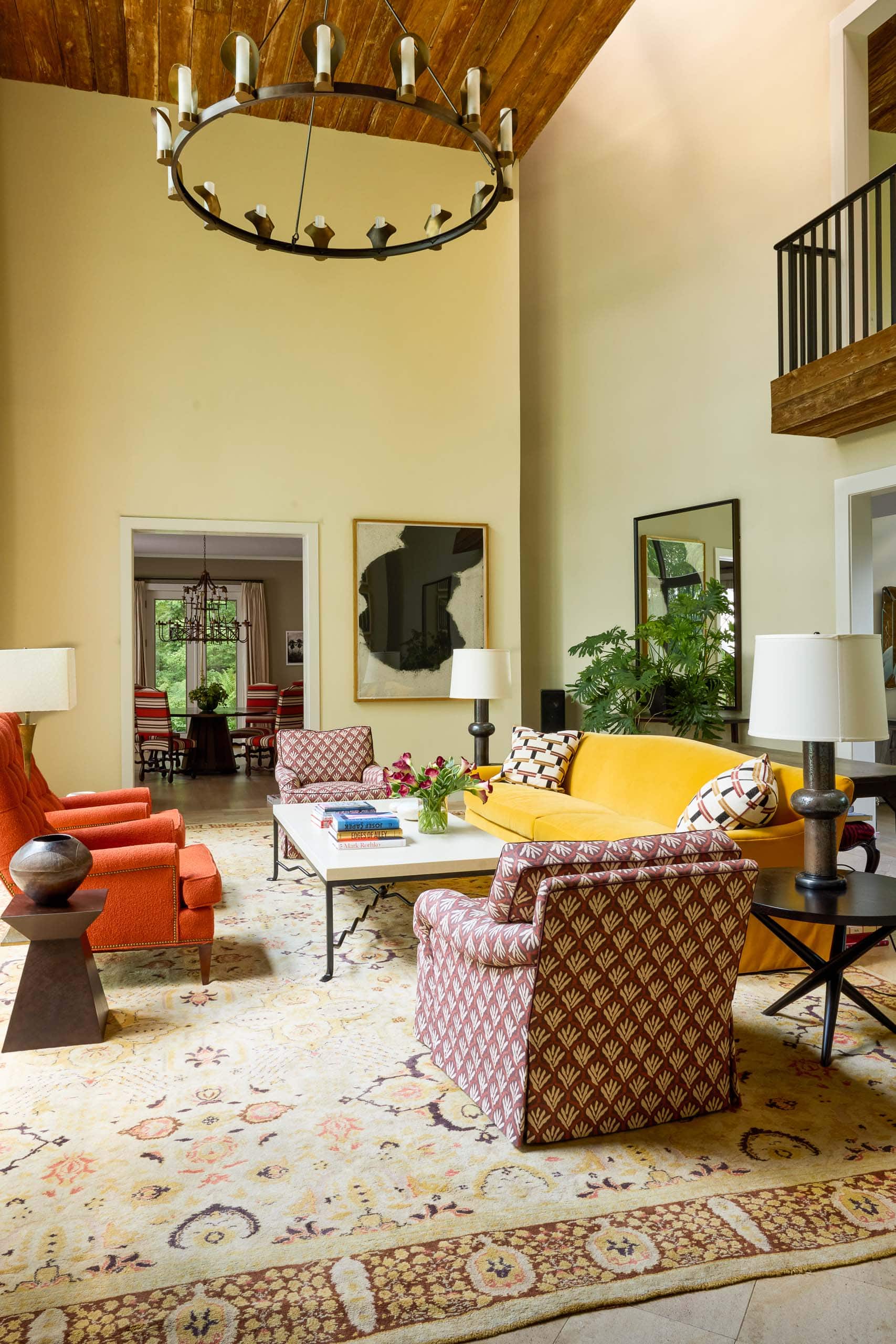
The Great Room rises to twenty feet at its peak—a height that is amplified by the balcony above. The clients’ Portuguese rug, purchased initially from Stark, establishes the boundaries of the seating area, which is atop limestone floors. We whitewashed the wood in the adjacent rooms so that the entire ground plane appears as one seamless surface.

Kent Hollow, Connecticut

Novograd

This 1980s house in Litchfield County was the first commission of a Yale architect, which he built for his parents. Then, twenty years ago, a couple with deep roots in publishing, travel, and the arts made it their own. They’d spent decades filling it with art and antiques, and recently asked Glenn Gissler Design to rethink the public rooms and how to display their collections.

The Great Room’s twenty-foot ceilings command a house organized around classical symmetry. We started by addressing the lighting, which had never been properly considered—adding a six-foot chandelier and a comprehensive scheme that finally gave the space the gravitas it warranted. The adjacent dining room got a bold stripe treatment that reads surprisingly modern. A smaller sitting room became home to golden modernist furniture on a Moroccan area rug.

Throughout the spaces, our intervention was as much archaeological as architectural—excavating treasures from the clients’ storeroom, where decades of sophisticated collecting had accumulated objects waiting for proper display. Each piece was thoughtfully repositioned, elevating their assemblage from storage to statement.

Whitewashed floors replaced the original orange-hued wood, creating visual flow between rooms and allowing the limestone living room floor to feel connected rather than isolated. The clients’ existing vintage Portuguese rug provided the chromatic foundation for the entire palette. The result is a house that functions as both a residence and a gallery, where art, entertaining, and daily life coexist harmoniously.


The swimming pool was existing when Glenn purchased the house. He left the coping, but removed the awkward patios to allow it to fit quietly into the backyard landscape as a reflecting pool. The property expands beyond the back gate for some distance before connecting to hundreds of acres of the Roxbury Land Trust’s many preserves.

A six-foot diameter chandelier bathes the space in a soft glow in the evening. For seating, a sofa from Hickory, upholstered in brilliant yellow velvet, holds center stage, flanked by two Bridgewater chairs covered in a Studio 4 print and a pair of Nancy Corzine orange boucle-clad chairs. Donald Judd prints are stacked on one wall, accentuating the verticality of the space.

Beyond the home’s backdoor and through a split rail fence, summer visitors are greeted by an unobtrusive pool and a former art studio dubbed the “Pleasure Pavilion,” where a swim follows rustic lunches. Several weathered Adirondack chairs rest below a mature Sugar Maple tree, providing a respite from the midday sun.

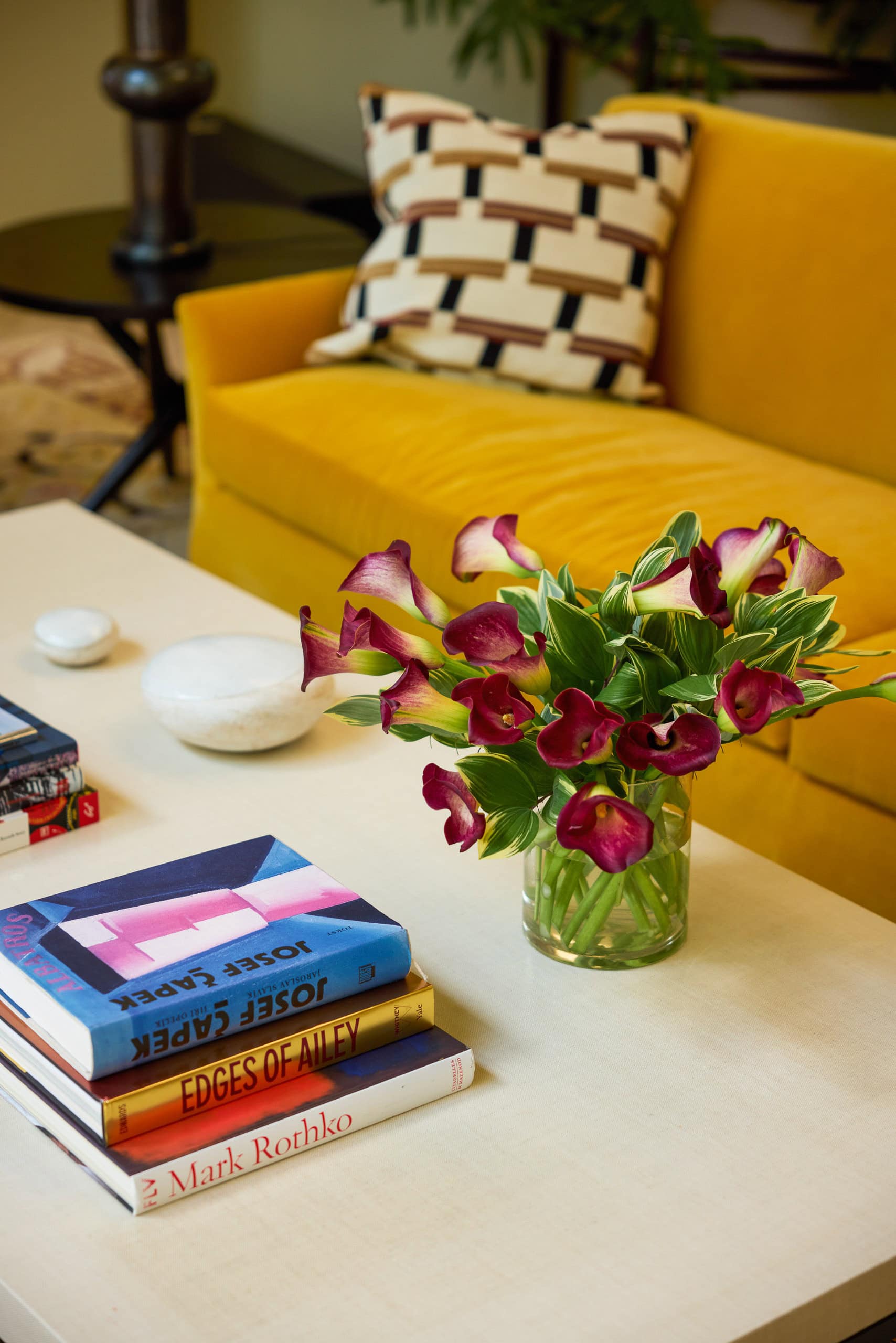
A custom coffee table from Arte-Fax—linen-wrapped and lacquered—gives the clients room to spread out books and objects they’ve collected over the years of travel. The surface is luminous and withstands daily use without issue.

In the entry hall, a pair of circa 1830 hall chairs rest atop a custom ‘falling block’ patterned hook rug, which Glenn designed for the space. Above the chairs, in what amounts to a mid-20th-century artistic dialog, are works by Alexander Calder (left) and Le Corbusier (right). The Calder is the first work inside the house, which Glenn chose because Calder’s homestead and studio–still maintained by the late artist’s family–are less than two miles away.

The clients’ Portuguese rug—featuring intermittent florals and paisleys rendered on a cream ground established the room’s palette from the start. In addition to the chandelier, table lamps on T.H. Robsjohn-Gibbings’ side tables add light at conversation height.

The side garden features a 19th-century urn in an established bed of pachysandra that came with the house. This is consistent with Glenn’s playful interpretation of classical tradition, which is part of the house’s Greek Revival roots.

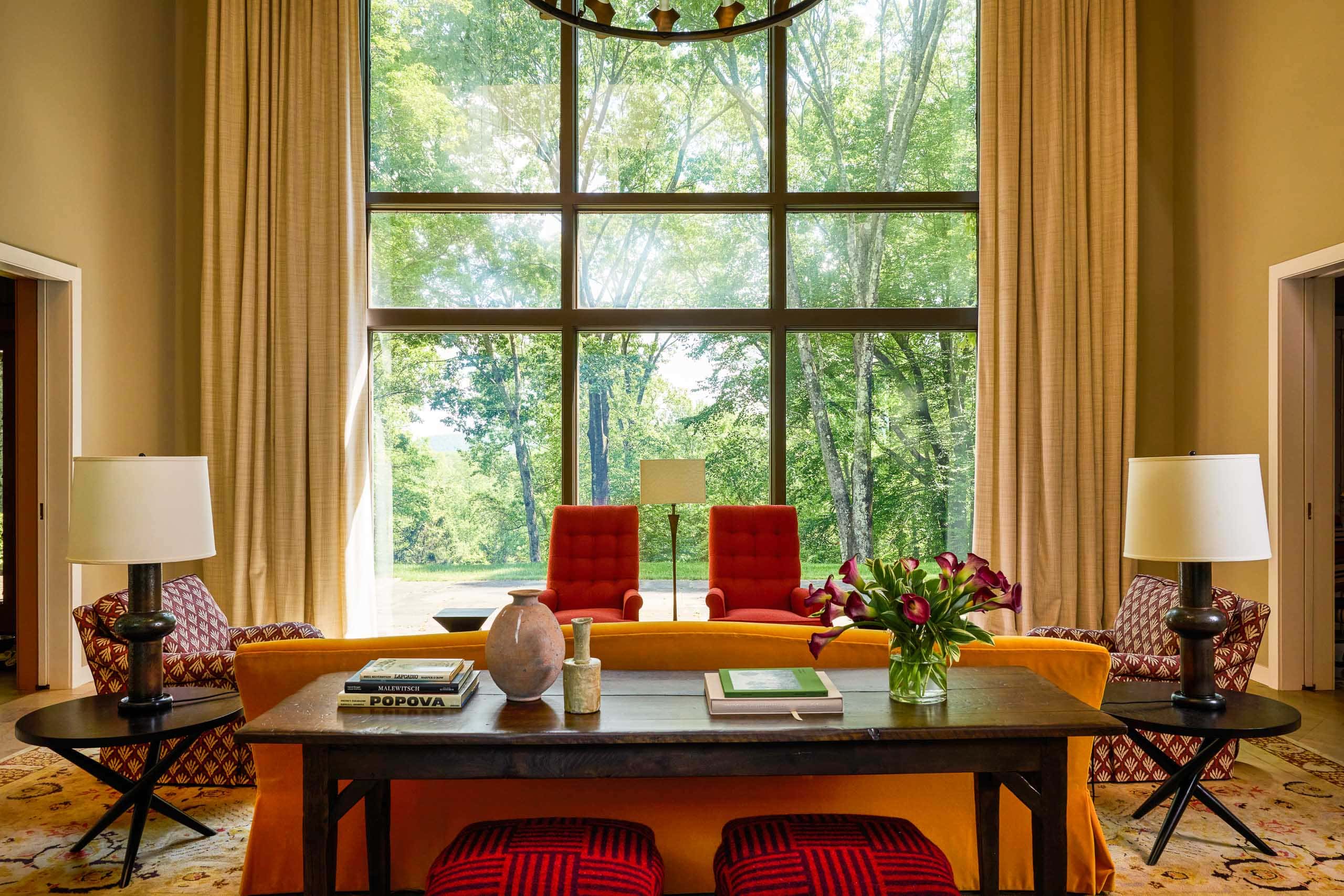
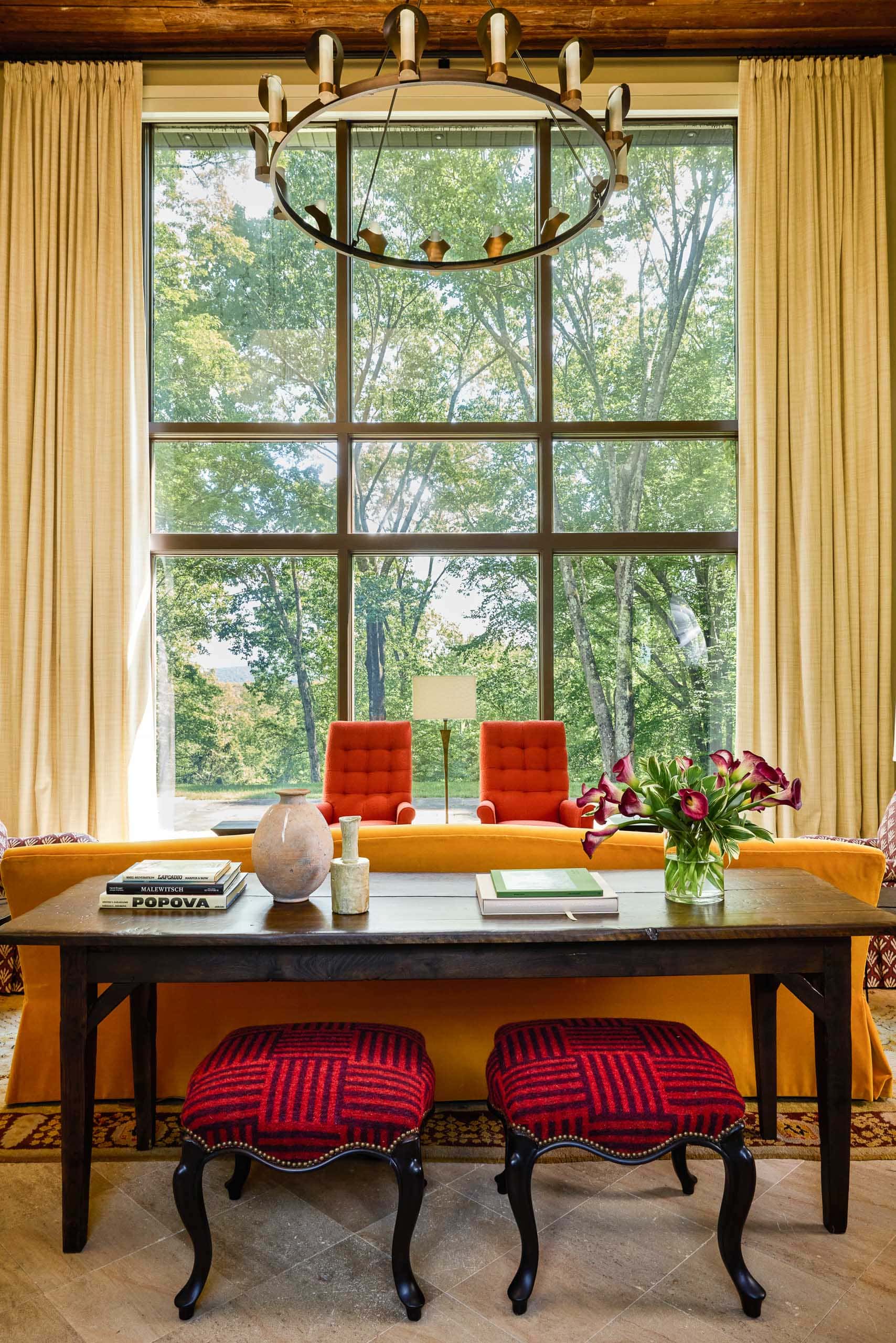
Floor-to-ceiling curtain panels frame the window wall, providing acoustical softening disguised as decoration. In the foreground, a pair of upholstered stools in geometric red sit below the sofa console table. The view out to the property was always there, but now the room feels worthy of its natural grandeur.

Subtle geometries abound in this view—the window’s mullion grid set against the limestone floor’s diamond pattern. The trees disrupt that order with their irregular sprawl. A pair of stools underscores the juxtaposition between architectural discipline and the natural world beyond the glass.


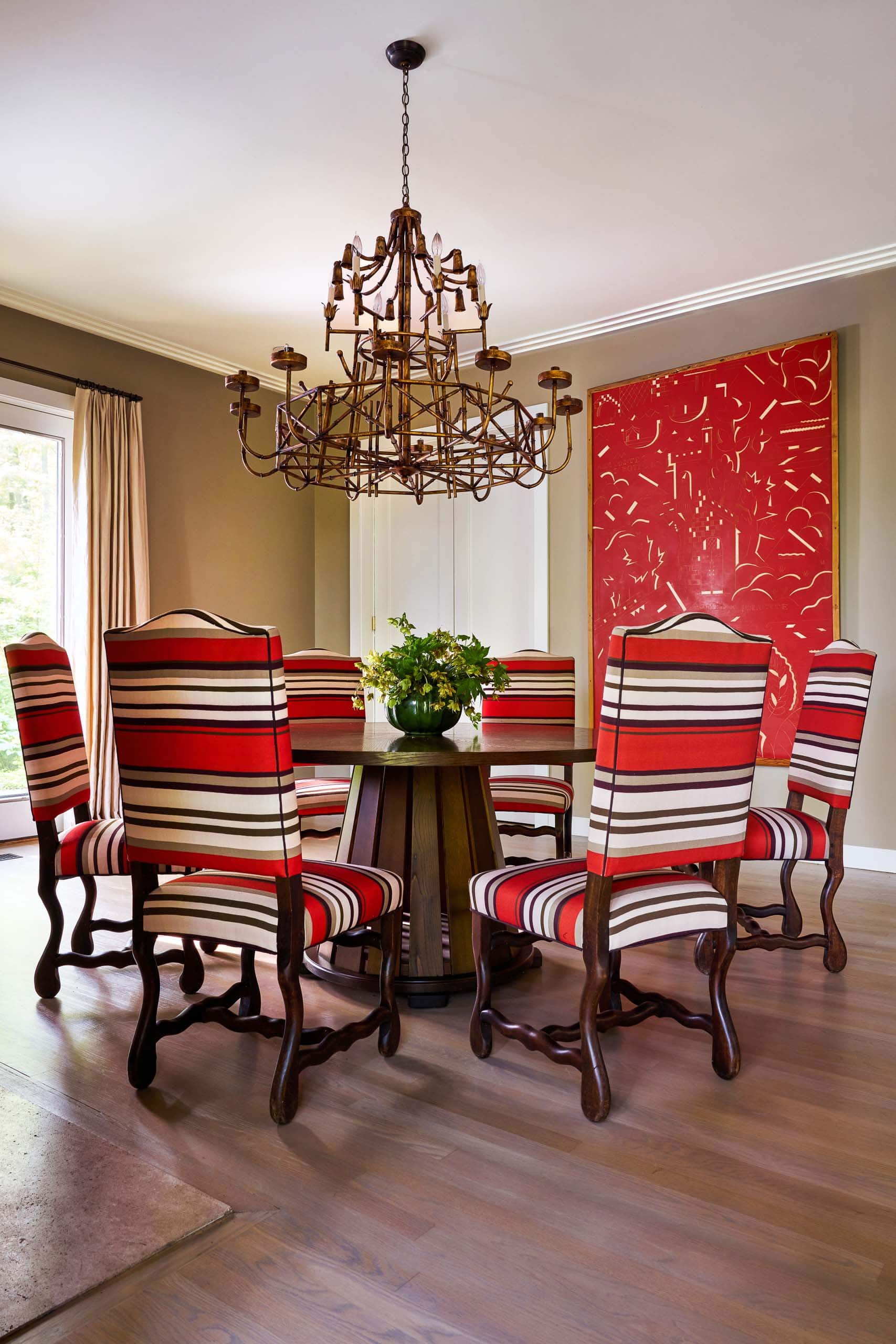
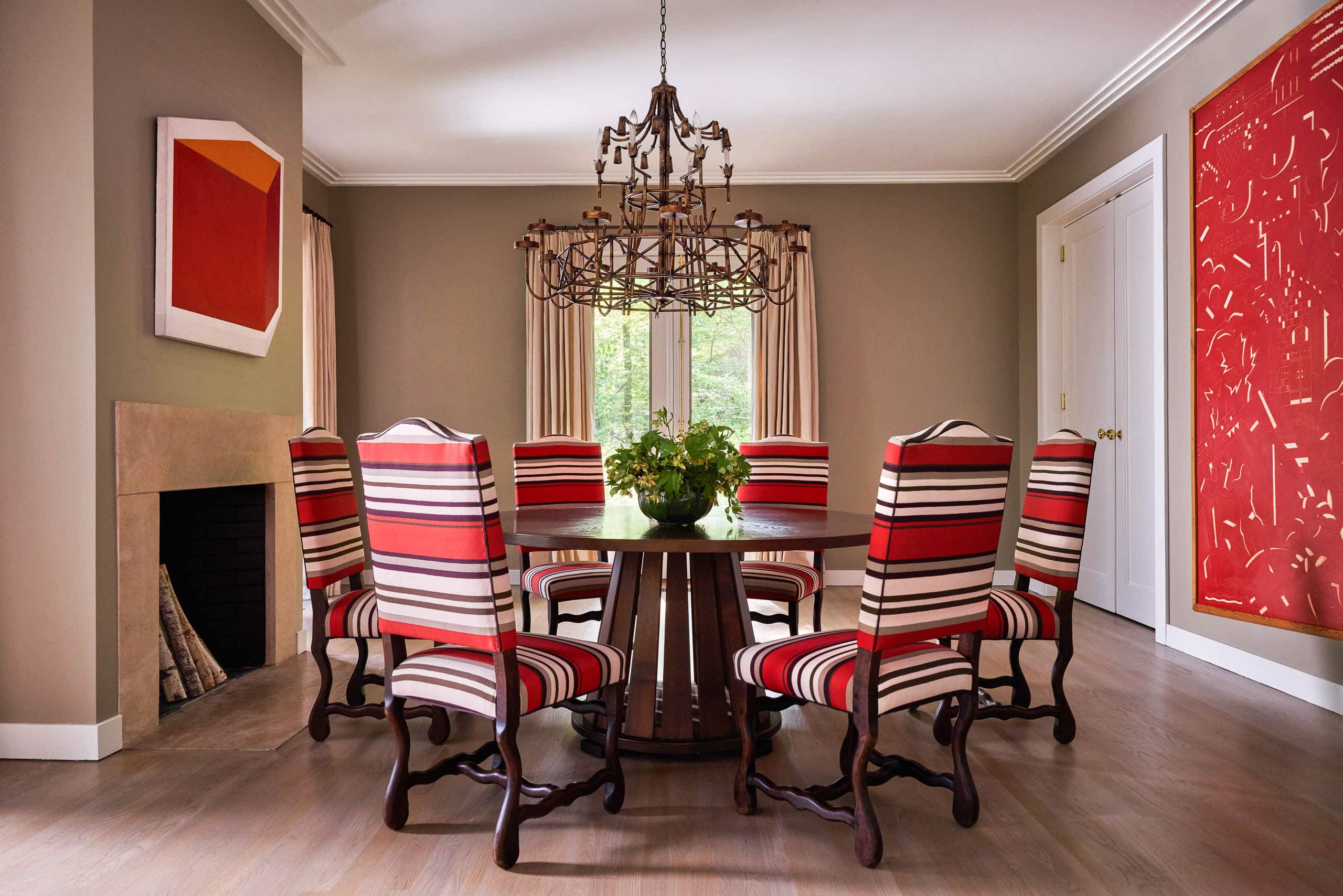
The antique French dining chairs feature bold horizontal stripes rendered in Angela Brown LTD’s Brochier fabric, which is arranged to run across the width rather than down the length, making the pattern appear more modern. Samuel and Sons trim finishes the edges, adding a tailored note. The artwork is a linocut panel depicting a scene from Romeo and Juliet, from the opera house in Marseille.

The clients’ existing round pedestal table anchors the room—its classical proportions and dark wood hold their own against the bold striped chairs and vivid art surrounding it.

The library’s furnishings, woven together like a historical tapestry, tell the story of Glenn’s interest in 19th—and 20th-century design. Pieces include a coffee table by T.H. Robsjohn Gibbins for Widdcomb, a 1940s sloping-arm sofa draped in an antique Suzani, and a Greek temple model found at a yard sale perched atop a marble pedestal. Part of his collection of objects by late 19th-century designer Christopher Dresser is presented on the top shelf of the etageres. The ceiling is covered in Farrow & Ball bumblebee paper.

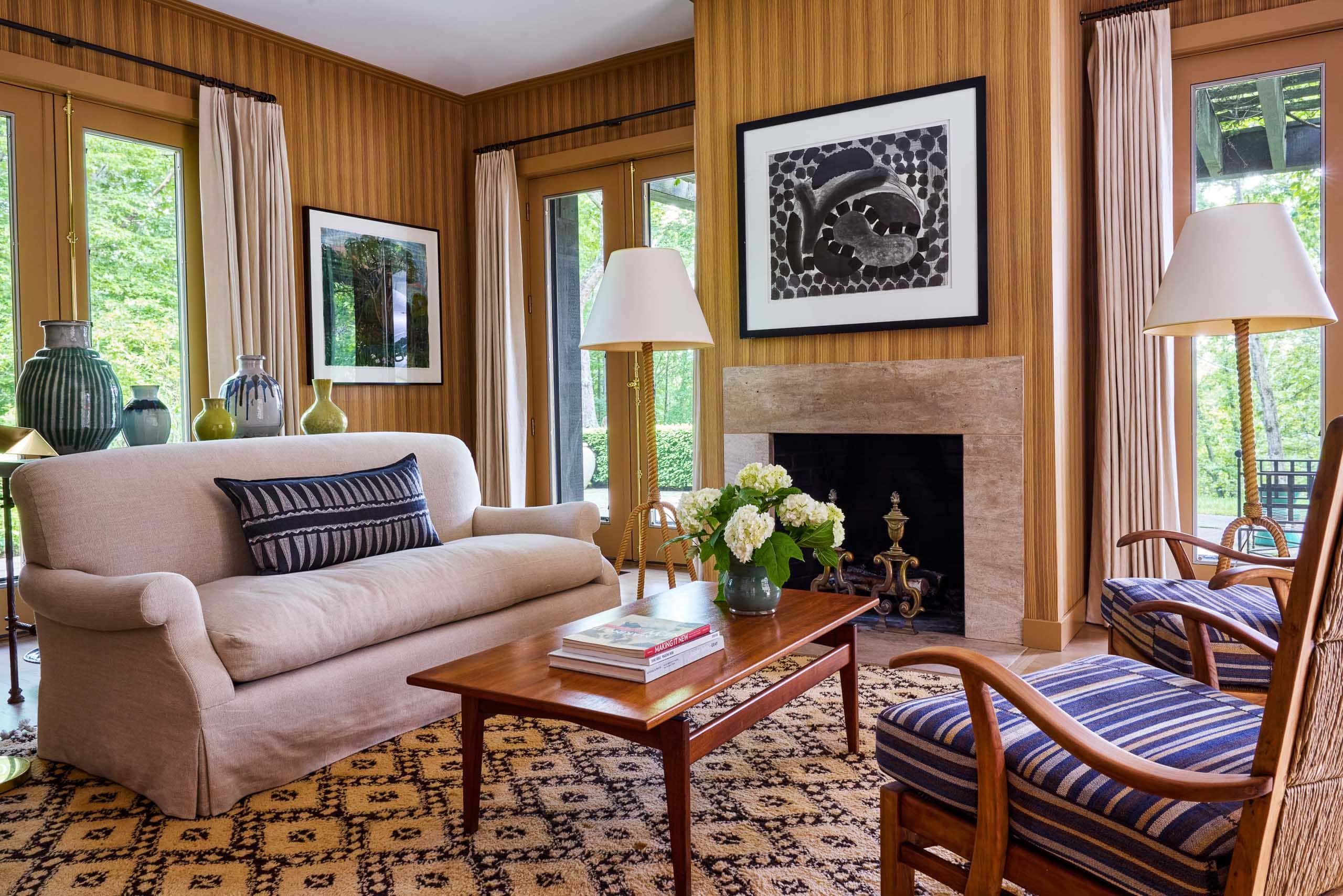
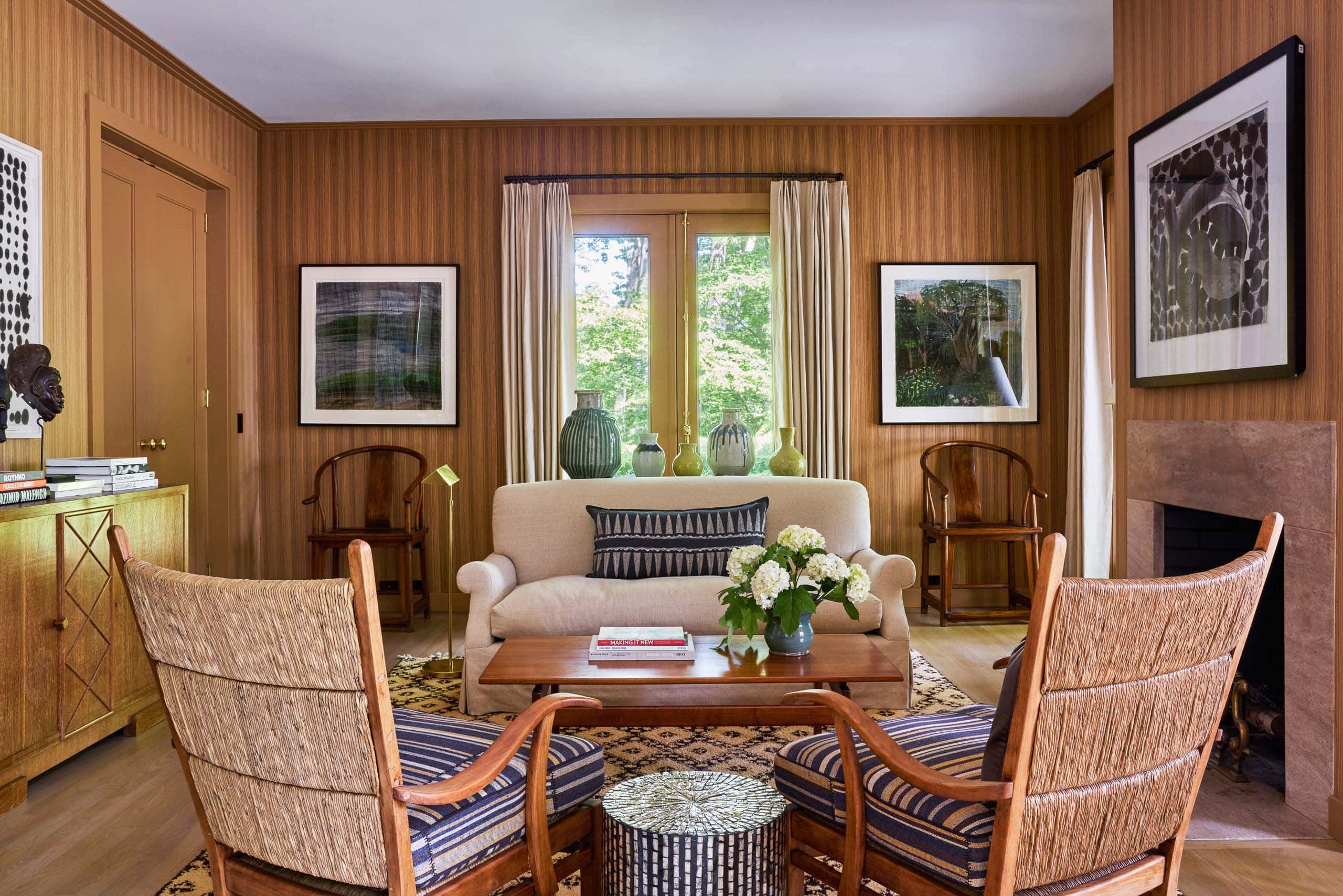
This sitting room is sheathed in caramel-toned vertical stripe wallpaper; we created a cocoon-like feeling by painting all the trim to match. Danish 1940s chairs were reupholstered in Zak + Fox fabric. The homeowners commissioned the rug during a trip to Marrakech. The seating arrangement ensures that everyone has a view of the fireplace on wintery evenings, with a lithograph by the English artist Howard Hodgkin hanging above.

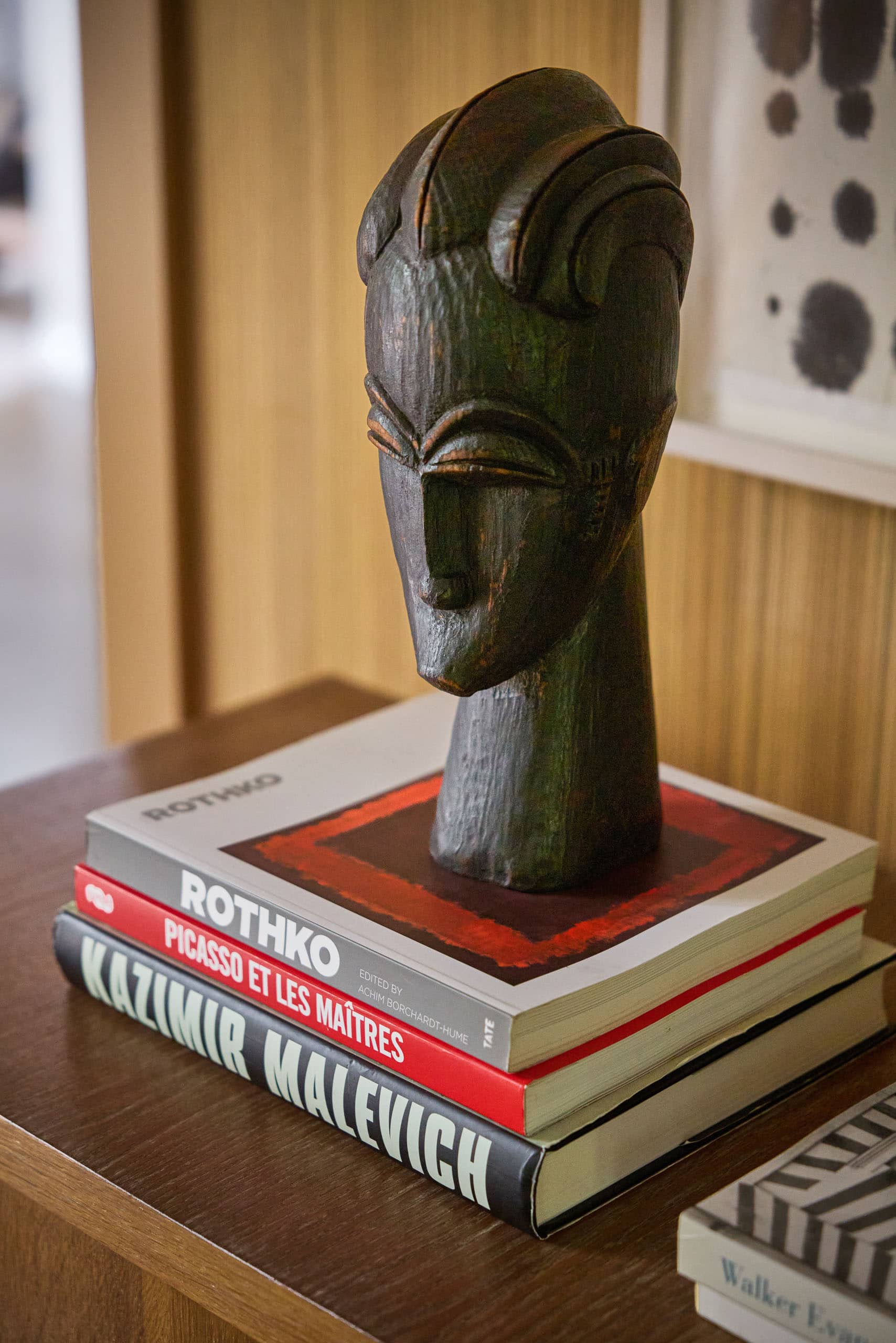
A patinated African carved-wood head sits atop art books on Rothko, Picasso, and Malevich in this vignette, all objects that highlight the homeowner’s interests.

Just inside the library, a circa 1820 Biedermeier Bar Cabinet is stocked with spirits, where guests are encouraged to help themselves to a cocktail. Hanging above are works on paper by Wilfred Zogbaum (left) and Tomas Eldred (right). The Klismos Chair, one of a pair, is attributed to T.H. Robsjohn-Gibbings.

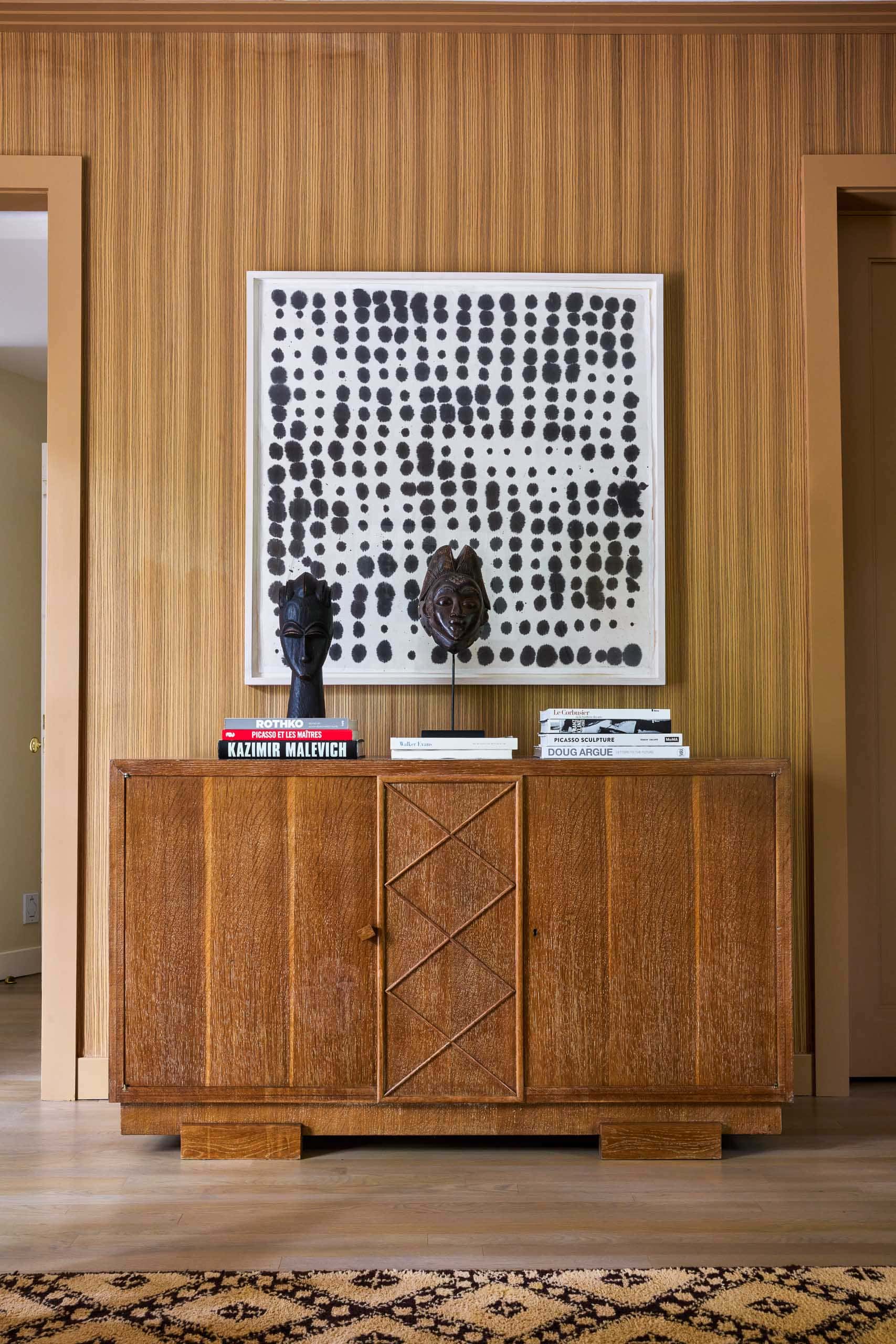
The French 1940s cabinet, sourced from Chairish, features a geometric diamond detail on the center door that marks the period. Atop, the clients’ African sculptures and art books rest in front of a work on paper by a Finnish artist that was purchased on a trip to Helsinki.

The room’s symmetry is established by matching Danish rush-backed chairs from the 1940s, which flank the coffee table—a pair of antique Chinese chairs and paintings by artist Jennifer Bartlett balance on either side of the window.

Senior Designer Craig Strulovitz
Photos by Peter Murdock

Connecticut Farmhouse

Built in 1840, the Greek Revival farmhouse would become a haven for some of the 20th century’s most celebrated artists. Designer Glenn Gissler removed the shutters from the home’s windows to achieve an “ecclesiastical purity [for] the Greek temple front” that offers a more contemporary appearance.

Mature globe boxwoods were moved from the paddock behind the house to soften the transition between the road and the front door. A sea of pachysandra enhances the effect. Many of the stone walls and walkways around the property appear ancient but were lovingly added over the years by Gissler and a supremely talented local stone mason.

LITCHFIELD, CT

Connecticut Farmhouse

Having fantasized about owning a weekend retreat within driving distance of New York City for nearly three decades, Glenn Gissler finally found this historical yet unassuming Greek Revival farmhouse on eight acres in Litchfield County, Connecticut. Reviewing his wishlist for a home, the property appealed for many reasons, not the least of which is that it is surrounded by three hundred acres of the Roxbury Land Trust, which ensured the pristine land adjacent to the property would continue in perpetuity in its magnificent, natural state.

Initially established in 1840 as the Ezekial Beardsley Homestead, the main house was sensitively expanded over the decades, meaning no immediate structural changes were necessary. So Glenn first focused on the sprawling landscape, removing spent trees and opening a bucolic vista beyond a discrete swimming pool. As the seasons progressed, he focused on the pleasant rooms beyond the facade’s pedimented portico.

Like many designers before him decorating their homes, Glenn carefully considered each finish, furnishing, and detail, ultimately creating a house with rooms that reflect his extensive knowledge of the decorative arts and inflected with the burnished colors and classical patterns that define his aesthetic. 

And as an avid entertainer, the home’s four bedrooms provide for a steady stream of eclectic guests, while a well-equipped kitchen and sprawling dining room that seats ten stands at the ready for dinners near the home’s original fireplace. With a sense of joy and abundance, Glenn sees his house as a place to be shared with friends and family where fun, playful, and considerate guests always get invited for return visits.

Beyond the home’s backdoor and through a split rail fence, summer visitors are greeted by an unobtrusive pool and a former art studio dubbed the “Pleasure Pavilion,” where a swim follows rustic lunches. Several weathered Adirondack chairs rest below a mature Sugar Maple tree, providing a respite from the midday sun.

Beyond the home’s backdoor and through a split rail fence, summer visitors are greeted by an unobtrusive pool and a former art studio dubbed the “Pleasure Pavilion,” where a swim follows rustic lunches. Several weathered Adirondack chairs rest below a mature Sugar Maple tree, providing a respite from the midday sun.

The swimming pool was existing when Glenn purchased the house. He left the coping, but removed the awkward patios to allow it to fit quietly into the backyard landscape as a reflecting pool. The property expands beyond the back gate for some distance before connecting to hundreds of acres of the Roxbury Land Trust’s many preserves.

The swimming pool was existing when Glenn purchased the house. He left the coping, but removed the awkward patios to allow it to fit quietly into the backyard landscape as a reflecting pool. The property expands beyond the back gate for some distance before connecting to hundreds of acres of the Roxbury Land Trust’s many preserves.

The side garden features a 19th-century urn in an established bed of pachysandra that came with the house. This is consistent with Glenn’s playful interpretation of classical tradition, which is part of the house’s Greek Revival roots.

The side garden features a 19th-century urn in an established bed of pachysandra that came with the house. This is consistent with Glenn’s playful interpretation of classical tradition, which is part of the house’s Greek Revival roots. 

The breakfast room has a simple round pedestal table paired with directors’ chairs. The tableau is comfortable and unassuming, inviting guests to enjoy coffee while watching the mist burn off the morning landscape, the birds visit the feeder, and a few chipmunks scamper about. The Russell Wright servicewear is part of an extensive collection that could serve an expansive buffet dinner.

The breakfast room has a simple round pedestal table paired with directors’ chairs. The tableau is comfortable and unassuming, inviting guests to enjoy coffee while watching the mist burn off the morning landscape, the birds visit the feeder, and a few chipmunks scamper about. The Russell Wright servicewear is part of an extensive collection that could serve an expansive buffet dinner.

The kitchen retains its farmhouse sensibilities but was updated with modern appliances. Muted-sage green cabinetry and trim are offset by black granite counters and the original floors, which Glenn stained dark walnut throughout. Period-style fixtures and pendant lights hang from the beadboard ceiling to illuminate the space.

The kitchen retains its farmhouse sensibilities but was updated with modern appliances. Muted-sage green cabinetry and trim are offset by black granite counters and the original floors, which Glenn stained dark walnut throughout. Period-style fixtures and pendant lights hang from the beadboard ceiling to illuminate the space.

In the entry hall, a pair of circa 1830 hall chairs rest atop a custom ‘falling block’ patterned hook rug, which Glenn designed for the space. Above the chairs, in what amounts to a mid-20th-century artistic dialog, are works by Alexander Calder (left) and Le Corbusier (right). The Calder is the first work inside the house, which Glenn chose because Calder’s homestead and studio–still maintained by the late artist’s family–are less than two miles away.

In the entry hall, a pair of circa 1830 hall chairs rest atop a custom ‘falling block’ patterned hook rug, which Glenn designed for the space. Above the chairs, in what amounts to a mid-20th-century artistic dialog, are works by Alexander Calder (left) and Le Corbusier (right). The Calder is the first work inside the house, which Glenn chose because Calder’s homestead and studio–still maintained by the late artist’s family–are less than two miles away.

The library’s furnishings, woven together like a historical tapestry, tell the story of Glenn’s interest in 19th—and 20th-century design. Pieces include a coffee table by T.H. Robsjohn Gibbins for Widdcomb, a 1940s sloping-arm sofa draped in an antique Suzani, and a Greek temple model found at a yard sale perched atop a marble pedestal. Part of his collection of objects by late 19th-century designer Christopher Dresser is presented on the top shelf of the etageres. The ceiling is covered in Farrow & Ball bumblebee paper.

The library’s furnishings, woven together like a historical tapestry, tell the story of Glenn’s interest in 19th—and 20th-century design. Pieces include a coffee table by T.H. Robsjohn Gibbins for Widdcomb, a 1940s sloping-arm sofa draped in an antique Suzani, and a Greek temple model found at a yard sale perched atop a marble pedestal. Part of his collection of objects by late 19th-century designer Christopher Dresser is presented on the top shelf of the etageres. The ceiling is covered in Farrow & Ball bumblebee paper.

Just inside the library, a circa 1820 Biedermeier Bar Cabinet is stocked with spirits, where guests are encouraged to help themselves to a cocktail. Hanging above are works on paper by Wilfred Zogbaum (left) and Tomas Eldred (right). The Klismos Chair, one of a pair, is attributed to T.H. Robsjohn-Gibbings.

Just inside the library, a circa 1820 Biedermeier Bar Cabinet is stocked with spirits, where guests are encouraged to help themselves to a cocktail. Hanging above are works on paper by Wilfred Zogbaum (left) and Tomas Eldred (right). The Klismos Chair, one of a pair, is attributed to T.H. Robsjohn-Gibbings.

A large-scale painting on paper by Melinda Stickney-Gibson takes pride of place at one end of the dining room, which is furnished with a 10-foot antique table and a set of leather-covered Anglo-Colonial X-back chairs that have been in Glenn’s possession for more than thirty years. At left, an 18th-century English server rests beneath a large mirror that amplifies the glow of a chandelier that Glenn designed.

A large-scale painting on paper by Melinda Stickney-Gibson takes pride of place at one end of the dining room, which is furnished with a 10-foot antique table and a set of leather-covered Anglo-Colonial X-back chairs that have been in Glenn’s possession for more than thirty years. At left, an 18th-century English server rests beneath a large mirror that amplifies the glow of a chandelier that Glenn designed.

Vintage Siapo Tapas rendered on barkcloth from Samoa, encircled in a broad gilt frame, add a cross-cultural reference on the opposite side of the dining room. The pattern is meant to depict Oceana’s flora and fauna stylistically. For Glenn, it also recalls Indian tantric paintings for meditation and barn decoration by Amish farmers.

Vintage Siapo Tapas rendered on barkcloth from Samoa, encircled in a broad gilt frame, add a cross-cultural reference on the opposite side of the dining room. The pattern is meant to depict Oceana’s flora and fauna stylistically. For Glenn, it also recalls Indian tantric paintings for meditation and barn decoration by Amish farmers.

In this view of the living room, an unusual 19th-century Thebes chair fashioned from slender bamboo branches sits in front of a pair of cocktail tables by T.H. Robsjohn-Gibbings. Directly above the fireplace is Untitled (Dollar Bill) 2000 by Thomas Friedman; to its left is a portrait by the late Donald Baechler, which was Glenn’s first art purchase after arriving in New York.

In this view of the living room, an unusual 19th-century Thebes chair fashioned from slender bamboo branches sits in front of a pair of cocktail tables by T.H. Robsjohn-Gibbings. Directly above the fireplace is Untitled (Dollar Bill) 2000 by Thomas Friedman; to its left is a portrait by the late Donald Baechler, which was Glenn’s first art purchase after arriving in New York.

With a flat-screen TV hanging on the adjacent wall, this armless corner sofa affords ample seating for movie viewing, especially on chilly winter evenings with a crackling fire. Chunky seagrass matting underfoot grounds the tableau.

With a flat-screen TV hanging on the adjacent wall, this armless corner sofa affords ample seating for movie viewing, especially on chilly winter evenings with a crackling fire. Chunky seagrass matting underfoot grounds the tableau.

The furnishings in this corner of the living room include an English Arts & Crafts table, a pair of 1940s French Bergeres covered in lush velvet, and a vintage industrial-inspired lamp. It’s the perfect spot for an intimate dinner for two or as a sun-splashed work desk. The art includes a piece by David Dupuis (left) and an anonymous tantric work from India (right).

The furnishings in this corner of the living room include an English Arts & Crafts table, a pair of 1940s French Bergeres covered in lush velvet, and a vintage industrial-inspired lamp. It’s the perfect spot for an intimate dinner for two or as a sun-splashed work desk. The art includes a piece by David Dupuis (left) and an anonymous tantric work from India (right).

A second custom-designed hook rug rests on the upstairs landing, which features the home’s original spindles and handrail. A pair of African masks adds a tribal note.

A second custom-designed hook rug rests on the upstairs landing, which features the home’s original spindles and handrail. A pair of African masks adds a tribal note.

Artworks by Roberto Matta hang above an 18th c. William & Mary bureau purchased at auction in this bedroom, which features a minimalistic four-poster bed dressed in vintage textiles. To the right of the window is a work by artist Nancy Spero. Because the room has no closet, Glenn attached shaker knobs at intervals around a high molding so that guests could hang their travel clothes. Two boudoir wing chairs provide seating.

Artworks by Roberto Matta hang above an 18th c. William & Mary bureau purchased at auction in this bedroom, which features a minimalistic four-poster bed dressed in vintage textiles. To the right of the window is a work by artist Nancy Spero. Because the room has no closet, Glenn attached shaker knobs at intervals around a high molding so that guests could hang their travel clothes. Two boudoir wing chairs provide seating.

"The people who come here and know a lot about art history, their eyes bug out."

GG

Maintaining a through line between the house’s past and present was paramount, so Glenn kept the existing mustard-yellow toile wallpaper in the primary bedroom to acknowledge the previous owners. By day, ample sunlight streams through the room’s large casement windows; in the evening, a pair of James Mont’s Open Helix Lamps from the 1950s illuminate the space.

Maintaining a through line between the house’s past and present was paramount, so Glenn kept the existing mustard-yellow toile wallpaper in the primary bedroom to acknowledge the previous owners. By day, ample sunlight streams through the room’s large casement windows; in the evening, a pair of James Mont’s Open Helix Lamps from the 1950s illuminate the space.

An ever-expanding collection of surrealist artworks animates the room, including works by Leon Golub, Alphonse Osorio, Gary Gissler, Pidder Auberger, James Siena, Hans Bellmer, Jacqueline Lamba, and Richard Tuttle. Also in the mix is a work by artist David Hare, a previous house owner. The framed works are installed almost randomly, referencing how the late Peggy Guggenheim displayed art in the Surrealist Gallery at her groundbreaking New York gallery, Art of This Century.

An ever-expanding collection of surrealist artworks animates the room, including works by Leon Golub, Alphonse Osorio, Gary Gissler, Pidder Auberger, James Siena, Hans Bellmer, Jacqueline Lamba, and Richard Tuttle. Also in the mix is a work by artist David Hare, a previous house owner. The framed works are installed almost randomly, referencing how the late Peggy Guggenheim displayed art in the Surrealist Gallery at her groundbreaking New York gallery, Art of This Century.

Photos by Gross & Daley