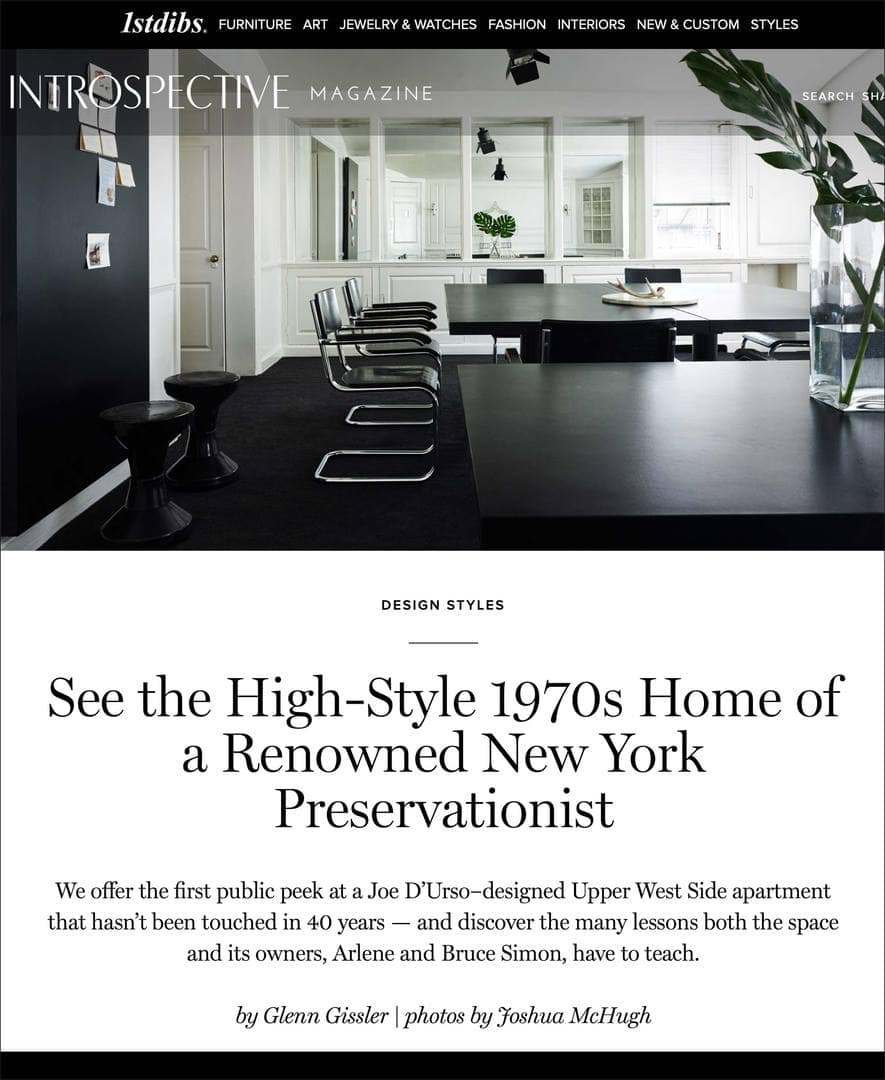
I + D

I + D

JULY / AUGUST 2019

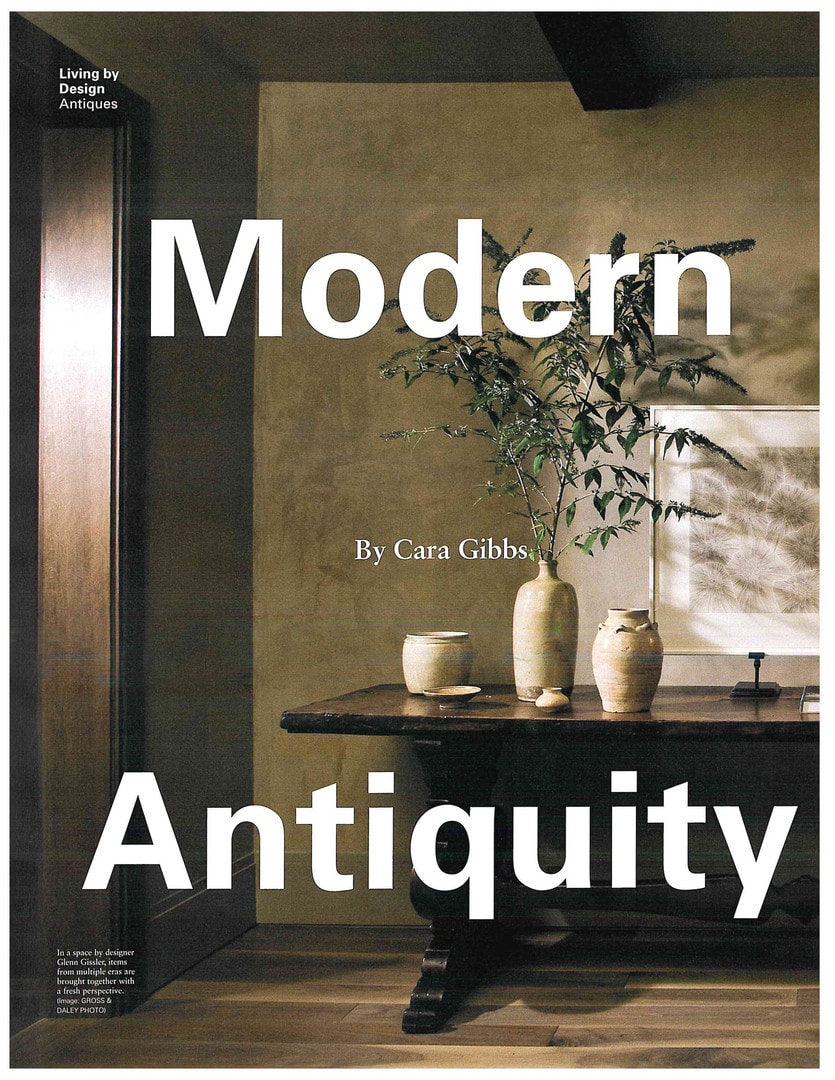
Modern Antiquity

Design pros discuss antiques in modern design-revealing their conscious footprint, lifting the veil on their intricate nuances, and moving past their typecast role as passé objects

by Cara Gibbs

Antiques tend to have a complicated reputation. On the one hand, they’ve been perceived as a status symbol for the ultra-wealthy, surviving relics
of generations past that are ripe with history and saturated by distinguishable style. And, on the other, they’re begrudged hand-me-downs, misfit furnishings that seem to never quite conform to current design standings.

That leads to the question: Can heirloom pieces be considered revolutionary in their design once they’ve passed their prime? Indeed, it’s the very fact that they’ve stood the test of time and become an heirloom that makes them so. To expose these ancient beauties as the modern marvels they are, we turned to our experts in the field to help navigate us through the sometimes confusing, and often misinformed, landscape of antique acquisition.

Date Book

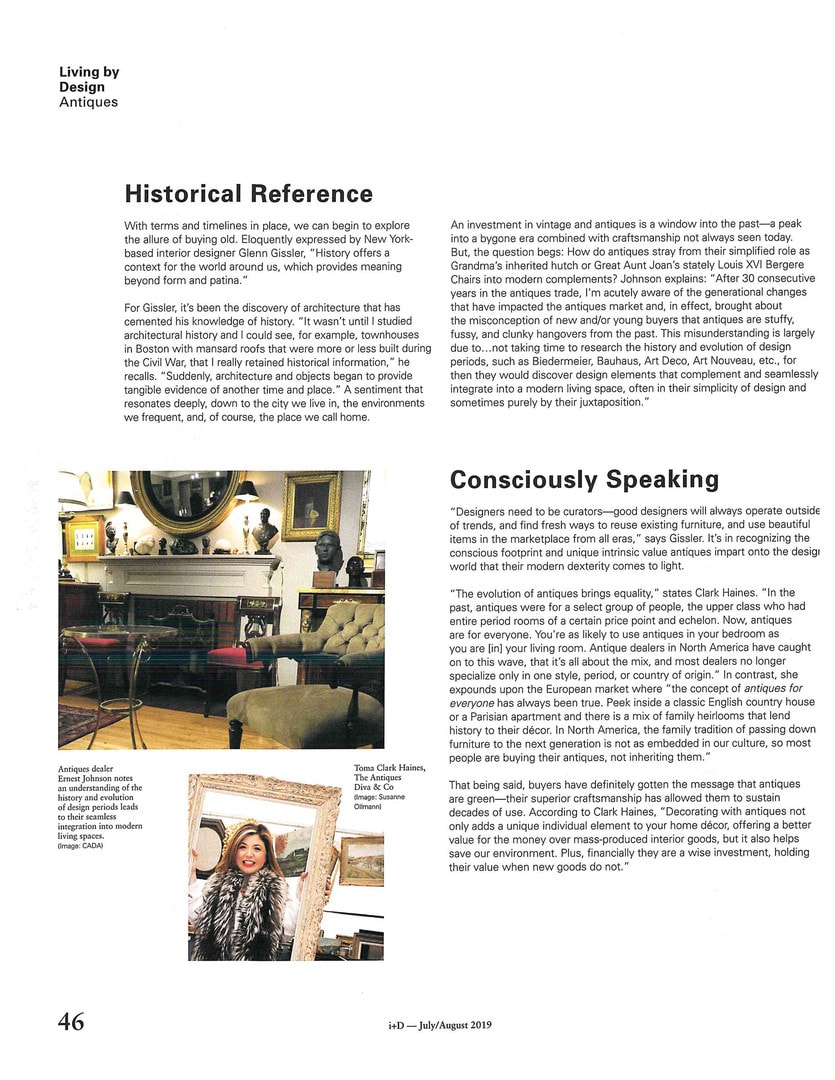
Perhaps the best place to start is by defining the terms. What is an antique? Kicking off the conversation is Ernest Johnson of Ottawa, Ontario, Canada­based Ernest Johnson Antiques, as well as a member and spokesperson for the Canadian Antique Dealers Association (CADA). Johnson explains that “for something to be referred to in the true sense of the word as being ‘antique,’ it would have to have been manufactured over 100 years ago, whereas something regarded as being ‘vintage’ would be roughly 50 years old.”

Johnson continues, “In dating an item, the word ‘circa’ is sometimes used, which is understood to mean the item was made within approximately 10 years of a stated date, e.g., ‘circa 1850’ meaning the item was made between 1840 and 1860.”

Toma Clark Haines. proprietor of the innovative platform The Antiques  Diva & Co, also weighs in, questioning, “What’s in a word? Technically speaking when it comes to antiques and vintage, we [in the industry] use a variety of evolving terms. Because antique items are not taxed, the [former] United States Customs Service [now known as U.S. Customs and Border Protection] set a rule in 1966 that to be classified antique, [an item] must be 100-years-or-older to keep people from claiming things as antiques that actually weren’t. Not all antique dealers abide by the 100-year rule; some will [claim] anything between 80- and 100-years-old.” Clark Haines also notes anything over 20-years-old is often labeled “vintage.”


Historical Reference

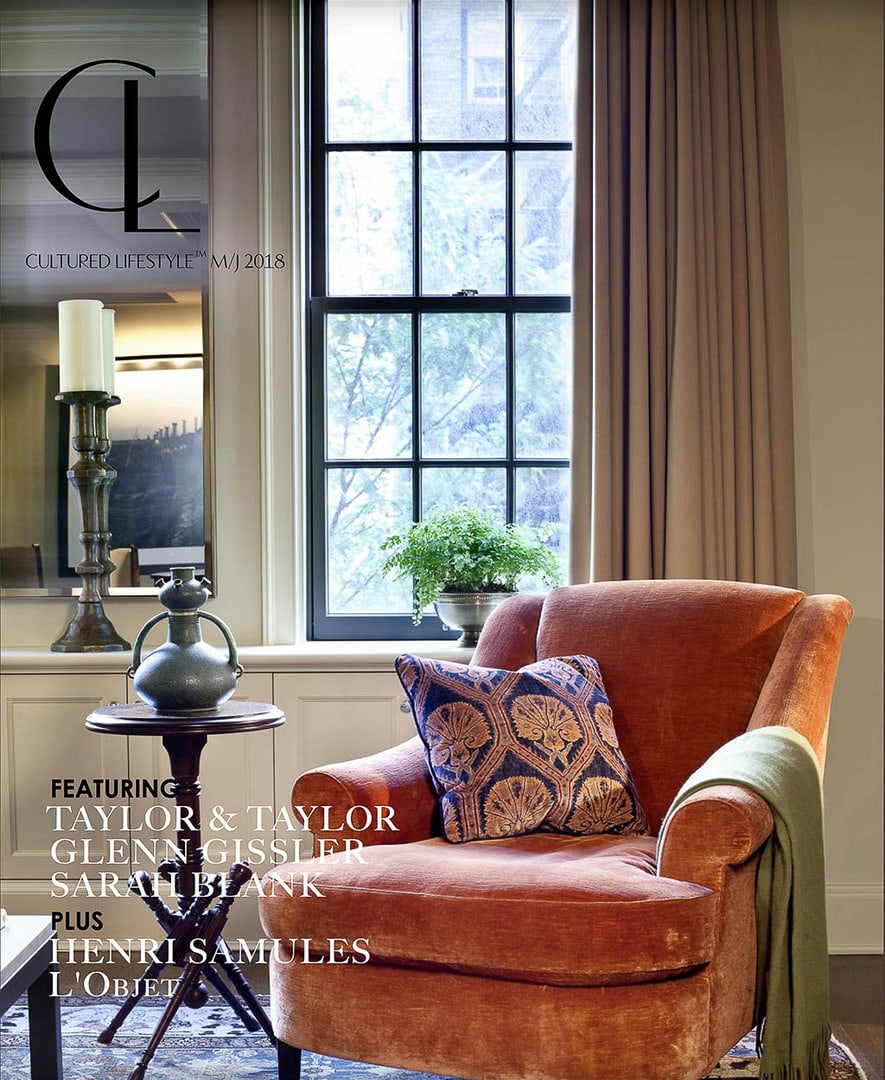
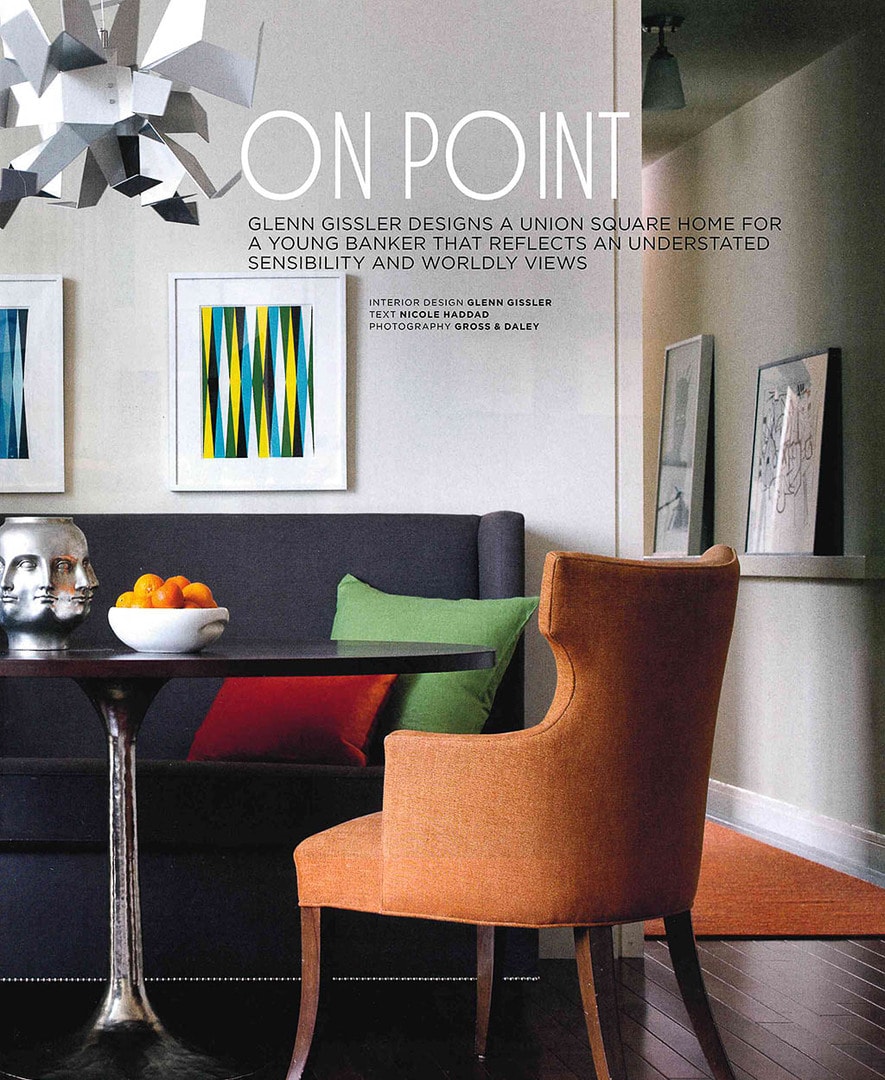
With terms and timelines in place, we can begin to explore the allure of buying old. Eloquently expressed by New York-­based interior designer Glenn Gissler, “History offers a context for the world around us, which provides meaning beyond form and patina.”

For Gissler, it’s been the discovery of architecture that has cemented his knowledge of history. “It wasn’t until I studied architectural history and I could see, for example, townhouses in Boston with mansard roofs that were more or less built during the Civil War, that I really retained historical information,” he recalls. “Suddenly, architecture and objects began to provide tangible evidence of another time and place.” A sentiment that resonates deeply, down to the city we live in, the environments we frequent, and, of course, the place we call home.
An investment in vintage and antiques is a window into the past-a peak into a bygone era combined with craftsmanship not always seen today. But, the question begs: How do antiques stray from their simplified role as Grandma’s inherited hutch or Great Aunt Joan’s stately Louis XVI Bergere Chairs into modern complements? Johnson explains: “After 30 consecutive years in the antiques trade, I’m acutely aware of the generational changes that have impacted the antiques market and, in effect, brought about
the misconception of new and/or young buyers that antiques are stuffy, fussy, and clunky hangovers from the past. This misunderstanding is largely due to … not taking time to research the history and evolution of design periods, such as Biedermeier, Bauhaus, Art Deco, Art Nouveau, etc., for then they would discover design elements that complement and seamlessly integrate into a modern living space, often in their simplicity of design and sometimes purely by their juxtaposition.”


Consciously Speaking

“Designers need to be curators-good designers will always operate outside of trends, and find fresh ways to reuse existing furniture, and use beautiful items in the marketplace from all eras,” says Gissler. It’s in recognizing the conscious footprint and unique intrinsic value antiques impart onto the desigr world that their modern dexterity comes to light.

“The evolution of antiques brings equality,” states Clark Haines. “In the past, antiques were for a select group of people, the upper class who had entire period rooms of a certain price point and echelon. Now, antiques are for everyone. You’re as likely to use antiques in your bedroom as you are [in) your living room. Antique dealers in North America have caught on to this wave, that it’s all about the mix, and most dealers no longer specialize only in one style, period, or country of origin.” In contrast, she expounds upon the European market where “the concept of antiques for everyone has always been true. Peek inside a classic English country house or a Parisian apartment and there is a mix of family heirlooms that lend history to their decor. In North America, the family tradition of passing down furniture to the next generation is not as embedded in our culture, so most people are buying their antiques, not inheriting them.”

That being said, buyers have definitely gotten the message that antiques are green-their superior craftsmanship has allowed them to sustain decades of use. According to Clark Haines, “Decorating with antiques not only adds a unique individual element to your home decor, offering a better value for the money over mass-produced interior goods, but it also helps save our environment. Plus, financially they are a wise investment, holding their value when new goods do not.” 

Gissler continues shedding a light on the acquisition aspect of antique buying. “I have found that antique and/or vintage furniture dealers can be amazing resources for historical knowledge, which can be reflected in incredible inventory. They are relentlessly curious seekers of special items and love to give new life to items that may have been forgotten,” he says. Johnson also illuminates the influence of the design industry on antiques, noting, “The interior design and architect community are important components in the sense they nurture and facilitate their clients’ desire to acquire contemporary and antique elements, as well as create compelling living spaces tailored to today’s lifestyles.”

Truly the first form of reusable design, antiques have long made modern strides, despite appearing contradictory to their very essence. Because of their provenance and typically long stretch of time since conception, antiques are seldom seen as modern, but, conversely, they have proven to hold their own through the ebbs and flows of the interiors world. “I don’t think enough is made note of the ‘green’ element regarding antiques,” states Johnson. “When cultivating interest within young or new collectors and buyers, dealers need to reinforce the fact that purchasing antiques is the original form of recycling and repurposing. For example, the mandate for CADA is stated on our homepage as ‘Preserving, Promoting & Selling Fine Antiques … ,’ with an emphasis on Preserving.”

Gissler notes while the green aspect of buying pre-owned furniture is obvious, it’s not typically the pitch he makes to clients about antiques or vintage items. “Rather,” the designer says, “I compare the cost and value of new showroom items versus what we can find in the pre-owned marketplace and there
is often no comparison. While the hunt may be more challenging, the results are often much better!” Clark Haines sums it up with a simple truth: “When you invest in the past, you’re investing in a sustainable future.”

ASID NY METRO

NEW YORK METRO ASID

SUMMER 2019

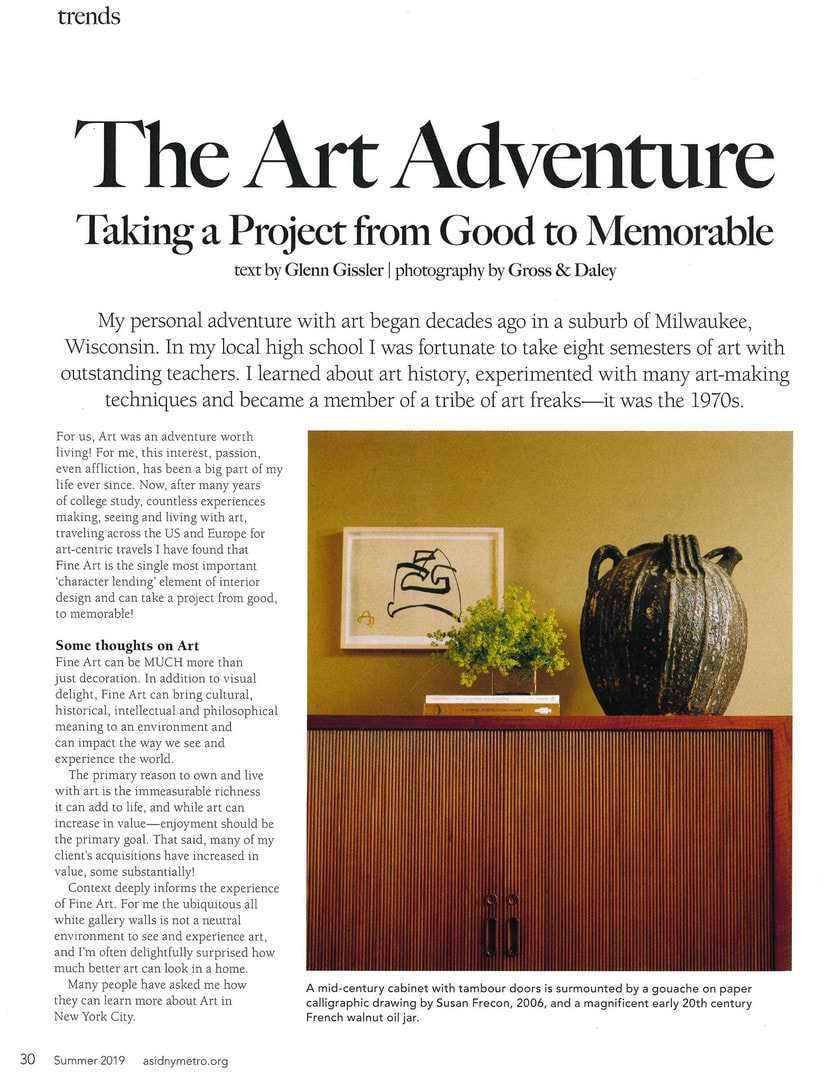
The Art Adventure:

Taking a Project from Good to Memorable

by Glenn Gissler
Photography by Gross & Daley

My personal adventure with art began decades ago in a suburb of Milwaukee, Wisconsin. In my local high school I was fortunate to take eight semesters of art with outstanding teachers. I learned about art history, experimented with many art-making techniques and became a member of a tribe of art freaks—it was the 1970s.

For us, Art was an adventure worth living! For me, this interest, passion, even affliction, has been a big part of my life ever since. Now, after many years of college study, countless experiences making, seeing and living with art, traveling across the US and Europe for art-centric travels I have found that Fine Art is the single most important ‘character lending’ element of interior design and can take a project from good, to memorable!

Some thoughts on Art

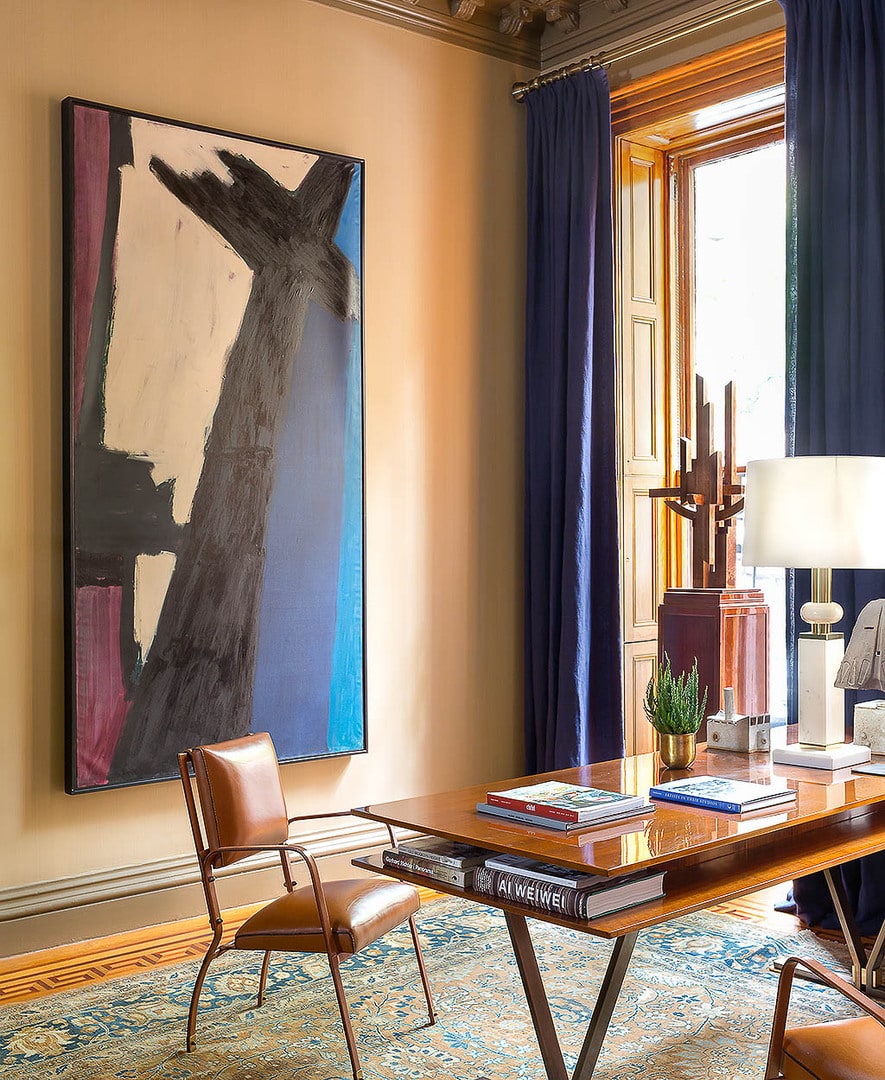
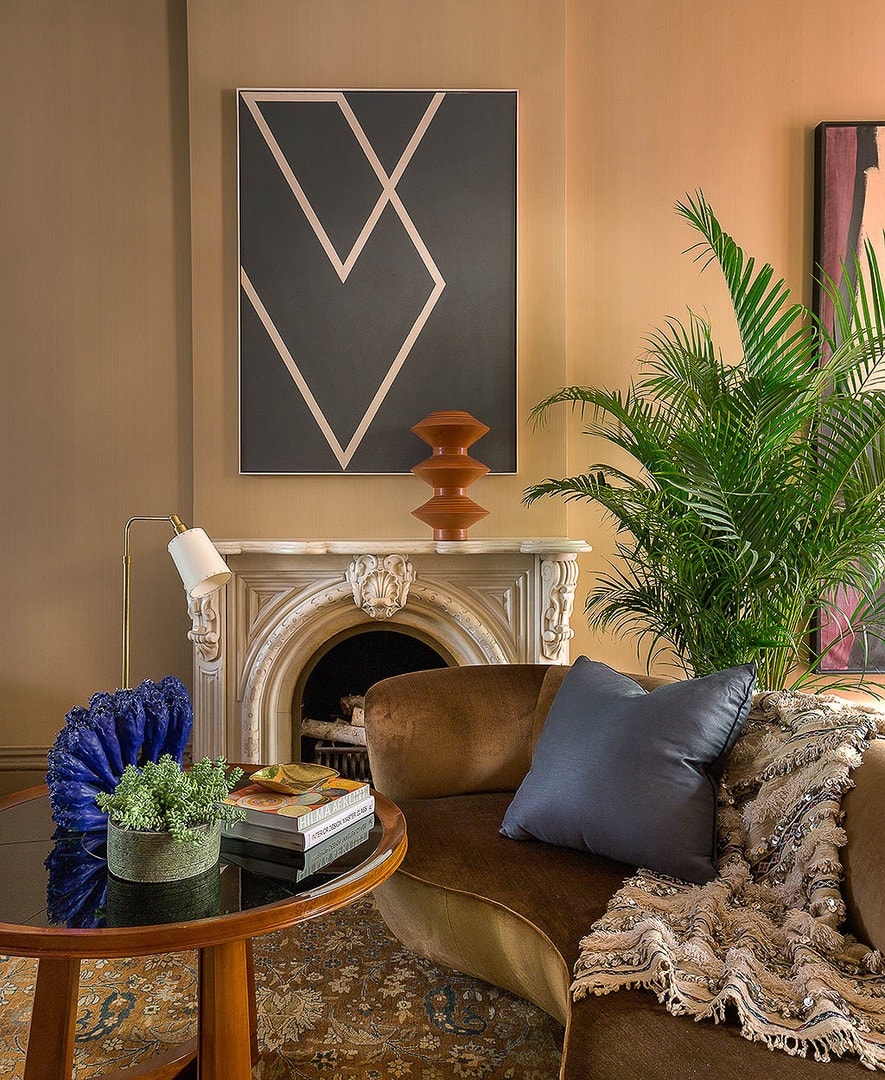
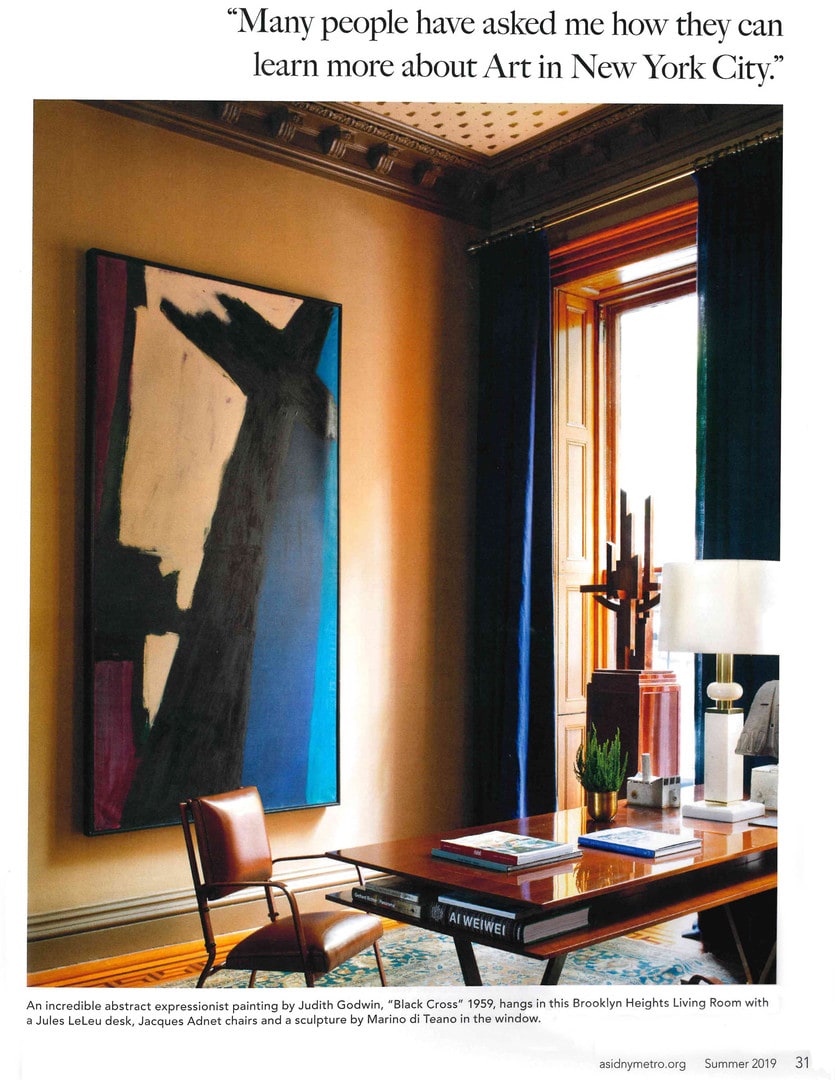
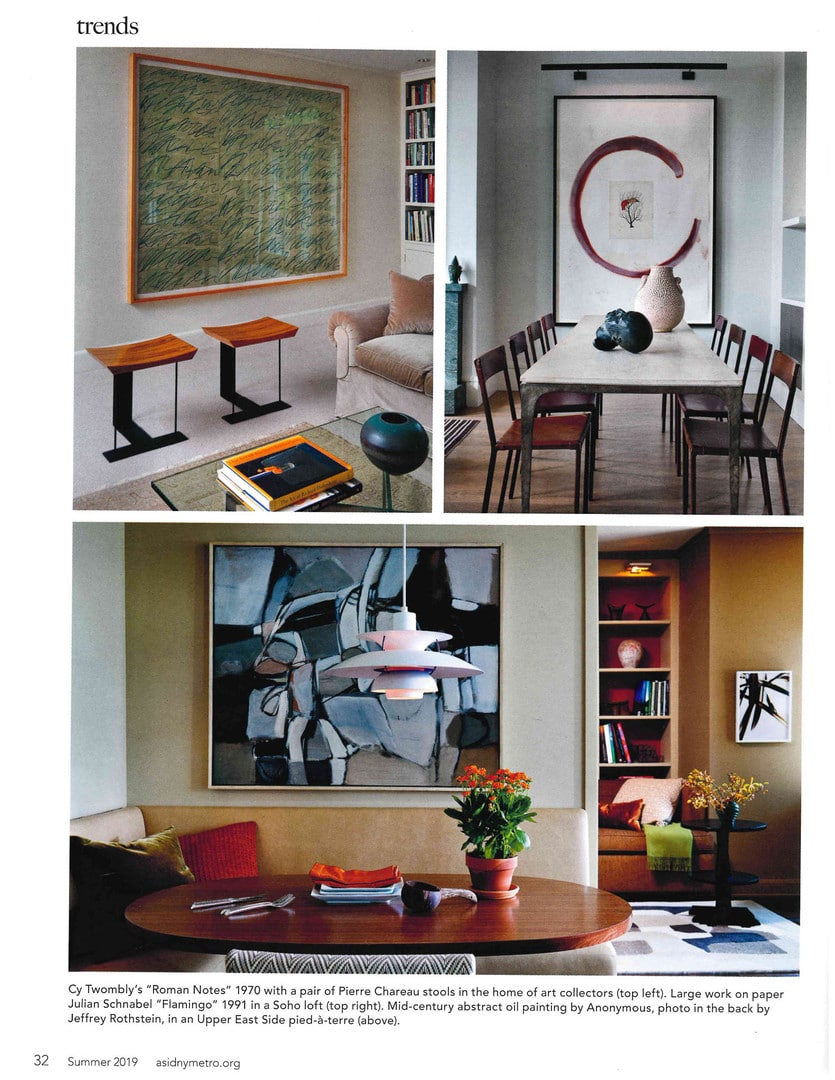
Fine Art can be MUCH more than just decoration. In addition to visual delight, Fine Art can bring cultural, historical intellectual and philosophical meaning to an environment and can impact the way we see and experience the world.

The primary reason to own and live with art is the immeasurable richness it can add to life, and while art can increase in value—enjoyment should be the primary goal. That said, many of my client’s acquisitions have increased in value, some substantially!

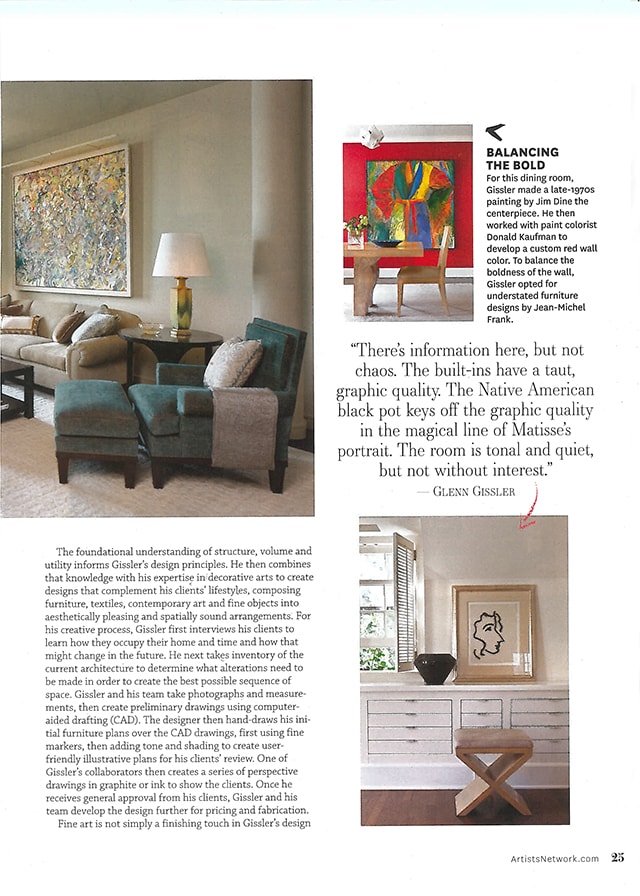
Context deeply informs the experience of Fine Art. For me the ubiquitous all white gallery walls is not a neutral environment to see and experience art, and I’m often delightfully surprised how much better art can look in a home.

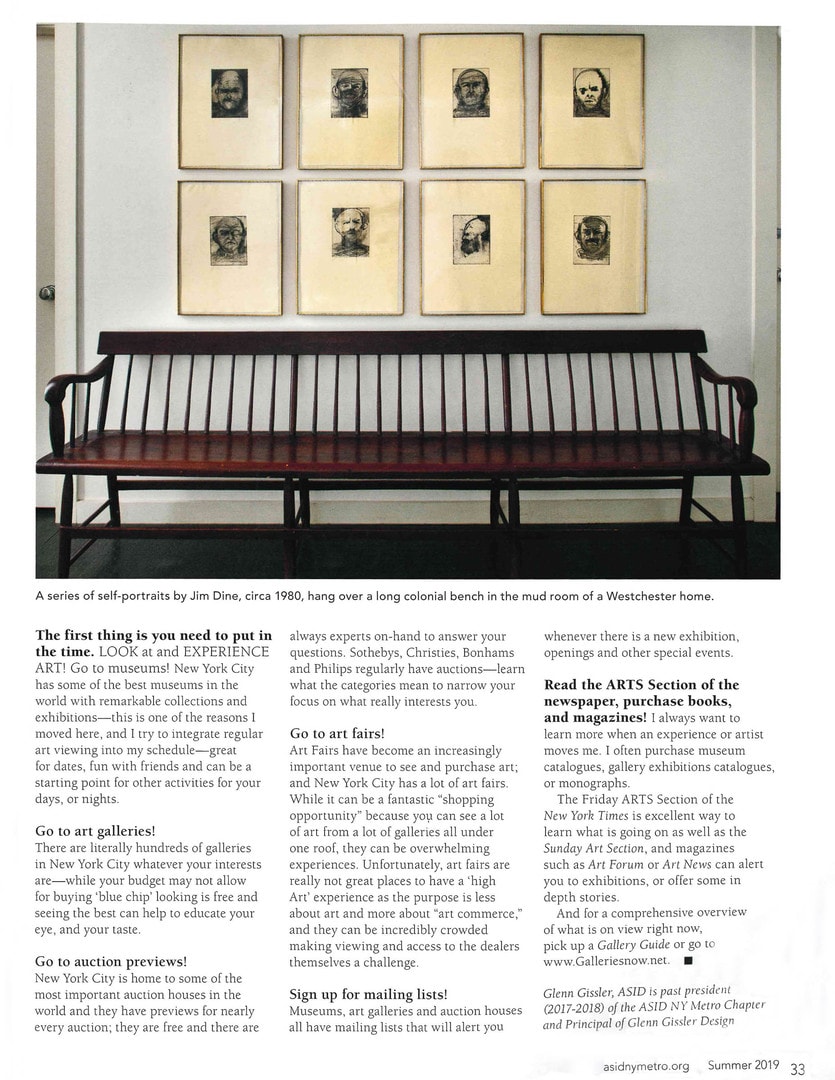
“Many people have asked me how they can learn more about Art in New York City.”


The first thing is you need to put in the time. LOOK at and EXPERIENCE ART! Go to museums! New York City has some of the best museums in the world with remarkable collections and exhibitions—this is one of the reasons I moved here, and I try to integrate regular art viewing into my schedule—great for dates, fun with friends and can be a starting point for other activities for your days, or nights.

Go to art galleries!
There are literally hundreds of galleries in New York City whatever your interests are—while your budget may not allow for buying ‘blue chip’ looking is free and seeing the best to help educate your eye, and your taste.s

Go to auction previews!
New York City is home to some of the most important auction houses in the world and they have previews for nearly every auction; they are free and there are always experts on-hand to answer your questions. Sothebys, Christies, Bonhams and Philips regularly have auctions—learn what the categories mean to narrow your focus on what really interests you.

Go to art fairs!
Art Fairs have become an increasingly important venue to see and purchase art; and New York City has a lot of art fairs. While it can be a fantastic “shopping opportunity” because you can see a lot of art from a lot of galleries all under one roof, they can be overwhelming experiences. Unfortunately, art fairs are really not great places to have a ‘high Art’ experience as the purpose is less about art and more about “art commerce,” and they can be incredibly crowded making viewing and access to the dealers themselves a challenge.

Sign up for mailing lists!
Museums, art galleries and auction houses all have mailing lists that will alert you whenever there is a new exhibition, openings and other special events.

Read the ARTS Section of the newspaper, purchase books, and magazines!
I always want to learn more when an experience or artist moves me. I often purchase museum catalogues, gallery exhibitions catalogues, or monographs.

The Friday ARTS Section of the New York Times is an excellent way to learn what is going on as well as the Sunday Art Section, and magazines such as Art Forum or Art News can alert you to exhibitions, or offer some in depth stories.

And for a comprehensive overview of what is on view right now, pick up a Gallery Guide or go to www.Galleriesnow.net.

Glenn Gissler, ASID is past president (2017-2018) of the ASID NY Metro Chapter and Principal of Glenn Gissler Design

Brownstoner

BROWNSTONER

SPRING/SUMMER 2018

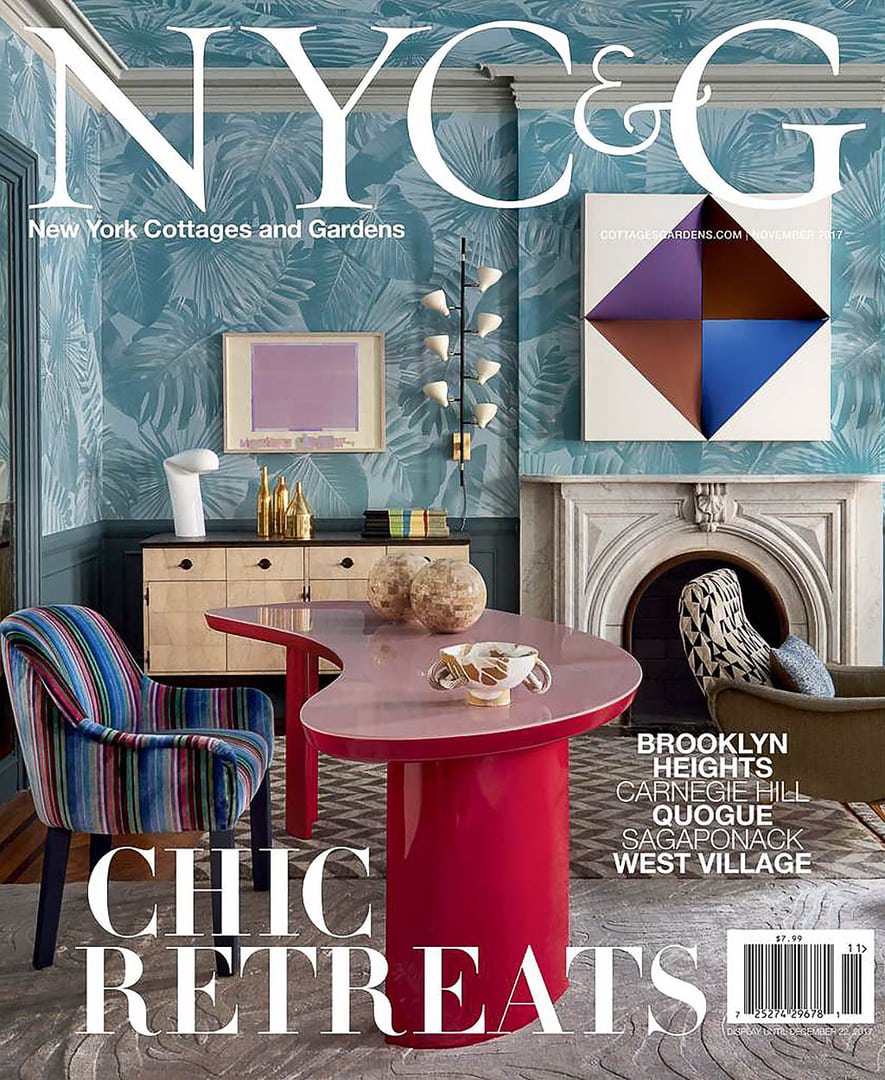
Maximum Glamour

by Cara Greenberg 

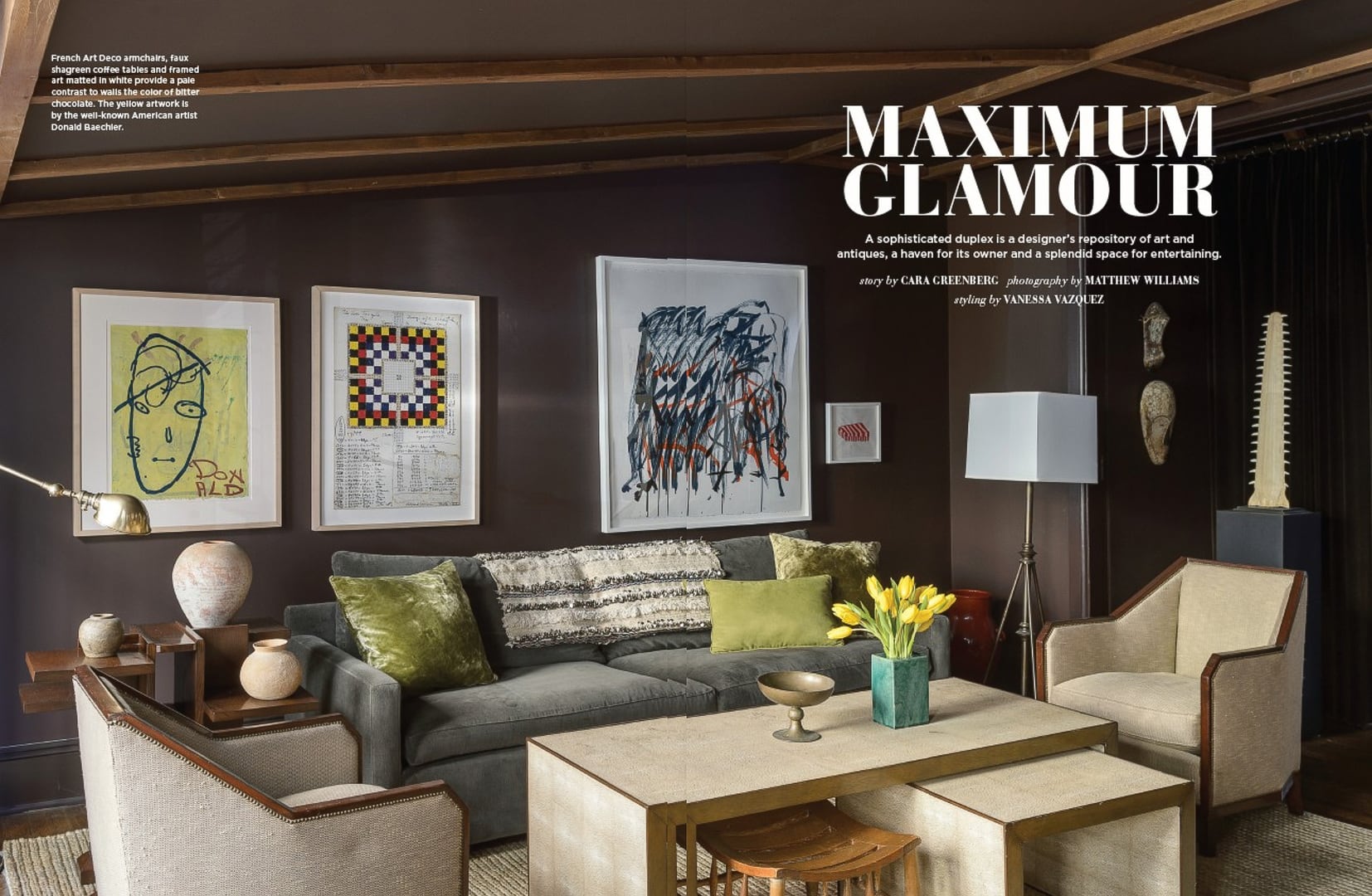
A sophisticated duplex is a designer’s repository of art and antiques, a haven for its owner and a splendid space for entertaining


When interior designer Glenn Gissler went apartment hunting six years ago, the longtime Manhattanite had been to Brooklyn very few times before. He was astounded by the charm and amenities he found in the upper duplex of a circa 1890 row house in central Brooklyn Heights. “The apartment exceeded my list of ‘must haves,’” Gissler says, recalling his initial reaction: “You mean I can have all this—two floors, a fireplace, a washer-dryer and a terrace—ten minutes from Greenwich Village?!”

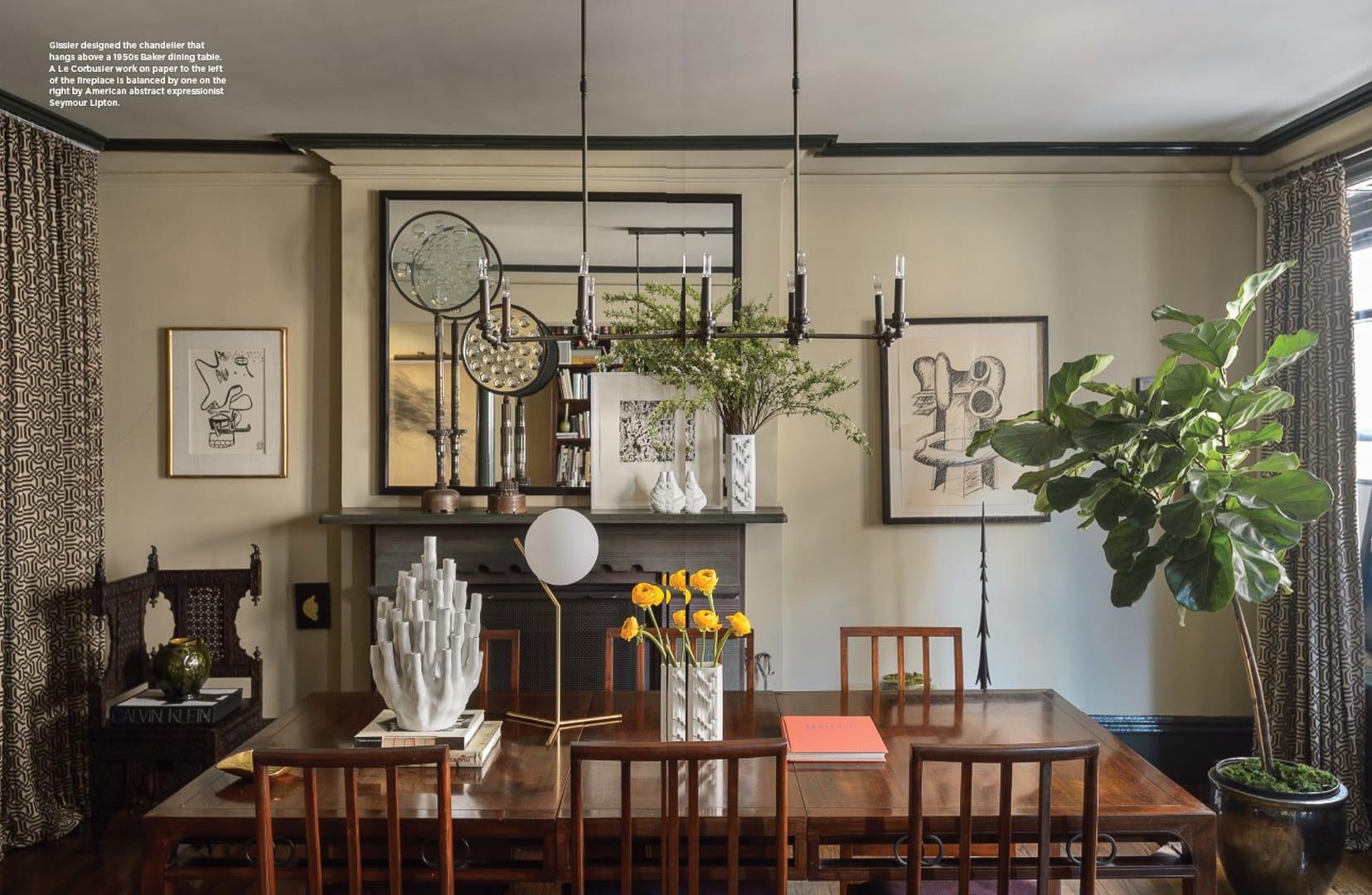
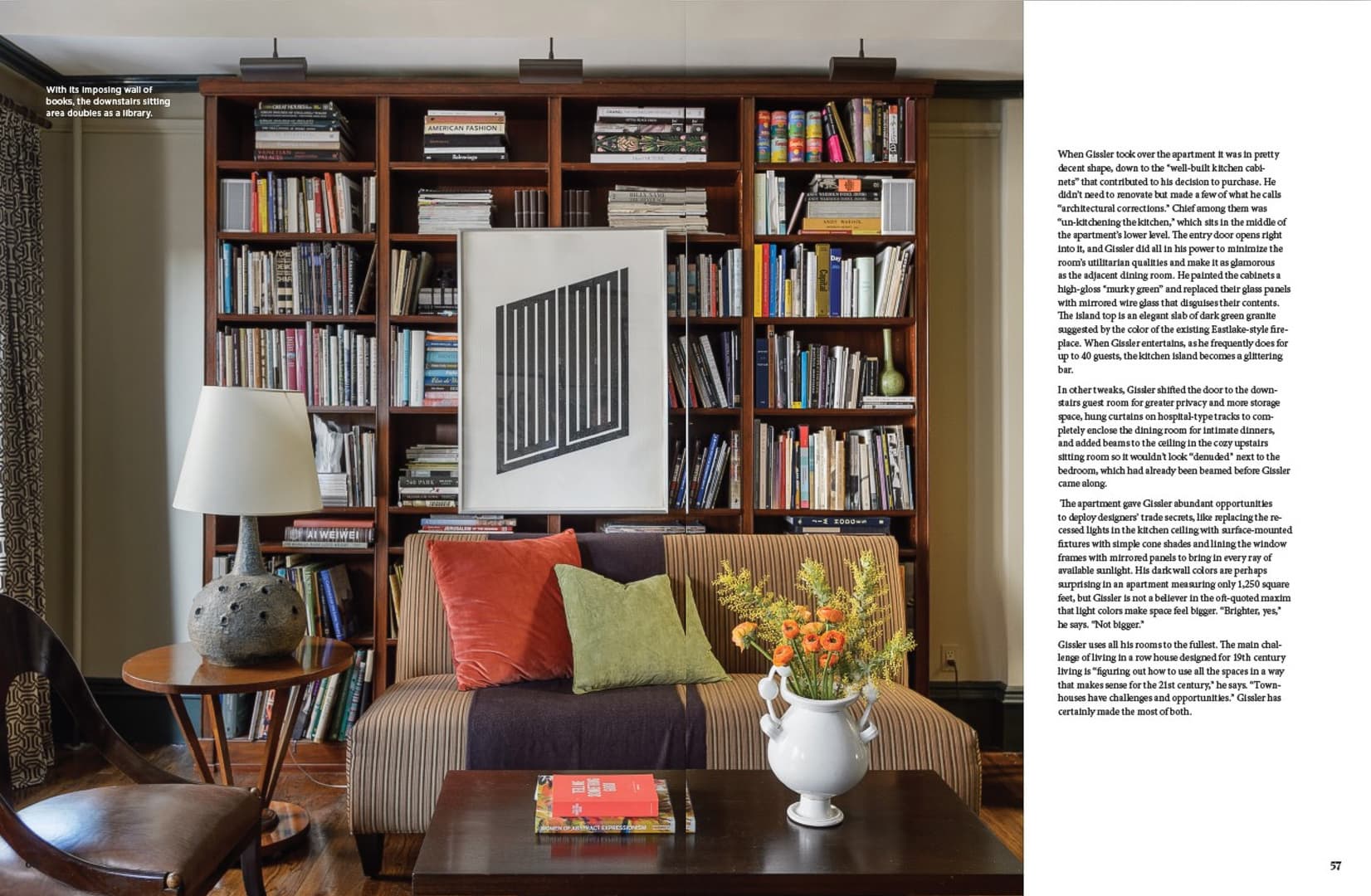
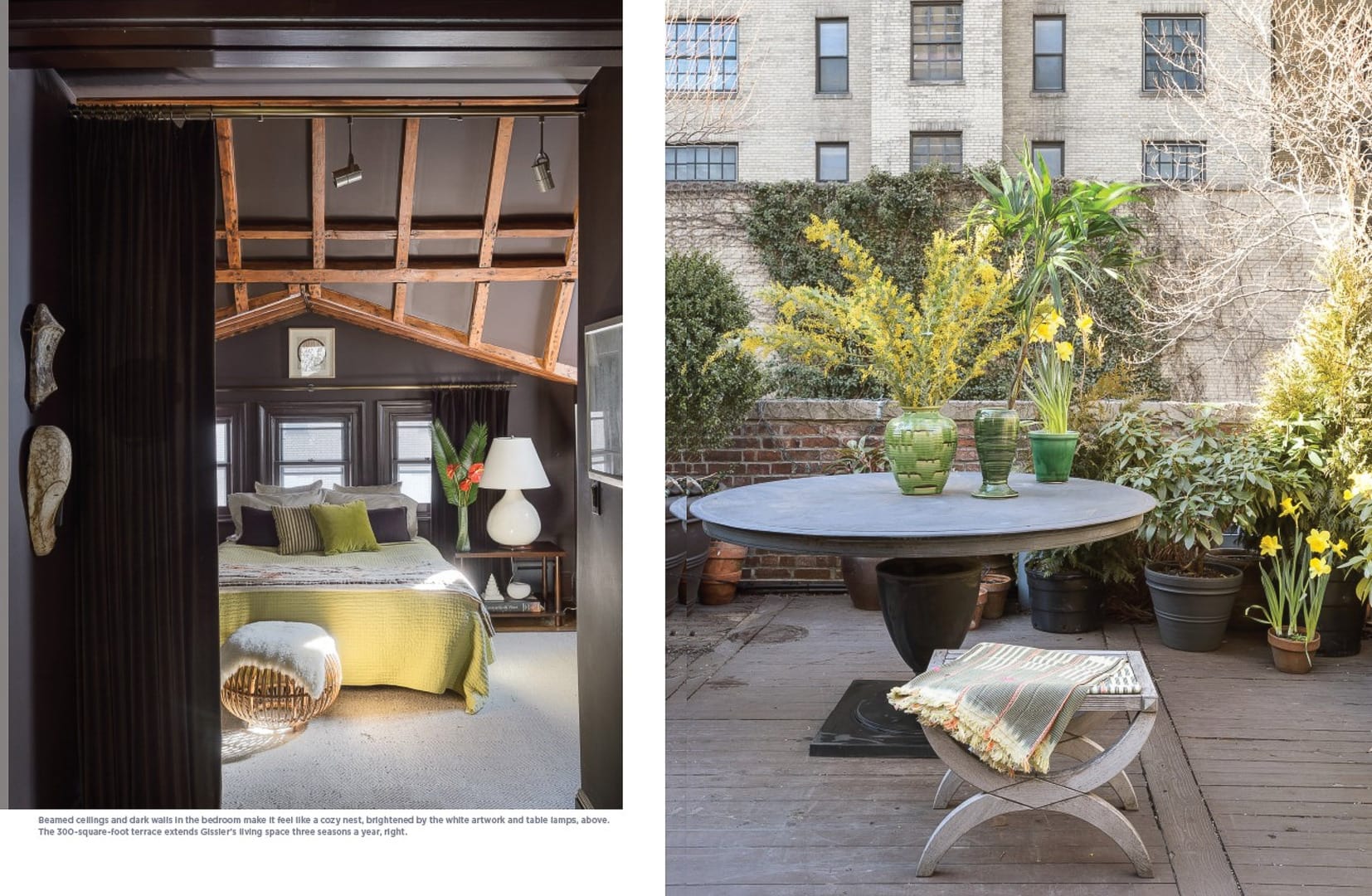
Now, furnished and decorated with what Gissler calls a “collage of art and artifacts,” the two-bedroom co-op is even more enviable. Sleek and cozy, modern and historic at the same time, it comprises a book-lined dining room, kitchen and guest room on the lower level, and two rooms with beamed ceilings, reminiscent of a Paris stelier. And who wouldn’t want to wake up to a view of a terrace filled with greenery?

Gissler’s atmospheric apartment, filled with intriguing places representing styles and periods from antiquity to the present day, is “a distillation of the designer’s development over the past three decades,” as the designer’s website puts it. Every item, from millicl-old clay pots to a Swedish mid-century lamp resembling a meteorite, from a Keith Haring poster given to Gissler by the artist at an anti-nukes demonstration his first summer in New York to framed childhood drawings by his now-teenage daughter, reflects who he is (an eBay addict, to be sure) and where he comes from. “Their cash value is irrelevant,” he says. “It’s whether it speaks to me.”
 

It was inevitable that Gissler would end up living in a vintage house (he also owns a 1840s farmhouse on eight aces in Connecticut). He saved his first building at the age of 18—a Gilded Age Milwaukee mansion he rescued by convincing his father, then an editor of Milwaukee’s largest daily newspaper, to write an opinion piece embarrassing the bankers who had refused to lend $200,000 to a preservation group to buy the building and keep it from destruction. The banks changed their tune and the Pabst Mansion still stands as a historic house museum.

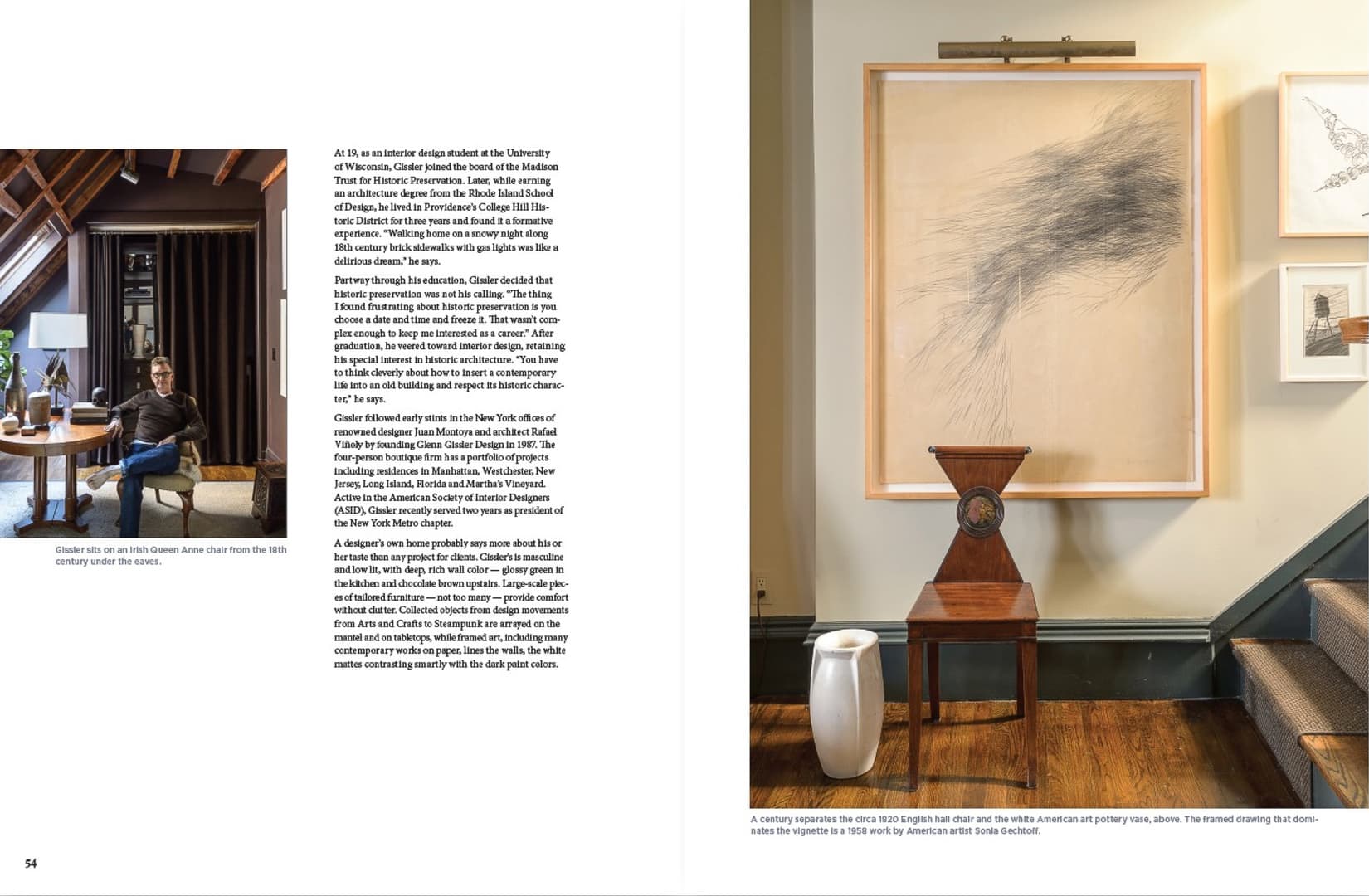
At 19, as an interior design student at the University of Wisconsin, Gissler joined the board of the Madison Trust for Historic Preservation. Later, while earning an architecture degree from the Rhode Island School of Design, he lived in Providence’s College Hill Historical District for three years and found it a formative experience. “Walking home on a snowy night along 18th century brick sidewalks with gas lights was like a delirious dream,” he says.

Part way through his education, Gissler decided that historic preservation was not his calling. “The thing I found frustrating about historic preservation is you choose a date and time and freeze it. That wasn’t complex enough to keep me interested as a career.” After graduation, he veered toward interior design, retaining his special interest in historic architecture. “You have to think cleverly about how to insert a contemporary life into an old building and respect its historic character,” he says.

Gissler followed early stints in the New York offices of renowned designer Juan Montoya and architect Rafael Vinholy by founding Glenn Gissler Design in 1987. The four-person boutique firm has a portfolio of projects including residences in Manhattan, Westchester, New Jersey, Long Island, Florida and Martha’s Vineyard. Active in the American Society of Interior Designers (ASID), Gissler recently served two years as president of the New York Metro chapter.

A designer’s own home probably says more about his or her taste than any project for clients. Gissler’s is masculine and low lit, with deep, rich wall color–glossy green in the kitchen and chocolate brown upstairs. Large-scale pieces of tailored furniture—not too many—provide comfort without clutter. Collected objects from design movements from Arts and Crafts to Steampunk are arrayed on the mantle and on tabletops, while framed art, including many contemporary works on paper, line the walls, the white mattes contrasting smartly with the dark paint colors.

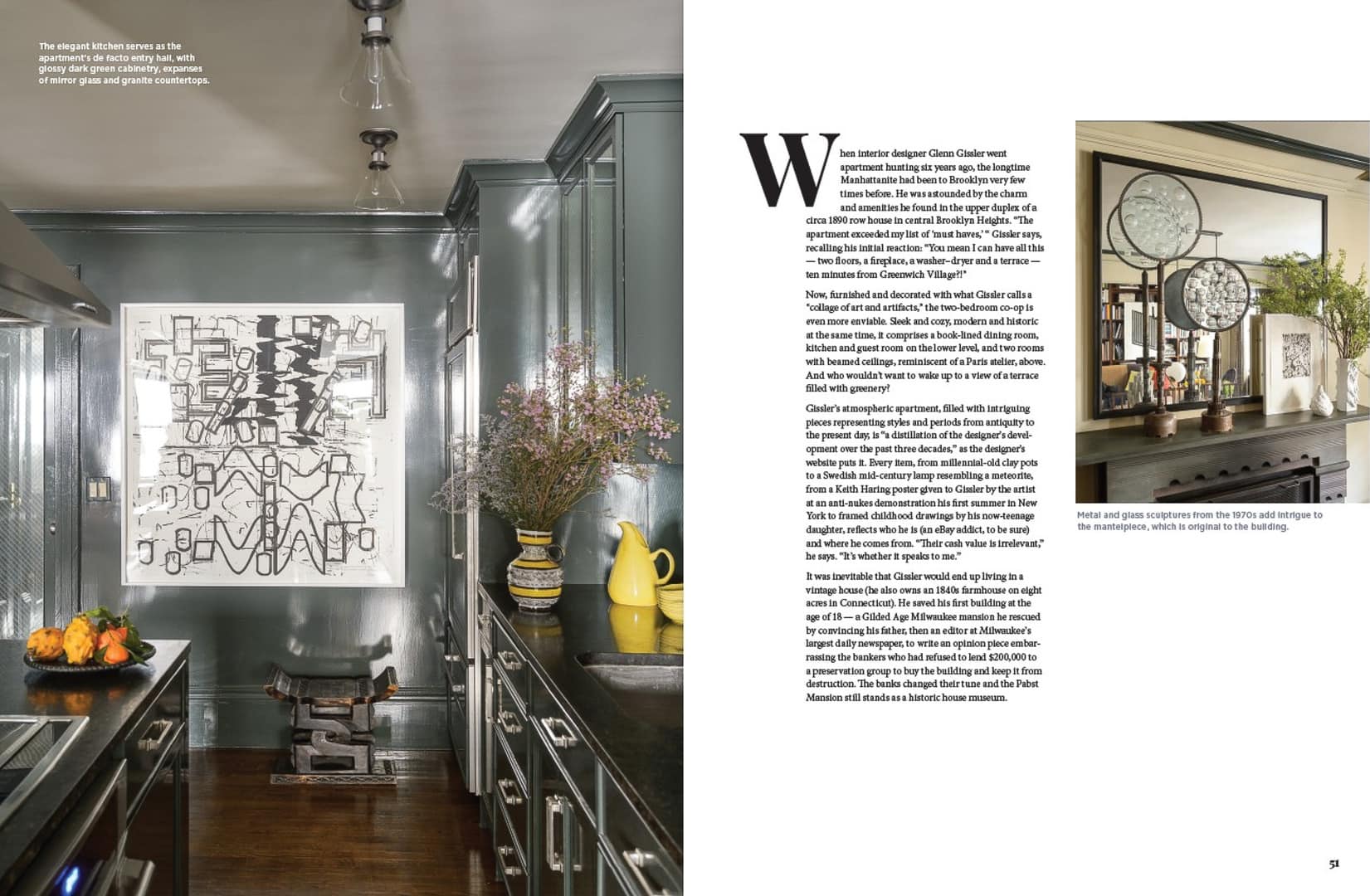
When Gissler took over the apartment it was inn pretty decent shape, down to the “well-built kitchen cabinets” that contributed to his decision to purchase. He didn’t need to renovate but made a few of what he calls “architectural corrections.” Chief among them was “un-kitchening the kitchen,” which sits in the middle of the apartment’s lower level. The entry door opens right into it, and Gissler did all in his power to minimize the room’s utilitarian qualities and makes it as glamorous as the adjacent dining room. He painted the cabinets as high-gloss “murky green” and replaced their glass panels with mirrored wire glass that disguises their contents. The island top is an elegant slab of dark green granite suggested by the color of the existing Eastlake-stye fireplace. When Gissler entertains, as he frequently does for up to 40 guests, the kitchen island becomes a glittering bar.

In other tweaks, Gissler shifted the door to the downstairs guest room for greater privacy and more storage space, hung curtains on hospital-type tracks to completely enclose the dining room for intimate dinners, and added beams to the ceiling int he cozy upstairs sitting rom so it wouldn’t look “denuded” next to the bedroom, which had already beamed before Gissler came along.

The apartment gave Gissler abundant opportunities to deploy designers’ trade secrets, like replacing the recessed lights in the kitchen ceilings with surface- mounted fixtures with simple cone shades and lining the window frames with mirrored panels to bring in every ray of available sunlight. His dark wall colors are perhaps surprising in an apartment measuring only 1,250 square feet, but Gissler is not a believer in the oft-quoted maxim that light colors make spaces feel bigger. “Brighter, yes,” he says. “Not bigger.”

Gissler uses all his rooms to the fullest. The main challenge of living in a row house designed for 19th century living is “figuring out how to use the spaces in a way that makes sense for the 21st century,” he says. “Town-houses have challenges and opportunities.” Gissler has certainly made the most of both.

Story: Cara Greenberg
Photography: Matthew Williams
Styling: Vanessa Vazquez

Artists Magazine

Artists Magazine

JANUARY/FEBRUARY 2018

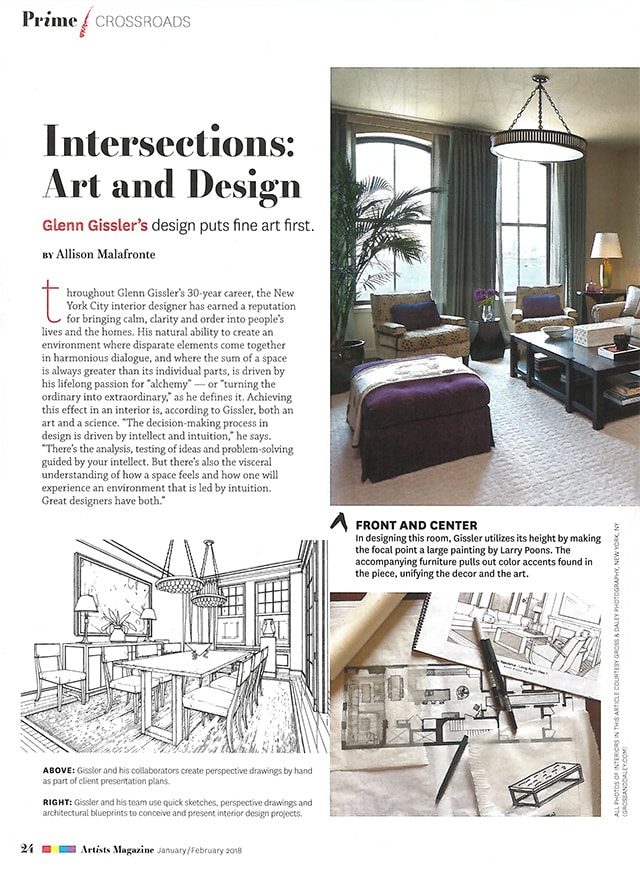
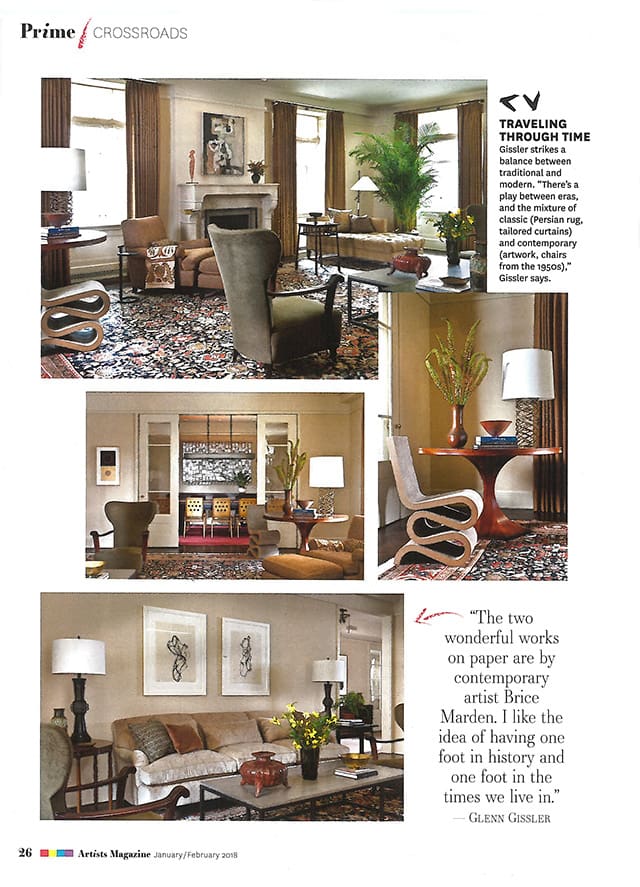
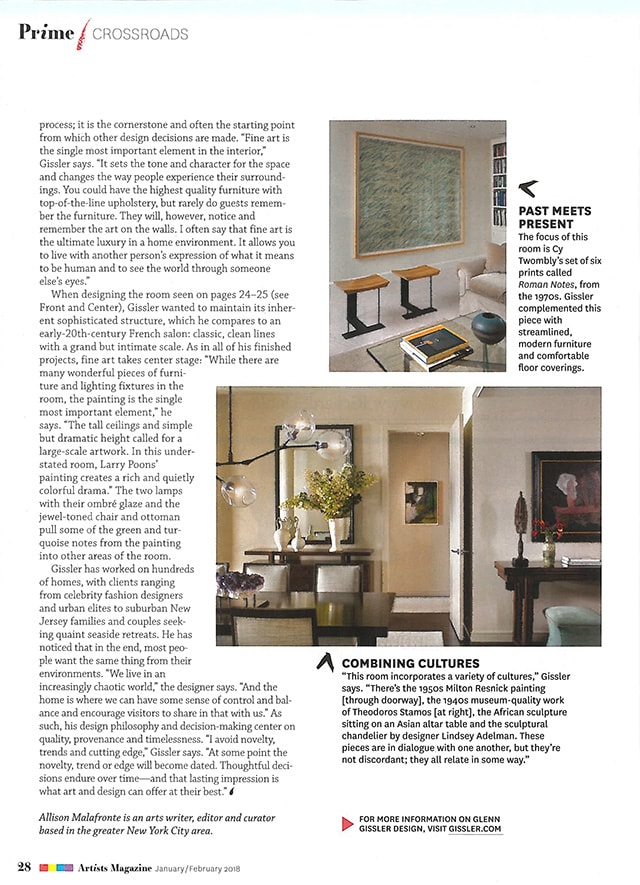
Intersections: Art and Design

by Allison Malafronte
Photos by Gross & Daley

Lighting & Decor

Lighting and Decor

NOVEMBER 2017

Last Look photos by Gross & Daley

Last Look

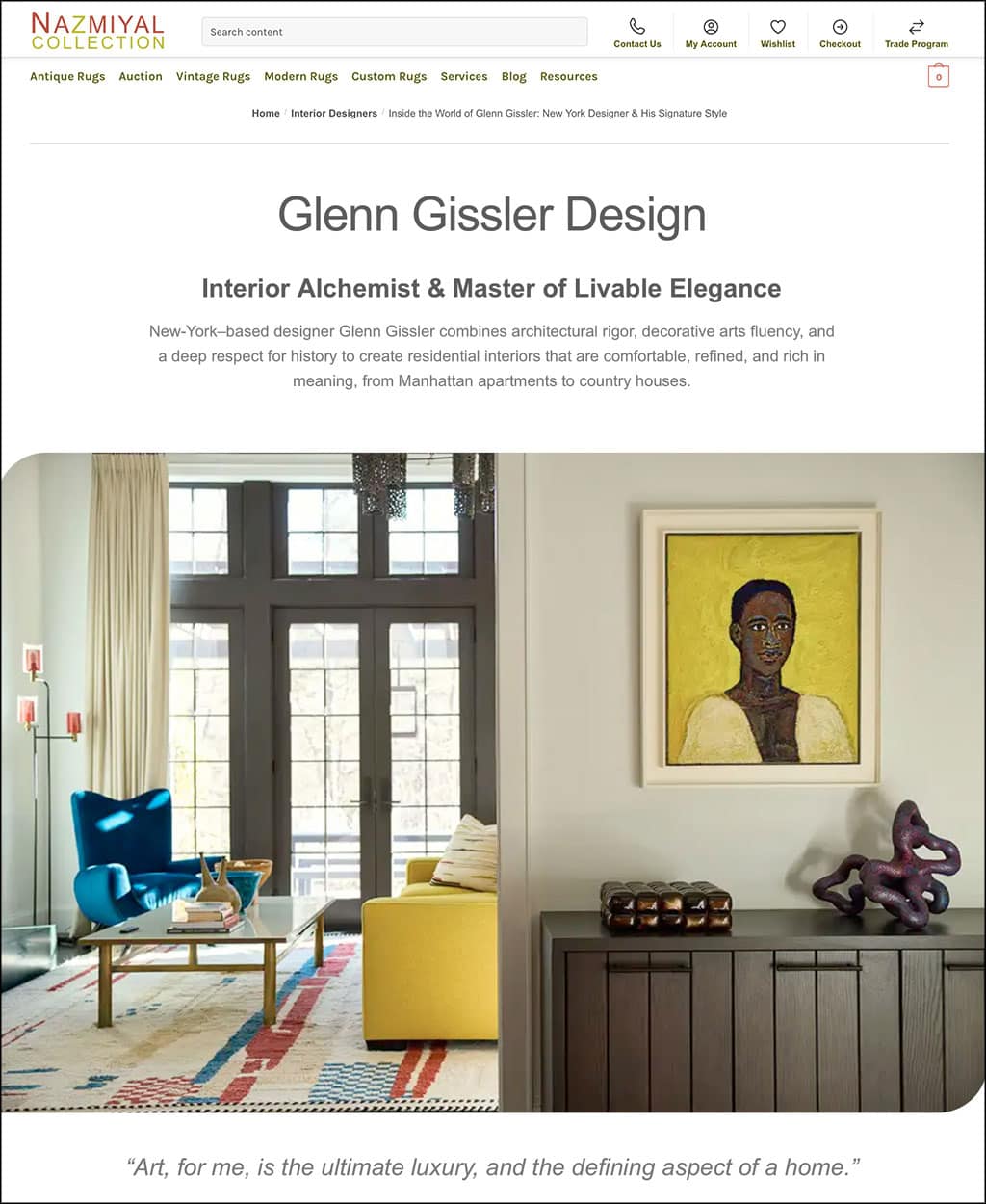
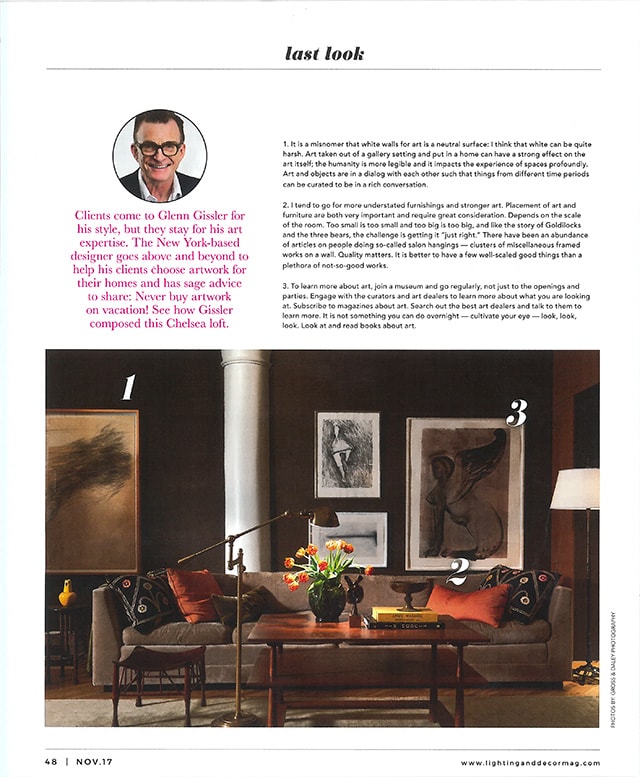
Clients come to Glenn Gissler for his style, but they stay for his art expertise. The New York-based designer goes above and beyond to help his clients choose artwork for their homes and has sage advice to share: Never buy artwork on vacation! See how Gissler composed this Chelsea loft.


1. It is a misnomer that white walls for art is a neutral surface: I think that white can be quite harsh. Art take out of a gallery setting and put in a home can have a strong effect on the art itself; the humanity is more legible and it impacts the experience of spaces profoundly. Art and objects are in a dialog with each other such that things from different time periods can be curated to be in a rich conversation. 

2. I tend to go for more understated furnishings and stronger art. Placement of art and furniture are both very important and require great consideration. Depends on the scale of the room. Too small is too small and too big is too big, and like the story of Goldilocks and the three bears, the challenge is getting it “just right.” There have been an abundance of articles on people doing so-called salon hangings—clusters of miscellaneous framed works on a wall. Quality matters. It is better to have a few well-scaled good things than a plethora of not-so-good works.

3. To learn more about art, join a museum and go reguarly, not just to the openings and parties. Engage with the curators and art dealers to learn more about wat you are looking at. Subscribe to magazines about art. Search out the best art dealers and talk to them to learn more. It is not something you can do overnight–cultivate your eye–look, look, look. Look at and read books about art.