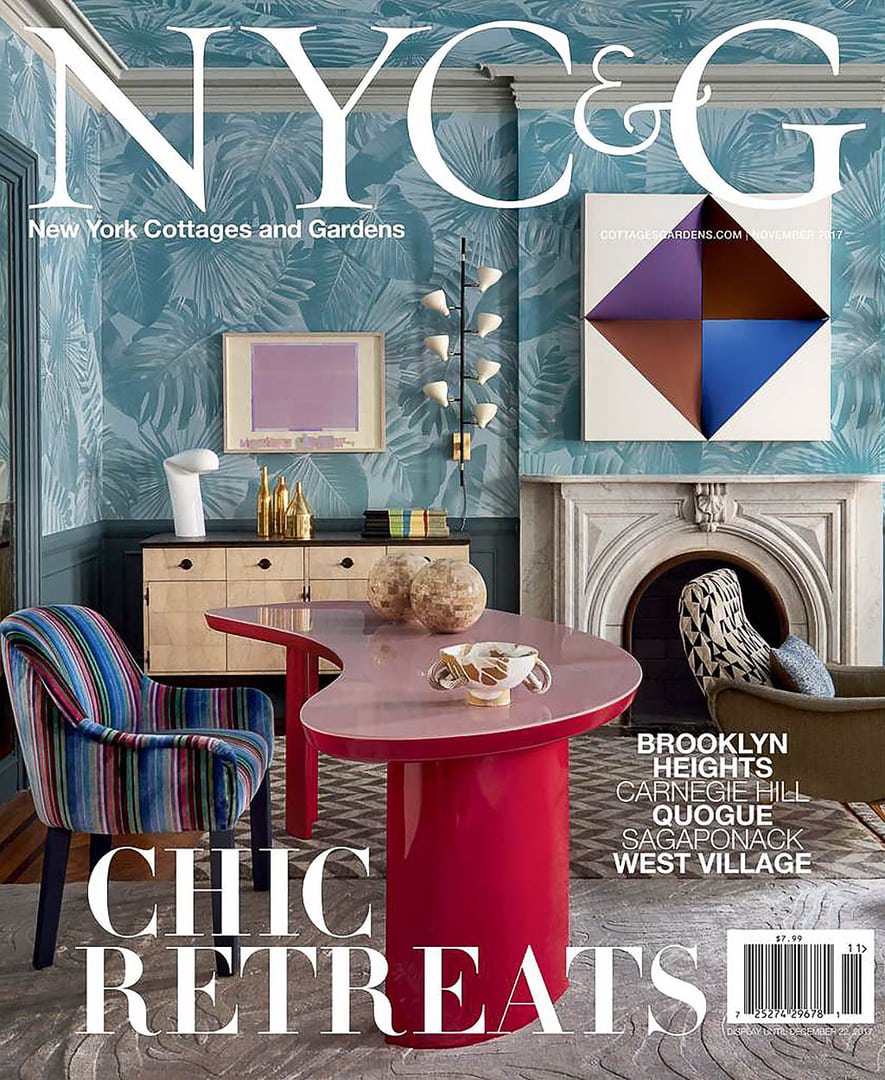
NYC&G (New York Cottages & Gardens) 2017
COTTAGES & GARDENS
SEPTEMBER 2017
Tour the Brooklyn Heights Designer Showhouse Presented by NYC&G
Photographs by Anastassios Mentis
by Tisha Leung
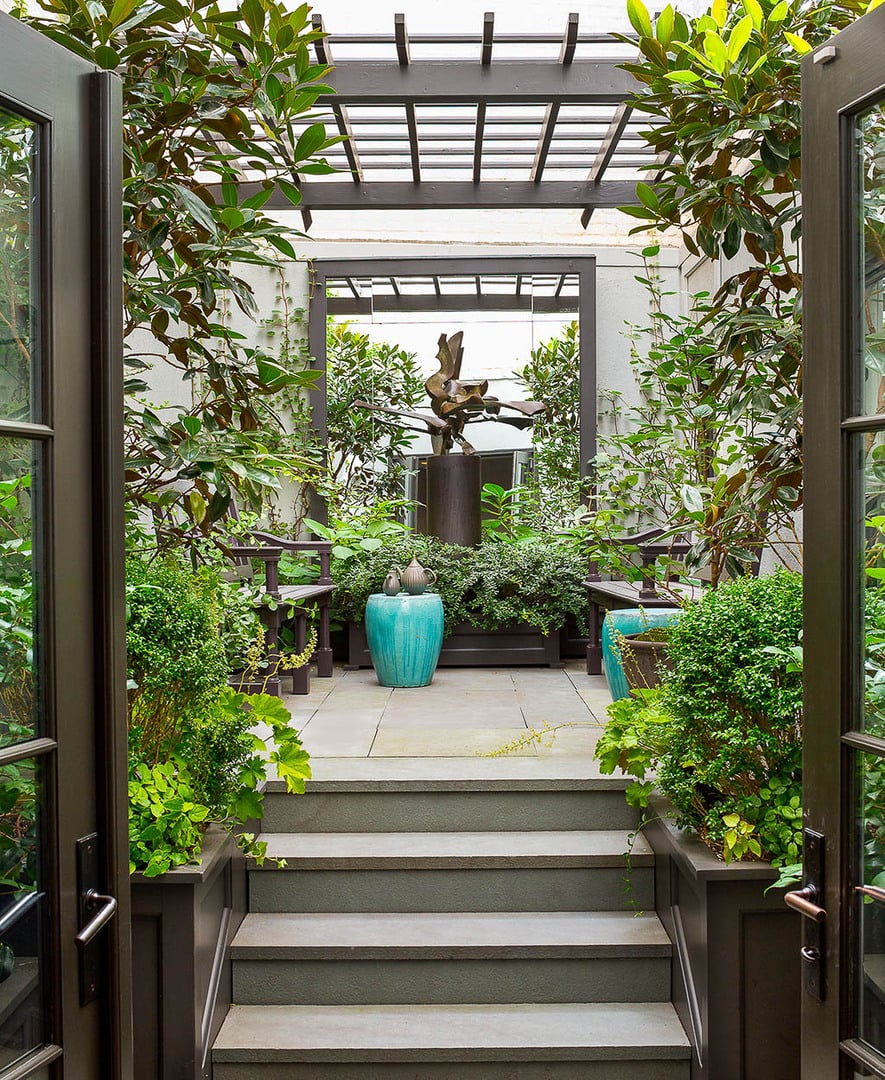
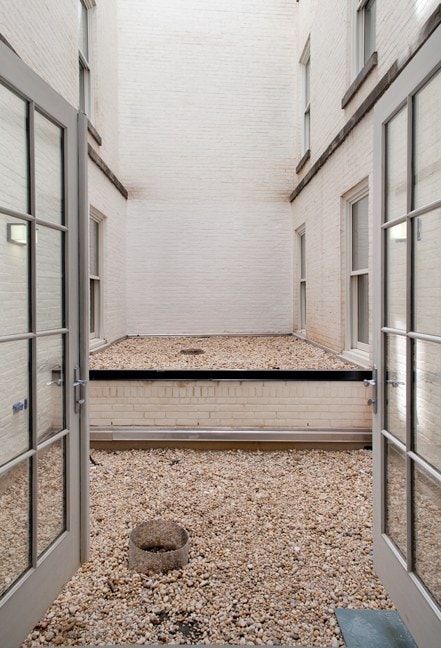
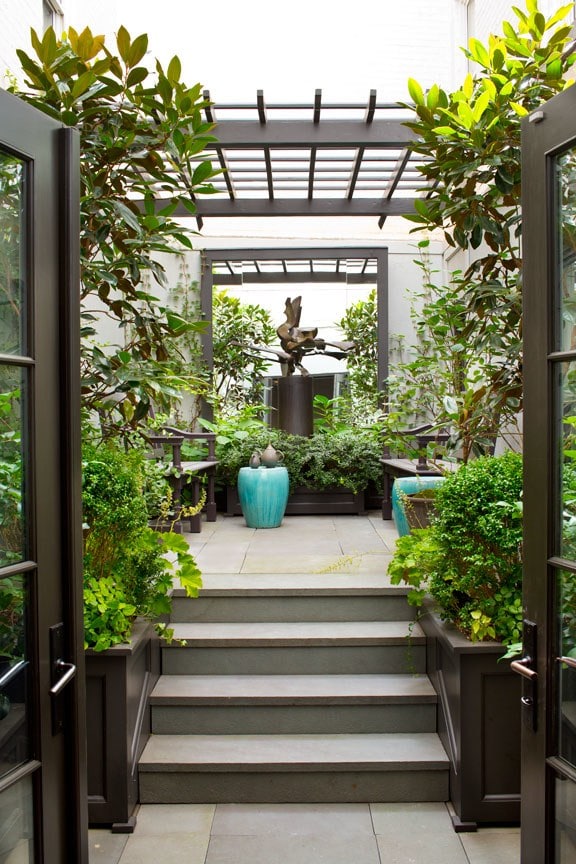
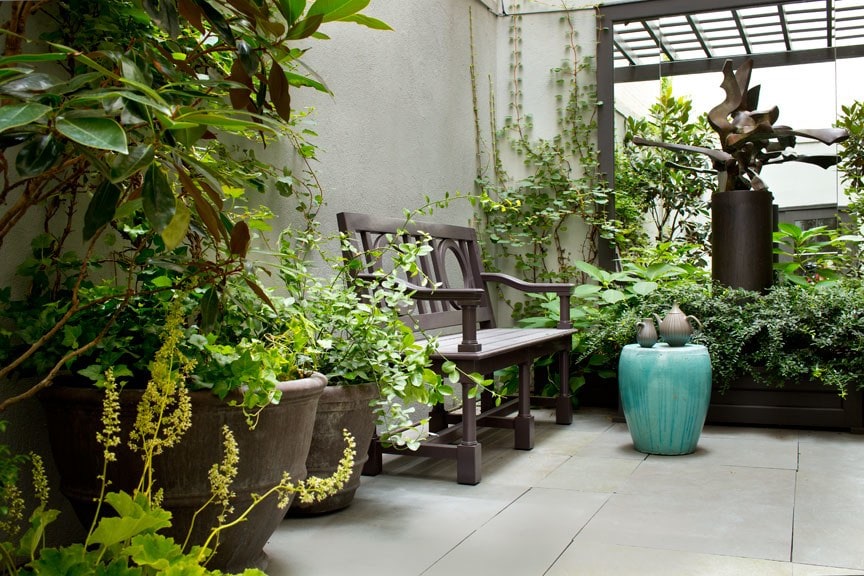
For big-city dwellers, having a little outdoor space to call your own is a luxury. Which is why the owners of this 1900s New York duplex were thrilled to have a 250-square-feet area for their family of four—except that it was actually a nondescript, open air shaft wedged between building walls. “The kids’ rooms were on one side and a guest room on the other, so it was a private jewel of a space,” says local designer Glenn Gissler. And he knew exactly how to transform it into a place of respite. First, he created a vestibule as a welcoming entry into the garden by installing stairs and raising the height of the seating area. A trellis overhead offers a sense of enclosure, while a mirror on the back wall makes the space feel larger. “A pair of French glass doors open up to the garden from a hallway,” says Gissler. “It’s lovely to view during the warmer months, but the architectural elements are just as compelling covered in snow in the winter.” Read on to see how the designer created a garden oasis in the middle of the city.
Photography by Gross & Daley Photo
To design an understated and symmetrical space that felt organic, Gissler confined his color scheme to dark browns, greens, and blues. Custom benches by Accents of France feature classical circular motifs, while the trellis overhead provides shade. “I included two bright blue Chinese garden stools that are placed off-center so the symmetry doesn’t feel so static,” he says.
The air shaft was filled with white gravel and white-painted brick walls. To give the space a solid foundation on which to build the rest of the garden, Gissler laid down bluestone pavers and covered the walls with stucco.
To design an understated and symmetrical space that felt organic, Gissler confined his color scheme to dark browns, greens, and blues. Custom benches by Accents of France feature classical circular motifs, while the trellis overhead provides shade. “I included two bright blue Chinese garden stools that are placed off-center so the symmetry doesn’t feel so static,” he says.
The garden is filled with evergreens like boxwood, rhododendron, and ivy mixed with colorful annuals and perennials. To sustain the vegetation, a self-watering irrigation system was installed beneath the removable pavers. Simple terra-cotta pots in various sizes help make the terrace feel bountiful.
by Mindy Pantiel
Most designers would look at a windowless room in a historic 1906 building and immediately start layering with mirrors and other reflective surfaces to create the illusion of light. But faced with a dark formal dining area in a West Village home, interior designer Glenn Gissler, opted to turn the lack of fenestration into an asset. “We took the position that it’s a space only used at night, so why not create a special environment and fill the walls with decorative murals that depict an imaginary version of New York City history?” says Gissler, who installed Moroccan-style metal fixtures and recessed architectural lighting to cast a romantic glow on hot-air balloons, palm fronds and fanciful characters that dance around the room. “When you dine here, it’s as if you are in the landscape. It’s positively magical.”
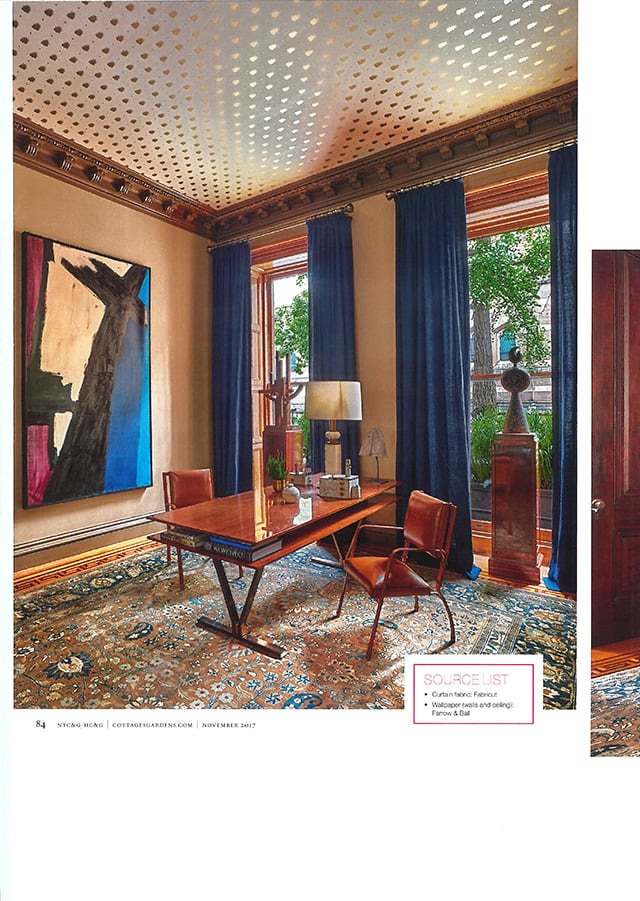
The murals were just one part of a larger design scheme that involved recreating a past for the stripped-down maisonette, housed in an early 20th-century building that once served as a women’s hostel. The homeowners, a couple who have two young daughters, also charged the designers, working with builder Dale Faught, with making the spaces in the two-story 6,000-square-foot residence feel welcoming despite the imposing scale. “They wantd to turn down the volume and amp up the detiling to establish a historical connection, but they also wanted it to be livable and happy,” Gissler says.
Providing an immediate link with the past is a new entry door that is an exact replica of the original. Just inside, the walls lining the stair that leads to the main level are painted a warm aubergine—Donald Kaufman’s DKC-90—to fulfill the inviting requirement. Curtains hang across the opening on the landing–“portieres were common back then,” Gissler explains–creating an intimate tansitional moment before the granduer of the first floor is revealed. There, a spiraling staircase enveloped by wood paneling designed by Gissler climbs to a 30-foot ceiling, where a massive Lindsey Adeiman chandelier offers a contemporary counterpoint.
Photography: Peter Murdock
Interior Design: Glenn Gissler & Craig Strulovitz
Home Builder: Dale Faught, Nutech Interior, Inc.
Interior designer Glenn Gissler conceived the perused-oak panels that hug the swooping stair leading to the upper-level rooms. Each piece of the custom runner from Martin Patrick Evan was fabricated individually to accommodate the complex geometry of the curving stair treads. The chandelier is by Lindsey Adelman.
An antique brass globe by Profiles casts a subtle glow on the wool run by Martin Patrick Evan in the entry of a 1906 West Village maisonette. A 19th-century Chinese bench upholstered in Kravet fabric provides a place to remove shoes, while a dresser of the same vintage–both from Pagoda Red, via 1stdibs, in Chicago–is a convenient spot for stowing gloves and scarves. O’lampia sconces light the aubergine walls.
The first-floor landing is encased in the same perused oak paneling as the staircase. A pair of 1980s bronze table lamps from Rago Arts and /auction Center in Lamberville, New Jersey, rest on a 1940s French trestle table from Galerie Sammeriath in Culver City, California. The Moroccan-style area rug is from Marc Philips Decorative Rugs.
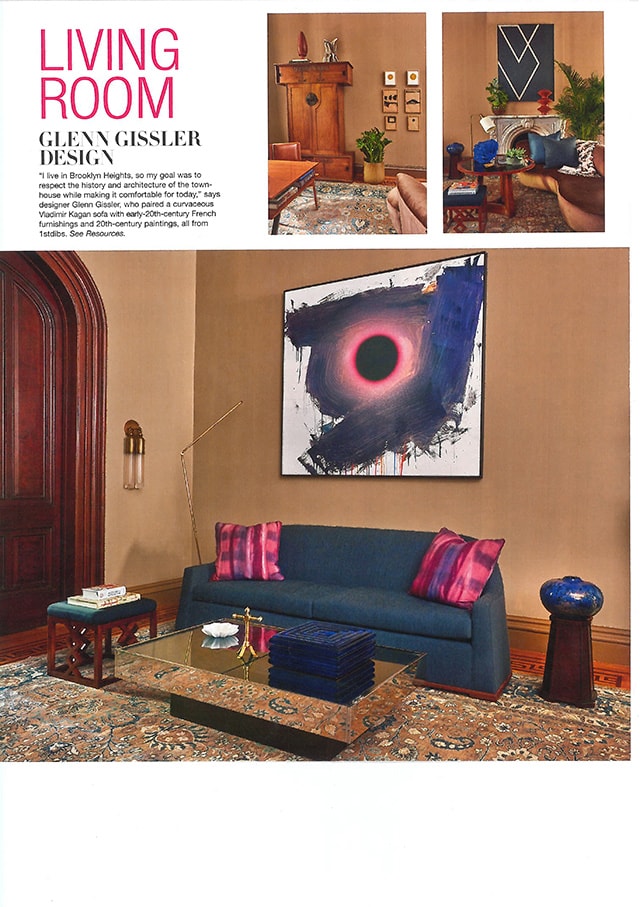
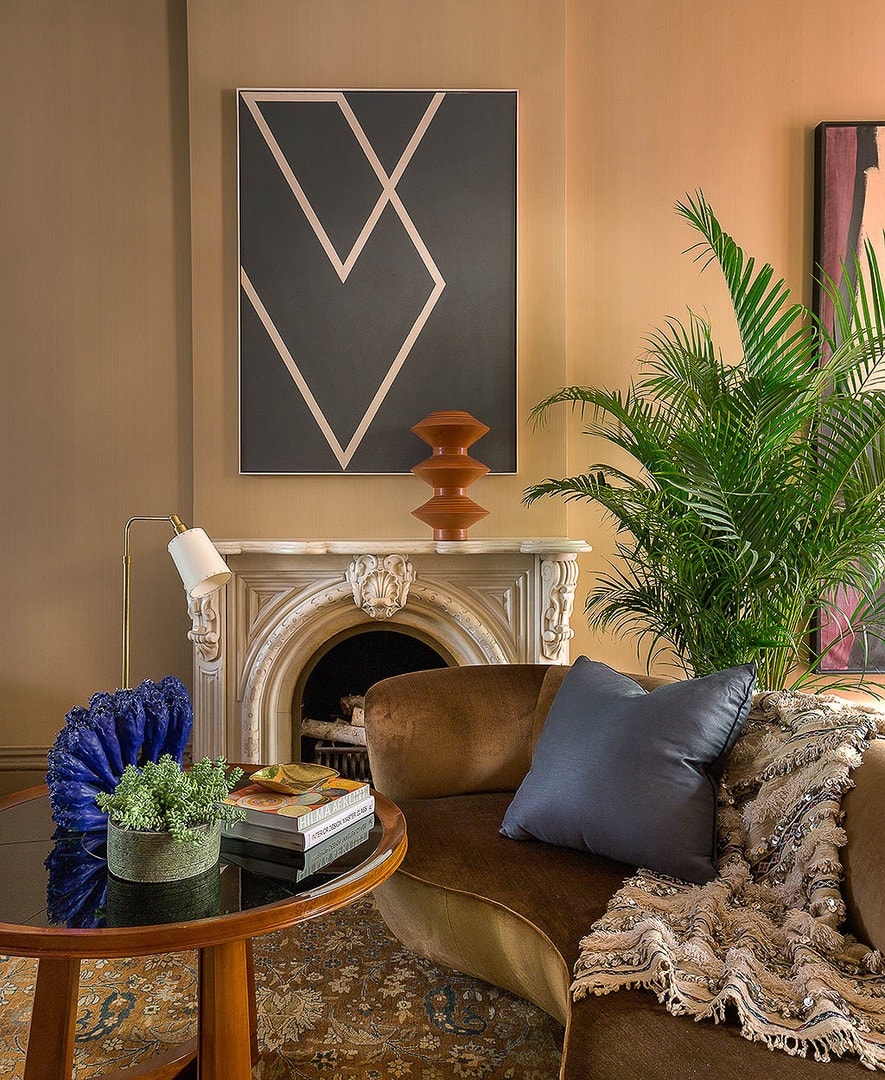
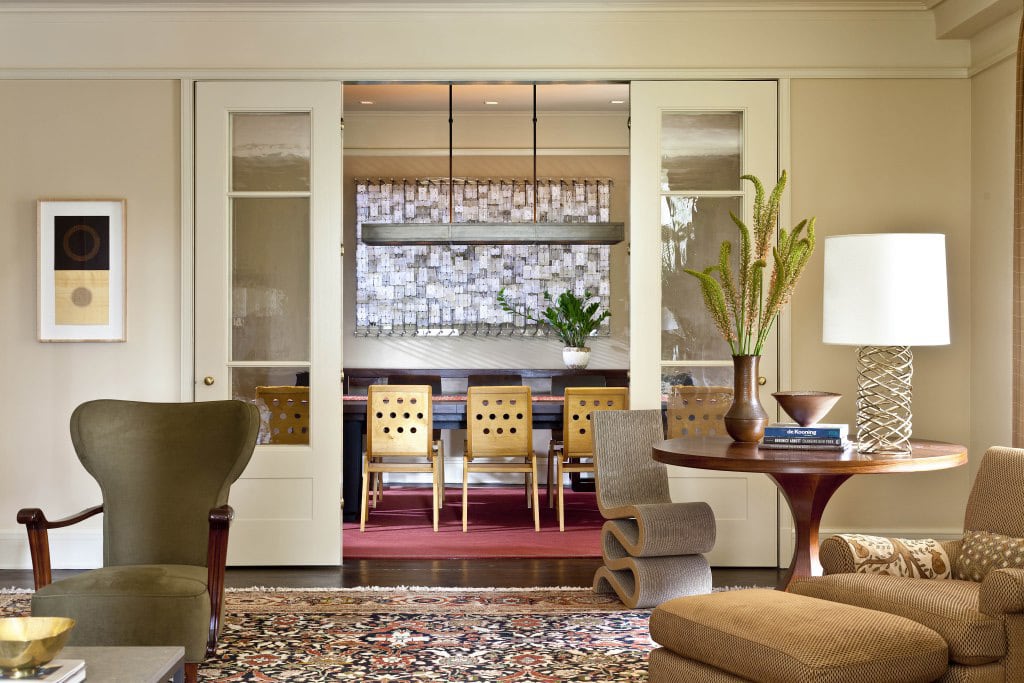
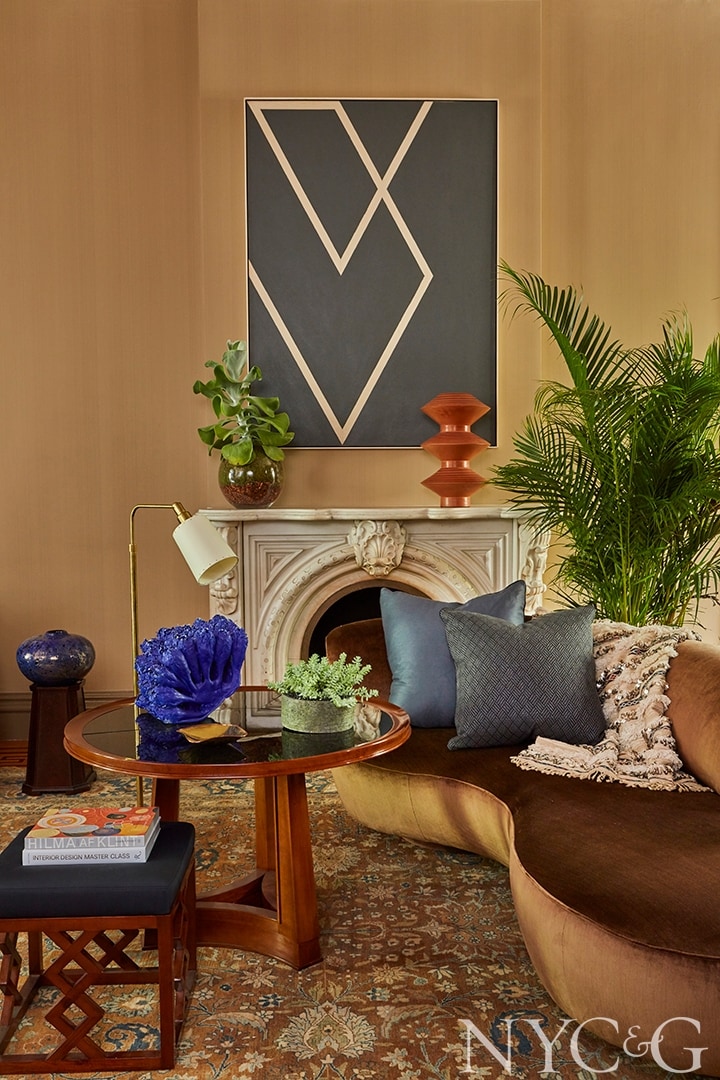
All the public spaces fan out from the central foyer, including the decidedly unfussy living room. “In their previous home, the clients had a living room they never used,” Gissler says. “they dubbed it ‘the fancy room.'” The designers avoided the moniker here with a playful blend of furnishings, such as a Bohemian-leaning woven tapestry on the sofa, a midcentury coffee table and a pair of side tables that evoke the Vienna Secession. “On one level, the furniture silhouettes are more classical,” Gissler says, “but there are tweaks—like a colorful contemporary rug instead of a Persian under the baby grand—that tell you: This is not your mother’s prewar apartment.” Plaster crown moldings, a picture rail alongside the piano and baseboards scaled for the room evoke a time gone by, but a bold canvas by Robert DeNiro Sr. brings visitors back to the current century.
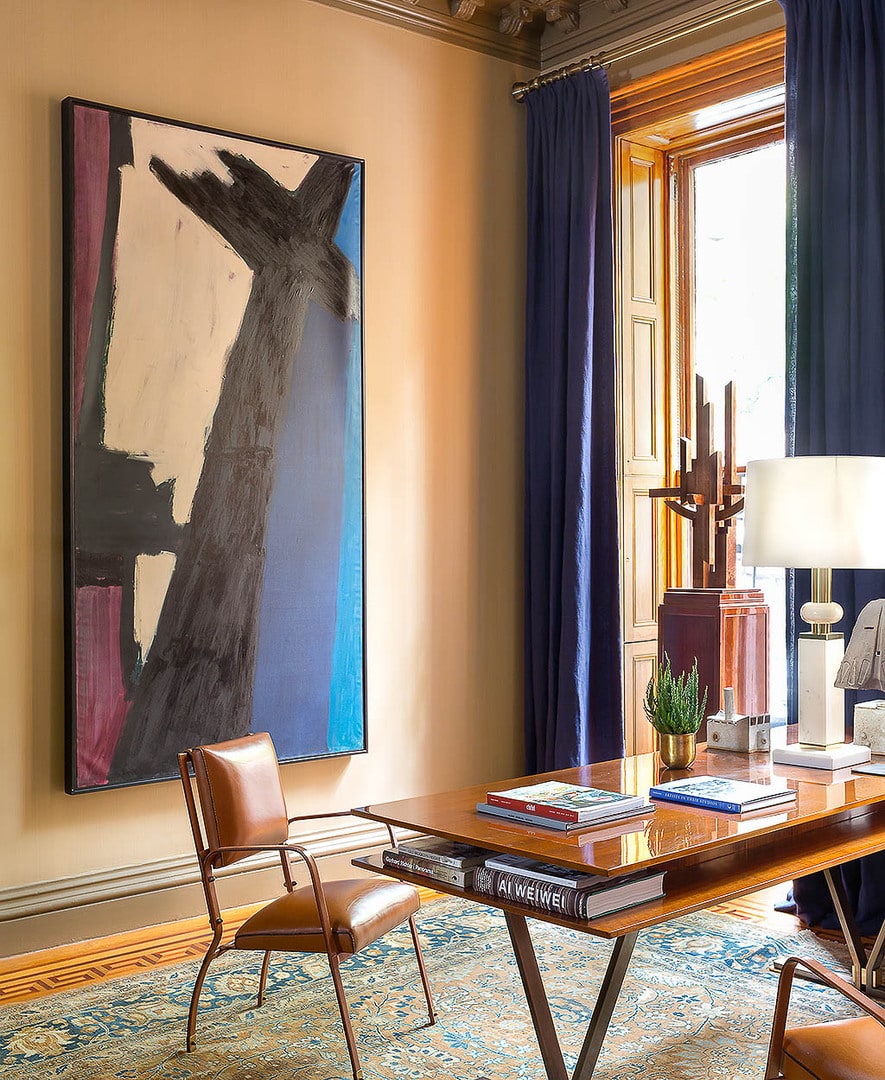
Art plays a critical role in the overall design of the home. From the living room, it’s possible to glimpse the sextet of Walton Ford’s large-scale bird editions dominating a wall in the library. “It was decided early on that the prints needed to hang togther, and they were a driving force for the palette,” says Gissler, who in response painted the walls a deep olive green. “In galleries, you always see art on harsh white walls, but I prefer to use color to frame the art.” A cushy upholstered sofa mimics the wall color, while patterns on the lamps and decorative pillows punctuated the tones of terra cotta provide an ethnic accent.
While most spaces incorporate a sense of modernity, the ambience in the kitchen is pure turn-of-the-last-century. New ceiling beams painted to match the deep blue recessed-panel cabinets and a wall of hand-wrought subway tiles with wide grout lines imply age. “One wall of cabinets was designed to resemble an old hutch that could have been there for years,” Strulovitz says. To break banquette wraps around a custom double-pedestal table, supplying a cozy family hangout.
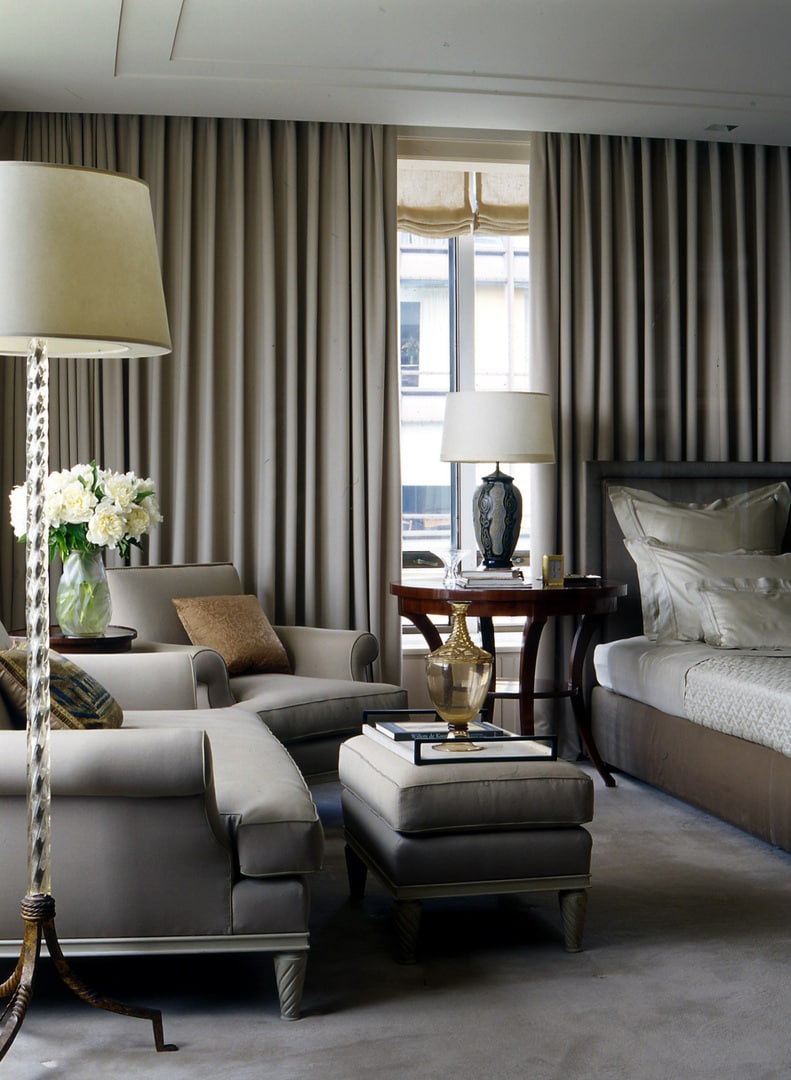
Nearby, a trip up the central stair leads to a patchwork of rooms, including the master suite, children’s rooms, play areas, and guest quarters. In the master bedroom—a commodious 750 square feet—a large portrait of Alex Katz handily brings the sitting area into focus and satisfies the scale of the room. Cheerful patterned draperies and a lush custom-woven carpet layer on the warmth, and there is ample room for a tall freestanding sculpture by Richard Filipowski. But unlike the walls in the entry and the first-floor office, where a deep hue establishes a dramatic mood, this room has shades of blue, gray and lavender that are suitably calming.
Thanks to the designers’ thoughtful use of color and millwork, coupled with appropriate furnishings and flourishes, the bare bones of the residence blossomed into a family home that effortlessly balances sophistication and comfort. Says Gissler, “It is a home that was designed to be lived in.”
In the living room, Gissler layered on a variety of furniture styles, including a Monte Carlo sofa and a dark gray Duchess of Windsor armchair wearing Kravet fabric, a Cambridge armchair covers in Quadrille fabric, and a skirted ottoman dressed in Stroheim velvet, all from Jonas. Carved-wood James Mont lamps from 1stdibs sit on oak side tables from Mark Newman in Palm Spings, California, and the coffee table is by French Art Deco Furniture. The perforated copper lanterns are by Dennis Miller Associates. Over the sofa is Tough Girls by Amy Sitman.
by Glenn Gissler
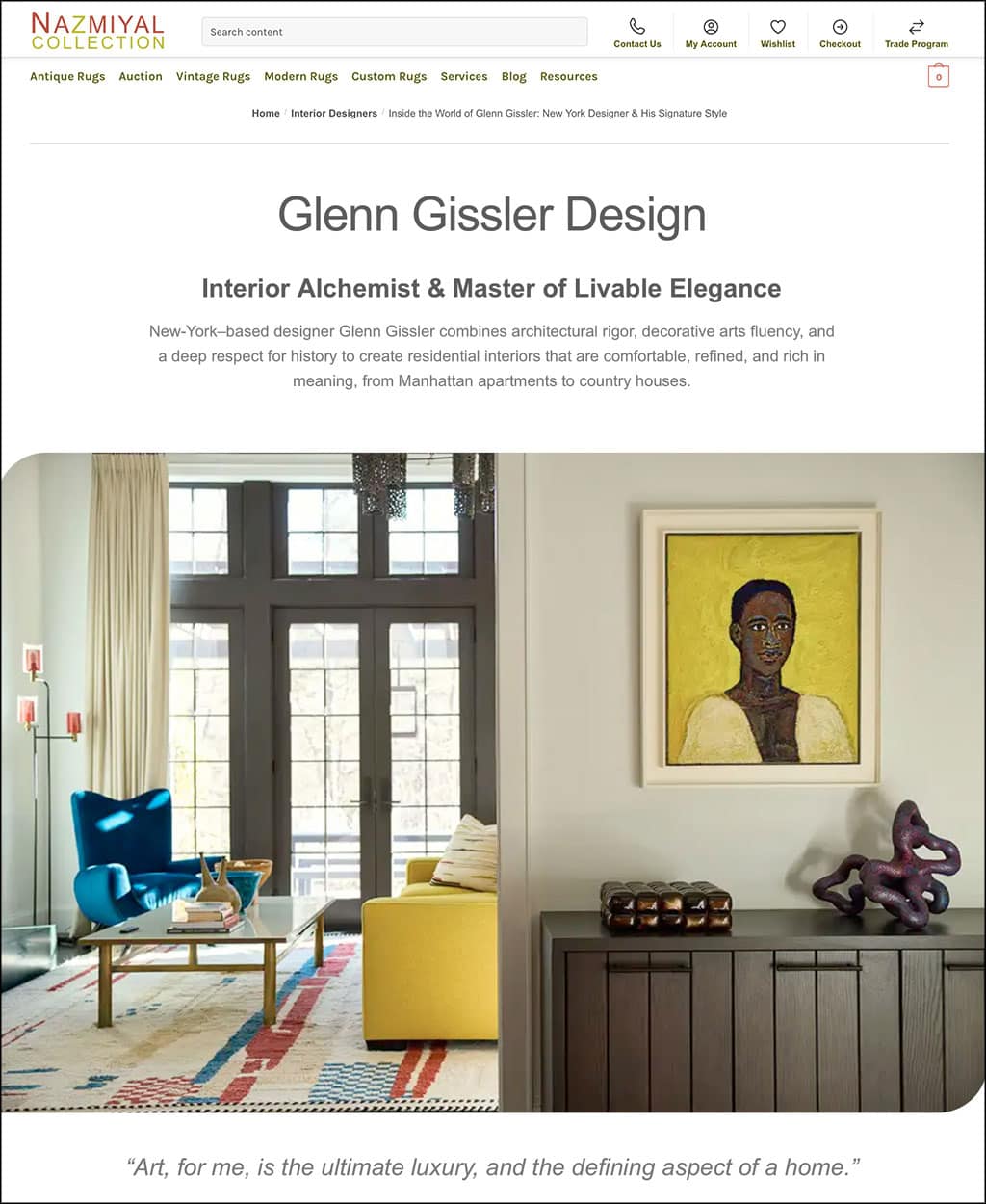
Alchemists have existed in every major civilization—along with great artists and artisans—all engaged in an attempt to transform base metals into gold. Similarly, a good designer possesses a knowledge of elements that when amalgamated create magic in an interior.
Two of my favorite elements are fine art and objects.
Every surface of an interior is important, but the alchemy of design comes into play when the designer introduces and orchestrates fine art and objects, humble or precious, simple or ornate. Art in the interior is the great transformer, the secret formula for achieving superlative design.
The selection and placement of an art in an interior is extremely important, possible the single most important decision a designer will make. You can arrange and rearrange things almost infinitely, creating fresh, startling design perspectives and tableaux. The talismanic power of an object is enhanced by its position and the objects adjacent to it. The whole, forged by the intuitive selection and arrangement of objects in an interior, is exponentially greater than the sum of its parts.
I often assist my clients in purchasing art—in some cases forming a nucleus on their collection—and I encourage clients to buy the very best art and objects they are willing to afford, but caution that if everything they purchase is at the highest level, the provocative potential—the poetry—of juxtaposition is neutralized.
The quality of interior design cannot be quantified; it does not have a price tag. Art and artifacts evoke a moment in time. It doesn’t matter if it’s “original”; it might be a nineteenth-century plaster cast of a Roman bust or the real thing. A beautiful object possesses an aura, an energy you cannot fake.
Art and objects alone do not make the room, although they may ignite its magic. The culmination of all the endless design decisions can be the most perfectly understated background, giving the illusion that nothing, neither heavy-handed nor weak, was done. The designer must learn to distribute resources to create design alchemy, a process which need not be enormously costly, but may pay great dividends to the client in the future in terms of increased value. Yet this is merely a fringe benefit; the presence of art creates an added value. Clients of relatively modest circumstances may be willing to send a surprising proportion of their money on art and objects simply because they perceive their incalculable aesthetic—and even spiritual value—in the interior.
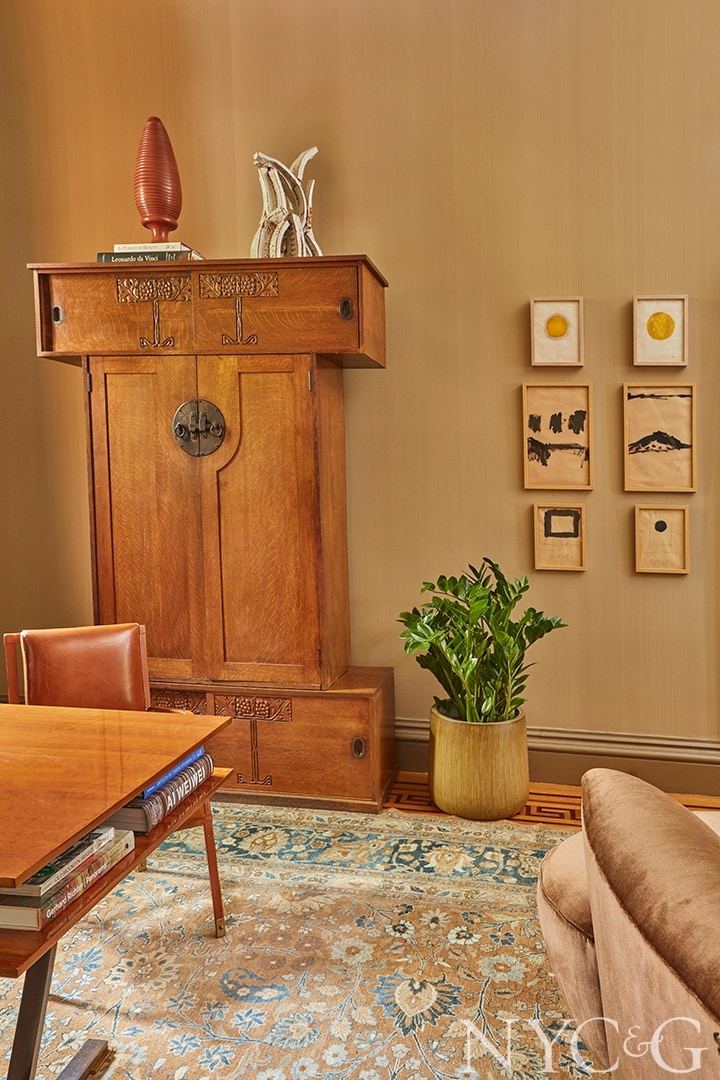
Seeking visual relationships between artifacts of different eras and places is important to the alchemical process. A gifted photographer will uncover an affinity between two things that may have escaped me, see something I haven’t yet seen, as in the white, curving swathe in the middle of Richard Avedon’s photograph of Dovina and the elephant and the adjacent tall, white, curving caste on the mantlepiece. Sometimes between like and unlike, there is a hidden correspondence, as in a “fancy gilded X-legged Regency stool that is nevertheless clean and modern in its lines, which might be felicitously juxtaposed, say, with modern gold-leafed Carlo Scarpa vase. Although sometimes I transmit my own sensibility to my clients, I am always open to the inspired object, be it Bauhaus or Baroque. The fascination of form is to be found in all eras—all styles—but there is one caveat: eclecticism in the wrong hands is permissions for chaos.
Everyone seeks rooms that are inviting and pleasurable, designed for living life in all its complexity and depth. Art and objects may cause the visitor to pause, they may, at the same time, prompt an inhabitant to see a new visual relationship, previous undiscovered, a dense web of relationships and resemblances, an interior world endlessly enriched and enriching. And the result is pure gold, brought forth by design alchemy.
by Sharon King Hoge
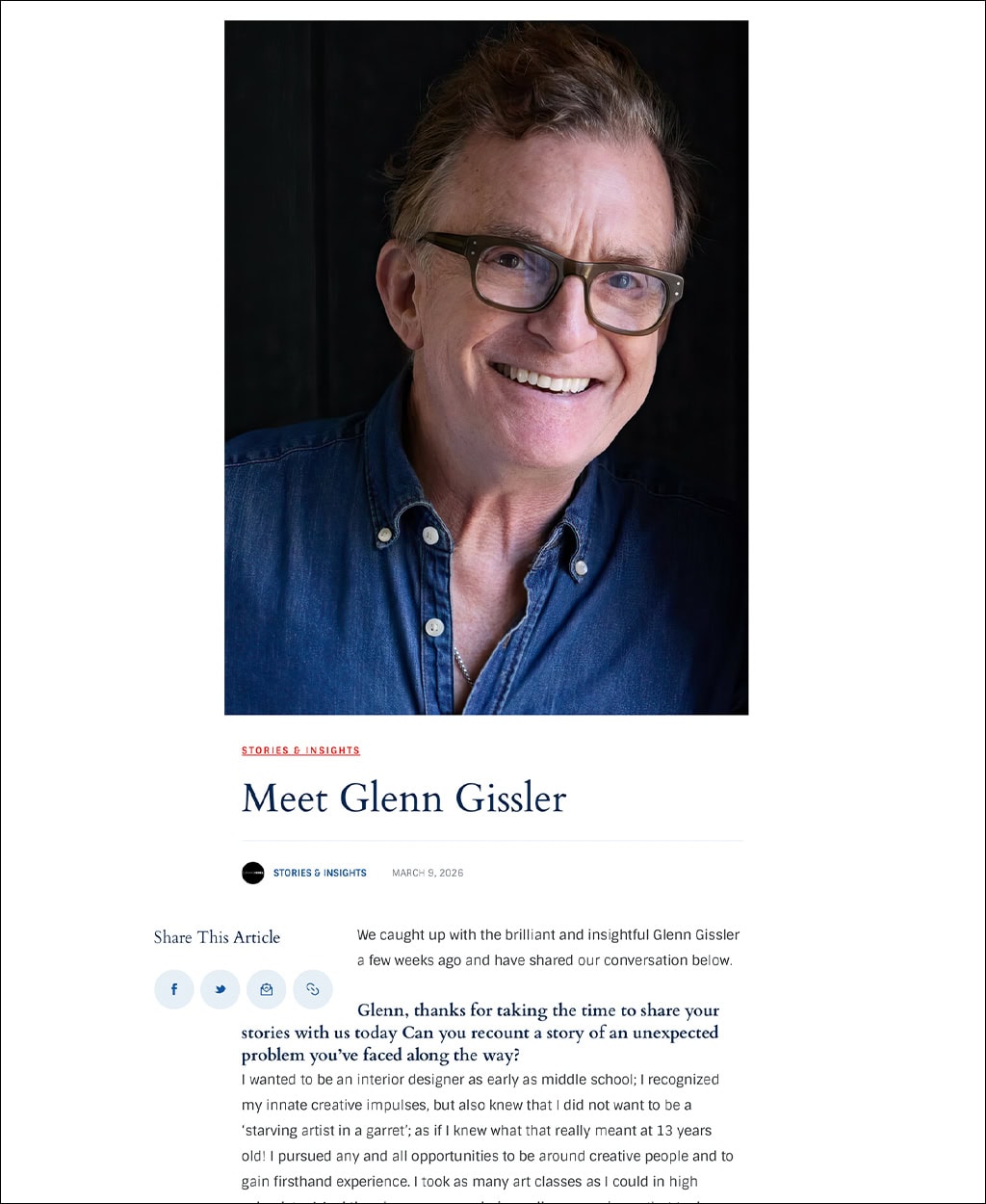
Creating the original showroom for a fledgling designer Michael Kors was the project that launched Glenn Gissler on a career that included innovative work in lofts, beach houses, Westchester mansions and urban pied-a-terre. A greek Revival farmhouse acquired in Conneticut just over a year ago is his latest personal project.